The deployment of over 280 uncrewed aerial vehicles (UAVs) in a single synchronized operational window represents a shift from tactical harassment to a strategic suppression of integrated air defense systems (IADS). This volume of fire is not merely a numerical milestone; it is a stress test of Russia’s deep-rear intercept geometry and a calculated gambit in the economics of modern attrition. By saturating the electromagnetic and kinetic defensive layers of the Moscow, Tula, and Kaluga regions, Ukraine is transitioning toward a "long-range blockade" model designed to decouple Russian industrial capacity from its frontline logistics.
The Triad of Mass Saturation Logic
To understand why 280 drones constitutes a qualitative change in the conflict, one must analyze the offensive through three distinct functional pillars: Intercept Exhaustion, Sensor Overload, and the Cost-Exchange Ratio.
Intercept Exhaustion and Magazine Depth
Every air defense battery, from the short-range Pantsir-S1 to the long-range S-400, possesses a finite "magazine depth"—the number of ready-to-fire interceptors before a mandatory reload cycle. When an attacking force launches a swarm exceeding the simultaneous engagement capability of the local battery, the defense enters a state of kinetic bankruptcy.
If a Russian battery can track 20 targets but only engage 12, the remaining 8 drones achieve "lethal transparency," passing through the defensive umbrella uncontested. At a scale of 280 units, Ukraine is betting that the density of targets across multiple vectors will force Russia to prioritize high-value assets (oil refineries and military airfields) while leaving secondary infrastructure (electrical substations and regional transport hubs) exposed.
Sensor Overload and False Positives
Mass drone operations exploit the signal-to-noise limitations of aging radar systems. Small, low-RCS (Radar Cross Section) drones constructed from composite materials or even treated wood often mirror the radar signature of migratory birds or atmospheric clutter. When 280 such signatures appear on radar screens simultaneously, the "operator cognitive load" increases exponentially. This lead to two outcomes:
- Target Saturation: The system cannot distinguish between a decoy and a high-explosive payload, forcing the expenditure of million-dollar missiles on low-cost airframes.
- System Blinding: The density of targets creates "tracks" that overlap, confusing automated fire control computers and inducing a temporary paralysis in the defensive network.
The Cost-Exchange Asymmetry
The fundamental economic driver of this offensive is the radical disparity between the cost of the effector and the cost of the interceptor.
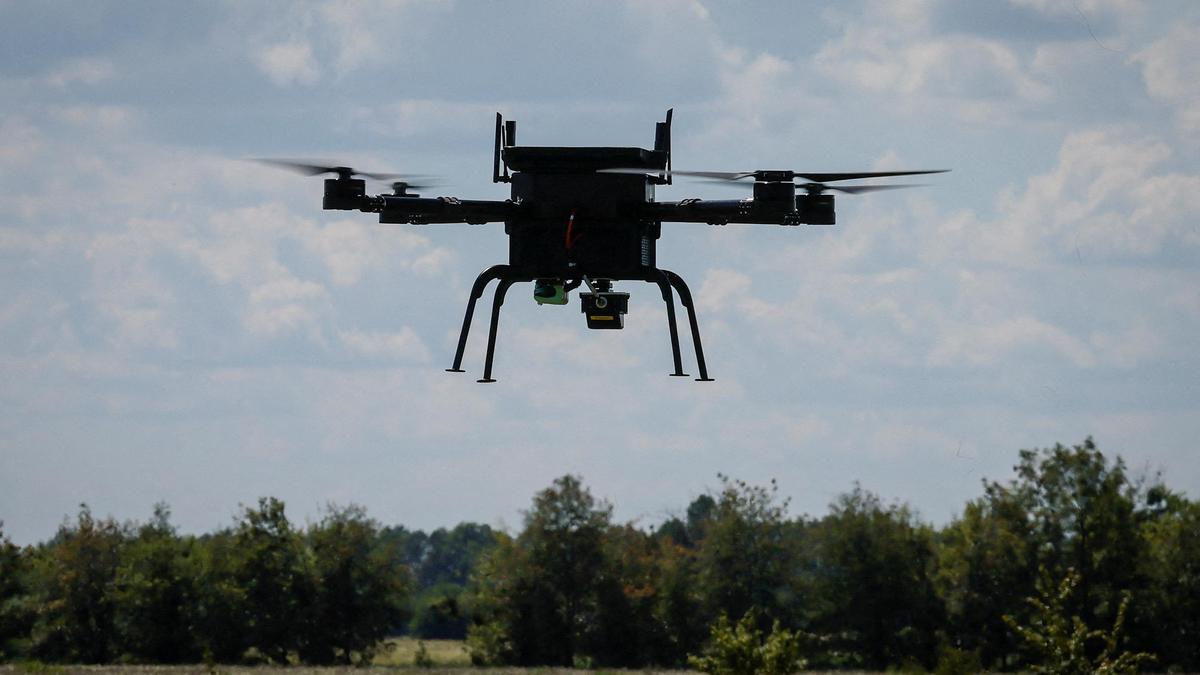
- The Attacker's Unit Cost: A long-range Ukrainian "Lyutyi" or "Bober" drone is estimated to cost between $30,000 and $50,000.
- The Defender's Unit Cost: An S-400 interceptor missile (such as the 48N6) costs approximately $2 million. A Pantsir 57E6 missile costs roughly $100,000.
Even if Russian defenses achieve a 90% intercept rate—a high estimate for a decentralized swarm—the financial burden remains unsustainable for the defender. In this 280-drone wave, if Russia fires 300 interceptors to neutralize 270 drones, they have expended roughly $150 million to $300 million in munitions to stop roughly $14 million worth of hardware. This is a "Value Attrition" strategy where the goal is not just to hit the target, but to bankrupt the defense.
Structural Vulnerabilities in the Russian Deep Rear
The geographic distribution of these strikes reveals a sophisticated mapping of Russia’s "Inland Defense Gap." Historically, Russian air defense has been optimized for high-altitude, high-speed threats (NATO cruise missiles and aircraft). The sudden influx of slow, low-altitude, "lawnmower-engine" drones exposes a lack of layered SHORAD (Short-Range Air Defense) around civilian and industrial infrastructure.
The Refined Hydrocarbon Bottleneck
By targeting energy infrastructure in regions like Ryazan and Yaroslavl, Ukraine is applying a "Critical Node" logic. A refinery is an exceptionally fragile target. Unlike a reinforced concrete bunker, a refinery consists of pressurized distillation columns, heat exchangers, and storage tanks. A single 20kg warhead hitting a fractional distillation tower can cause damage that requires months of specialized repair, often dependent on Western-manufactured components that are now under sanction.
This creates a Degradation Loop:
- Attack damages refinery.
- Fuel production for the front decreases.
- Repair efforts divert skilled labor and capital from the defense industry.
- Decreased domestic supply increases inflation, stressing the Kremlin’s "War Economy" stability.
The Psychological Front: Normalization of Insecurity
Beyond the physical destruction, mass drone waves serve to dismantle the "security contract" between the state and the urban population. When air raid sirens become a daily occurrence in Moscow—a city previously insulated from the kinetic realities of the war—it forces the Russian Ministry of Defense to make a zero-sum choice. They must either pull air defense assets away from the front lines to protect the capital, or leave the capital vulnerable to maintain frontline coverage. Every Pantsir battery moved to a rooftop in Moscow is one fewer battery protecting a supply depot in occupied Crimea.
Technical Evolution: From Remote Piloting to Terminal Autonomy
The scale of this 280-drone launch suggests significant advancements in Ukrainian command and control (C2) and production scaling. Launching such a volume requires decentralized "cells" capable of synchronized timing to ensure the drones arrive at their targets in waves.
Electronic Warfare Resilience
Russia’s primary defense against drones is Electronic Warfare (EW), specifically GPS jamming and "spoofing." However, the 280-drone wave indicates a shift toward Machine Vision and Inertial Navigation Systems (INS). Modern Ukrainian drones are increasingly using "terrain contour matching" (TERCOM) or simple optical sensors that recognize landmarks. These systems do not rely on GPS, making them immune to standard Russian jamming towers. This technical adaptation renders billions of dollars of Russian EW infrastructure obsolete in the face of "dumb" or "offline" navigation.
Production and Logistics Scaling
Managing the logistics for 280 long-range launches implies a robust industrial pipeline. This is no longer a "garage-built" operation; it is a standardized manufacturing process. The ability to coordinate 280 separate flight paths requires a sophisticated mission-planning software suite, likely utilizing AI-driven pathfinding to avoid known Russian radar sites.
Limitations and Operational Constraints
Despite the scale, these operations face hard ceilings that prevent them from being a singular "war-winning" tool.
- Warhead Mass: Most long-range drones carry between 20kg and 50kg of explosives. This is sufficient for "soft" targets like fuel tanks but insufficient for "hard" targets like reinforced aircraft shelters or bridge piers.
- Transit Time: At speeds of 120-150 km/h, these drones take hours to reach their targets, providing ample time for visual detection and manual interception by mobile fire groups equipped with heavy machine guns.
- Intelligence Dependency: The success of these strikes is entirely dependent on real-time satellite imagery and signals intelligence to identify "holes" in the radar net. Without high-fidelity intelligence, many of the 280 drones likely flew into pre-established "kill zones."
Strategic Recommendation for Territorial Defense
The 280-drone offensive signals the end of "passive defense" as an option for industrial powers. To counter this, the focus must shift from expensive missile-based interception to Kinetic Volume Defense. This involves the mass deployment of automated, radar-linked anti-aircraft cannons (such as the Gepard or Skynex systems) which utilize programmable airburst ammunition.
The cost-per-kill for an airburst shell is measured in hundreds of dollars, not millions. Until Russia—or any modern state—can transition its defensive architecture to favor "high-volume, low-cost" interceptors, the advantage will remain with the attacker. The next logical escalation in this theater will be the "swarm-on-swarm" engagement, where autonomous interceptor drones are deployed to hunt and ram incoming strike drones, effectively moving the battle for the deep rear into a fully automated, robotic attrition phase.
The current trajectory suggests that Ukraine will continue to expand these launch numbers until they reach a "sustained saturation" threshold, where daily waves of 100+ drones become the baseline operational tempo. This would force a total reorganization of Russian domestic logistics, effectively creating a "no-fly zone" for industrial continuity within 1,000km of the border.
Would you like me to analyze the specific propulsion systems used in these long-range drones to understand their range-to-payload trade-offs?