Education is usually pictured inside bright rooms with standard desks and daytime schedules. But high in the rugged terrain of Mokhotlong, Lesotho, that model completely falls apart. Thousands of young boys and men spend their formative years tending livestock across remote mountain plateaus. Herding isn't just an informal gig here; it's a foundational pillar of the rural economy and family survival.
It also demands full-time labor that forces children out of conventional classrooms before they ever learn to read or write. Standard school hours assume you don't have a flock of sheep waiting on a cliffside. When a child's daily survival depends on physical labor, daytime education stops being an option and turns into a locked door.
That structural mismatch created a quiet crisis of literacy across the highlands. Yet, a modest, shoestring network of night schools is rewriting that script.
Scaling the Slopes After Dark
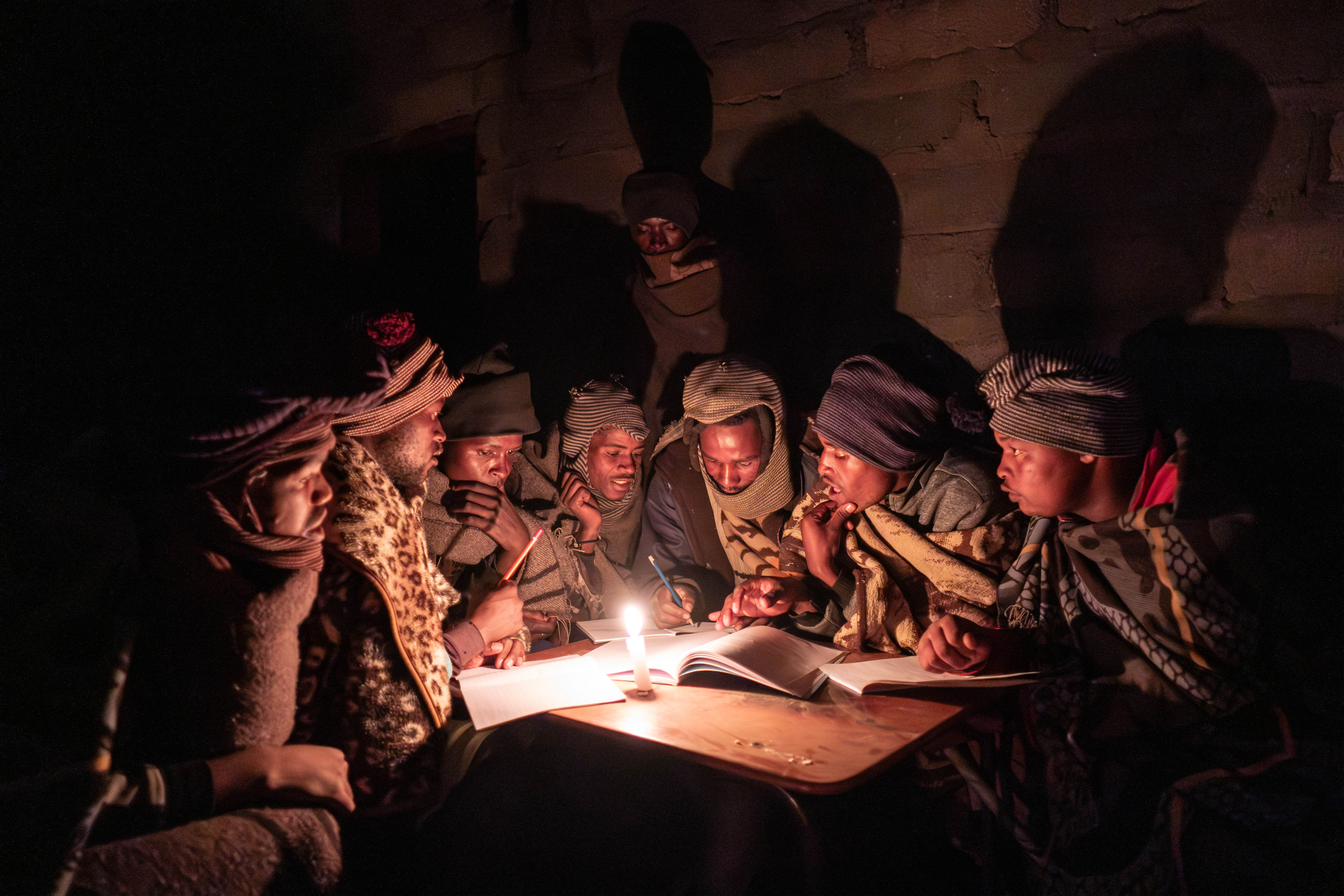
When the sun dips below the peaks and the animals are secured for the evening, the work day doesn't quite end for these young herders. Instead, they trade their walking sticks for notebooks. Students hike down steep mountain trails in the freezing dark to reach modest classrooms.
Photographer Tommy Trenchard documented these night classes for NPR, capturing a stark visual reality that flips standard educational narratives upside down. Usually, photojournalism frames childhood around the classroom, treating work as an interruption. Here, grueling physical labor is the main event of the day, and school happens in the margins of the night.
These classes operate on minimal funding, relying heavily on community goodwill, dedicated teachers, and sheer stubborn persistence. They survive on very little because they have to. There are no state-of-the-art tablets or sprawling campus facilities. Just a chalkboard, some chairs, and students who have walked miles down a mountain in the pitch black just to learn the alphabet.
Literacy as Economic Leverage
It's easy to look at a night school for herders through a purely sentimental lens. Observers often frame it as a heartwarming tale of perseverance against the odds. But reducing these classes to an inspiring anecdote misses the core point.
Basic literacy in a remote, rugged landscape isn't a soft skill or a nice-to-have decoration. It is survival infrastructure.
When you manage livestock, negotiate trade deals, handle land agreements, and interact with regional markets, being unable to read leaves you deeply vulnerable. A herder who can read a document, check a record, or verify a transaction operates on entirely different terms than one who cannot. Literacy brings leverage. It strips away the unfair advantage that middlemen and predatory traders hold over people who have to sign their names with an 'X' because they never got a chance at schooling.
Organizations like Sentebale—co-founded by Britain's Prince Harry and Lesotho's Prince Seeiso—have long highlighted the intense vulnerability of these herd boys. Beyond missing out on basic education, they face brutal winters, dangerous terrain, and the constant threat of armed stock thieves. Giving them tools to read and write provides a layer of defense in a harsh economic ecosystem.
Fixing the Mismatch
The existence of these night schools points to a glaring institutional failure in standard educational design. If hundreds of young herders willingly pack into dark, makeshift classrooms after a punishing day on the mountain, the problem was never a lack of ambition or desire to learn.
The problem is that traditional institutions refuse to adapt to rural realities.
Governments and policy planners typically build infrastructure for a hypothetical student who lives in a town, stays indoors, and has the luxury of free daylight hours. They rarely account for agricultural rhythms or pastoral economies. When the system fails to accommodate the lifestyle, the blame unfairly falls on the child for dropping out.
The night school model corrects that diagnostic error. It proves that education doesn't have to fit into a rigid 8-to-3 box to be effective.
If you want to support or understand grassroots educational equity, look past polished urban initiatives and look toward programs that bend their schedules to fit the realities of working people. Real access means meeting students where they actually are—even if that requires climbing down a mountain in the dark.