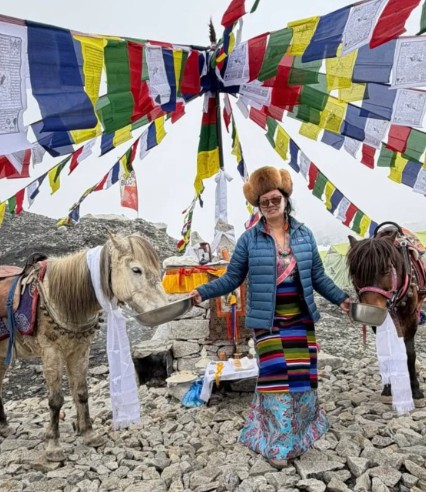
Lhakpa Sherpa just stood on top of the world for the eleventh time. At 52, the woman widely known as the "Mountain Queen" broke her own world record on May 12, 2024, proving that her physiological engine remains unmatched in the "death zone" above 8,000 meters. While the headlines focus on the sheer number of summits, the real story lies in the staggering disconnect between her athletic dominance and her life at sea level. For decades, the greatest female climber in history has balanced these record-breaking feats with the grueling reality of life as a single mother working minimum-wage shifts at a Whole Foods in Connecticut.
The Physical Toll of Eleven Summits
Reaching the summit of Everest once is a life-altering physiological trauma. Reaching it eleven times is a biological anomaly. When a climber enters the "death zone," the oxygen levels are so low that the body’s cells begin to die. The heart works at maximum capacity just to maintain basic functions while the brain struggles with hypoxia. Lhakpa Sherpa does not just survive this environment; she operates within it with a level of efficiency that defies standard sports science.
She grew up in the Makalu region of Nepal, carrying heavy loads on steep terrain from a young age. This wasn't training for a hobby. It was daily life. This upbringing likely contributed to a high red blood cell count and a cardiovascular system primed for extreme altitudes. Most professional climbers spend months on specialized nutrition and strength programs. Lhakpa often spends her months leading up to an expedition washing dishes or stocking shelves.
The contrast is jarring. She moves from the repetitive, low-impact labor of retail to the most high-stakes physical environment on Earth. Most athletes would find this transition impossible.
Breaking the Sherpa Glass Ceiling
In the early days of Himalayan exploration, Sherpa women were almost entirely excluded from the climbing industry. They stayed in the villages, managing households and livestock while the men earned money and fame as high-altitude porters and guides. Lhakpa changed that trajectory in 2000 when she became the first Nepali woman to summit Everest and survive the descent.
It was not a warm welcome. She faced significant cultural resistance from a male-dominated climbing culture that viewed high-altitude work as a male-only domain. To get on that first expedition, she had to organize it herself, showing a level of grit that surpassed the actual climbing. Even after ten successful summits, she struggled to secure the kind of blue-chip corporate sponsorships that her Western counterparts receive after just one or two successful climbs.
The industry likes the narrative of the "Mountain Queen," but it has been slow to provide the financial infrastructure to support her. We see a persistent gap in how climbing achievements are valued. A professional male climber with eleven Everest summits would likely have a multi-million dollar gear contract and a global speaking tour. Lhakpa, until very recently, was still Crowdfunding her expeditions.
The Logistics of a Record
Climbing Everest in the 2020s is vastly different from the expeditions of the 1990s. The mountain is more crowded, the fixed lines are more managed, and the weather forecasting is surgical. However, these "modern conveniences" do not make the climb easy for someone in their fifties.
- Acclimatization: Even with her genetic advantages, Lhakpa must spend weeks moving between base camp and higher camps to prepare her blood chemistry.
- Weather Windows: Eleven summits mean she has successfully navigated eleven different, often lethal, weather patterns. This requires an intuitive understanding of the mountain that cannot be taught in a gym.
- Oxygen Use: While she has used bottled oxygen for her recent records, her ability to maintain pace and lead others at 29,000 feet is a masterclass in mountain craft.
The Economic Paradox of High Altitude Success
It costs anywhere from $40,000 to $100,000 to climb Everest. For a woman who spent years working for hourly wages in the United States, the math rarely adds up. Her career highlights a uncomfortable truth about the mountaineering world: it is an expensive playground where the true experts are often the least compensated.
Lhakpa has lived a double life. In Nepal, she is a national hero, a symbol of female empowerment, and a legendary figure in the trekking community. In the United States, she was an immigrant mother trying to make rent. This duality is a harsh commentary on the "professional" status of Sherpa climbers. They are the backbone of the multi-million dollar Everest industry, yet they often lack the marketing machines that turn Western climbers into household names.
She recently founded her own guiding company, Cloudscape Climbing. This was a necessary move to reclaim her agency. Instead of being a hired hand or a solo record-seeker, she is now positioning herself as a business owner. This is the only way to turn high-altitude records into long-term financial stability.
Aging in the Death Zone
At 52, the window for elite performance is usually closing. Mountaineering is an endurance sport that rewards experience over raw explosive power, but the "death zone" is notoriously unkind to older bodies. Recovery takes longer. The risk of stroke or heart attack increases.
Lhakpa’s eleventh summit wasn't just about beating her own number. It was about proving that the biological limits we set for women—and for climbers in their fifties—are largely arbitrary. She hasn't indicated that she is finished. The physical mechanics of her climbing remain fluid and strong.
The obsession with "the first" or "the most" often obscures the human cost of these records. Lhakpa Sherpa has spent a significant portion of her life in the most dangerous place on the planet to secure a legacy that, for a long time, the world ignored. Her eleventh summit is a definitive statement. She is no longer waiting for the climbing world to recognize her; she is simply making herself impossible to overlook.
The gear is packed, the record is documented, and she will return to her life away from the peaks. But the mountain doesn't care about records, and the grocery store doesn't care about summits. Lhakpa Sherpa exists in the space between those two worlds, a place where survival is the only true metric of success.