Limpet mines are compact, magnetically attached naval explosives designed to clamp directly onto a ship’s steel hull and detonate via a timer or mechanical trigger, crippling the vessel rather than sinking it. On October 29, 2026, attackers in a small craft fastened two of these devices to the MT Louise 1, a Panama-flagged crude tanker carrying 27 Indian seafarers roughly 25 nautical miles northeast of Khasab, Oman. The resulting blasts sparked an engine-room fire that temporarily disabled the ship, marking the first confirmed limpet mine strike in the Strait of Hormuz since the US-Iran conflict erupted in February 2026.
Most coverage treats the weapon as a naval curiosity. That misses the real story. The return of the limpet mine signals a deliberate tactical shift in maritime warfare—one where a few hundred dollars of high explosive and a fiberglass skiff can neutralize billions of dollars in naval mine-countermeasure hardware, drive Brent crude past $117 a barrel, and hold commercial seafarers hostage in the world’s most critical energy chokepoint.
Anatomy of an Asymmetric Weapon
Named after the conical marine snails that grip coastal rocks with muscular suction, limpet mines are engineered for stealth and precision. Unlike traditional moored or bottom sea mines—which sit passively in shipping lanes waiting for a hull's magnetic signature or acoustic wake—a limpet mine is hand-delivered to a specific target.
A standard naval limpet weighs between 15 and 50 pounds and carries a shaped or high-brisance explosive charge packed inside a buoyant or neutrally buoyant casing. Powerful permanent magnets, often reinforced with mechanical clamps or suction cups, lock the device against steel plating. Once attached, a timer fuse—historically driven by dissolving acid tablets or clockwork, and now frequently governed by digital delay circuits—counts down, giving the delivery team minutes or hours to vanish into coastal traffic before detonation.
The placement on the MT Louise 1 reveals the tactical intent behind the hardware. When attackers want to sink a supertanker, they target the cargo holds below the waterline to breach the double hull and flood the compartments. When they want to send an economic shockwave without triggering an ecological catastrophe that unites the international community against them, they aim for the stern.
By affixing the charges near the engine room or steering gear—often right at or slightly above the waterline where a fast boat can reach without deploying combat divers—the blast punches inward into machinery spaces. The explosion ruptures fuel lines, ignites electrical fires, and knocks out propulsion. The ship goes dead in the water. No crude oil spills into the Gulf, sparing the perpetrators the diplomatic blowback of a massive environmental disaster, while global commodity traders still watch a loaded tanker burn on satellite feeds.
Why Minehunters Cannot Stop Them
To understand why maritime security analysts viewed the MT Louise 1 attack with acute alarm, look at the coalition hardware already patrolling the Persian Gulf. Since April 2026, U.S. Central Command has maintained a massive naval presence—over 130 vessels in the region—specifically tasked with keeping the International Maritime Organization's Traffic Separation Scheme clear of mines.
Mine-countermeasure ships like the USS Gladiator and HMS Pembroke rely on high-frequency side-scan sonar, unmanned underwater vehicles, and acoustic sweeps to map the seabed and clear shipping corridors before commercial convoys pass through. Against conventional moored mines, those sweeps work.
Against limpet mines, they are virtually useless.
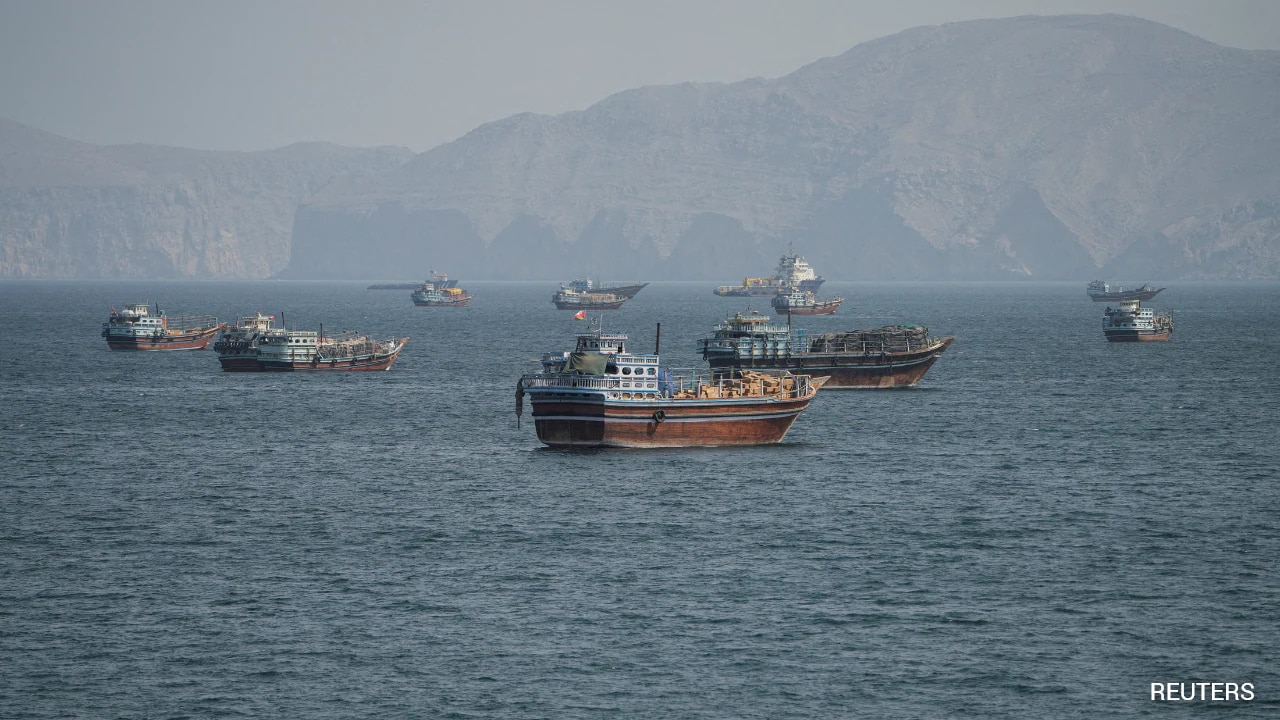
A limpet mine never sits on the ocean floor. It is stored in a warehouse on shore, loaded onto a commercial-style fishing dhow or high-speed skiff, and carried directly to a moving tanker at night. In the narrow 21-mile navigable bottleneck of the Strait of Hormuz, commercial supertankers steaming at 12 to 15 knots are surrounded by hundreds of legitimate fishing boats, supply craft, and coastal traders.
Radar operators on a tanker's bridge cannot distinguish a smuggling skiff carrying two magnetic mines from a local fisherman checking nets until the boat is already tucked inside the ship's radar blind spot under the stern flare. By the time a lookout spots the wake of a departing boat at 22:12 GMT—roughly the timestamp of the Khasab incident—the magnets are already locked onto the hull.
From World War II Frogmen to the Gulf of Oman
The operational playbook used in late October 2026 has deep roots. British Special Operations Executive engineers developed the first practical limpet mines during World War II, designing curved magnetic casings that combat swimmers could carry through murky harbors to cripple Axis merchant shipping. In 1985, French intelligence operatives used the same basic principle to sink the Greenpeace flagship Rainbow Warrior in Auckland Harbor.
In the Persian Gulf, however, the weapon evolved from a clandestine saboteur's tool into an instrument of state-backed gray-zone coercion.
During the tanker crisis of May and June 2019, limpet mines damaged four commercial vessels off Fujairah and two more tankers—the Kokuka Courageous and Front Altair—in the Gulf of Oman. That episode established a recurring forensic pattern. When the U.S. Navy released footage appearing to show an Islamic Revolutionary Guard Corps patrol boat removing an unexploded limpet mine from the hull of the Kokuka Courageous above the waterline, it confirmed that state naval units were deploying the devices directly from surface craft rather than relying on elite combat divers.
Between 2019 and 2026, the tactic migrated globally—appearing in 2025 against oil tankers in the Mediterranean that had called at Russian and Libyan ports—before returning to Hormuz with far higher stakes. Following a thwarted attempt in September 2026 where an adhesive device failed to detonate, the October 29 strike proved that attackers had refined their fuses and delivery timing under active wartime conditions.
The Shadow Blockade and the Shipping Trap
The MT Louise 1 strike did not happen in a vacuum. Four days earlier, on October 26, the IRGC formally declared the Strait of Hormuz closed, framing the internationally recognized IMO shipping lane as an "unauthorised route".
This created an impossible regulatory and physical trap for commercial shipping operators. To transit legally and maintain standard protection and indemnity insurance, captains must follow the IMO corridor through Omani waters. Yet Iranian state media explicitly blamed the MT Louise 1 for "ignoring radio warnings" and using that exact southern passage. Meanwhile, complying with IRGC demands to transit northern waters requires commercial masters to take instructions from a U.S.-sanctioned military force, instantly voiding Western insurance coverage and exposing vessels to seizure.
The maritime intelligence firm Windward noted that the October 29 strike kicked off a compressed wave of attacks, with four tankers struck in three days, including the Arzanah and Al Mayeda. Pre-war daily transits through Hormuz averaged roughly 138 vessels. By late October 2026, AIS-visible transits had collapsed to a fraction of that volume, leaving roughly 6,000 seafarers stranded inside the Persian Gulf while daily freight rates for operators willing to run the gauntlet surged.
India’s Frontline Exposure at Sea
Behind the macroeconomic headlines of $117 Brent crude lies a distinctly human vulnerability. Every time a commercial tanker is hit in the Persian Gulf, Indian nationals are disproportionately on board.
India supplies roughly 10 to 12 percent of the global seafaring workforce, with hundreds of thousands of Indian officers and ratings staffing the world's crude carriers, liquefied natural gas tankers, and bulk freighters. On the MT Louise 1, all 27 crew members were Indian. When the engine-room fire broke out off Khasab, it was those 27 sailors who had to seal ventilation dampers, deploy onboard carbon dioxide suppression systems, and fight a blaze inches away from volatile fuel lines in a darkened, drifting hull.
They extinguished the fire and saved the vessel without a single injury or drop of spilled crude. Less than three weeks later, on November 16, Indian seafarers were not as fortunate when the Panama-flagged LPG tanker MT Tara Gas was struck in the same waterway, leaving one Indian sailor missing and two injured.
New Delhi faces a delicate strategic bind. India relies heavily on Persian Gulf crude imports and maintains deep economic ties across the region, yet its citizens serve as the frontline civilian workforce keeping global energy moving through a de facto war zone. Naval escorts like the Indian Navy's Operation Sankalp can deter Somali pirates or shadow select Indian-flagged vessels, but they cannot station a destroyer alongside every Panama- or Liberia-flagged tanker crewed by Indian nationals.
The Economics of Asymmetric Disruption
Maritime risk firm Marisks summed up the tactical reality in stark terms: attaching limpet mines from a small craft is "cheap, low tech and very efficient".
Consider the cost asymmetry. A basic limpet mine assembled with military-grade C-4 or RDX explosive, industrial neodymium magnets, and a commercial timer costs less than a used compact car. The fiberglass boat used to deliver it costs a few thousand dollars.
On the other side of the ledger, a single disabled Very Large Crude Carrier carries upwards of two million barrels of oil worth over $200 million at late-2026 prices. War-risk insurance premiums for a seven-day transit into the Persian Gulf spike by hundreds of thousands of dollars per voyage after a single confirmed hull breach. Even when a ship survives and resumes its journey—as the MT Louise 1 eventually did—the mere proof that attackers can touch a hull inside a coalition-patrolled corridor forces charterers to price in catastrophic risk.
Deterring a missile battery requires air superiority and precision strikes on launch sites. Deterring a fighter jet requires surface-to-air radar networks. Stopping a limpet mine requires policing every wooden fishing boat and fiberglass skiff across 21 miles of congested water in the dark—a problem no navy on earth has solved without shutting down coastal commerce altogether. Until a political settlement reopens the corridor, every tanker captain entering the Strait of Hormuz knows that the greatest threat to their ship is not on the horizon, but silently clamping onto the steel beneath their feet.