The sea does not recognize the maps drawn in air-conditioned rooms. Along the jagged Mediterranean coastline where Israel meets Lebanon, the water is a seamless, shifting turquoise that hides a jagged history. For decades, this stretch of ocean has been a dead zone of silence—not the peaceful silence of a nature preserve, but the heavy, pressurized quiet of two neighbors who refuse to look each other in the eye.
Now, that silence has been broken by the sound of voices in a room.
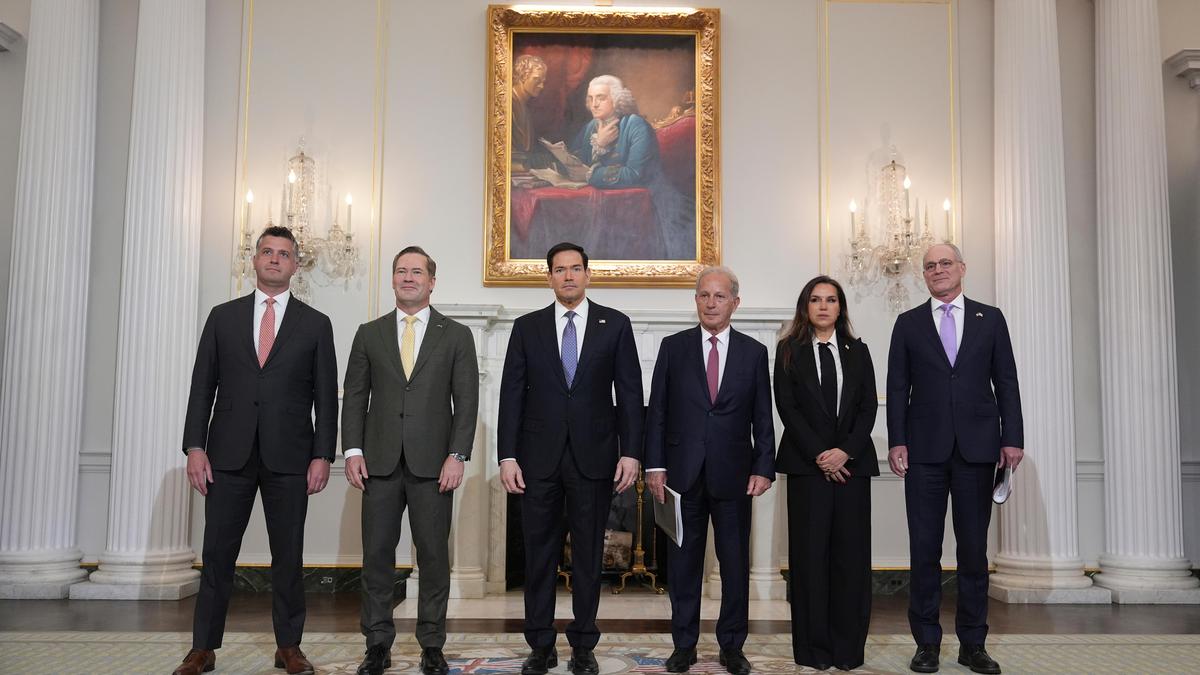
The announcement from Washington was dry, as diplomatic cables usually are. It spoke of "productive talks" and "direct negotiations." But to understand why a few coordinates on a nautical chart actually matter, you have to look past the ink and toward the blue. You have to imagine a fisherman from Tyre and a technician from Haifa, both staring at the same horizon, both knowing that beneath the waves lies enough natural gas to change the destiny of their children.
For years, the border was a ghost. It was a disputed "V" shape in the water, a patch of the Karish and Qana fields that neither side could touch without risking a war. Because there was no formal agreement, the wealth remained locked in the seabed. It was a standoff where everyone lost.
The Weight of a Handshake
Diplomacy is often portrayed as a grand stage of handshakes and flags. In reality, it is a grueling exercise in vocabulary. When the U.S. mediators sat down with representatives from Jerusalem and Beirut, they weren’t just talking about gas. They were navigating a labyrinth of pride, survival, and deep-seated fear.
Lebanon is currently a nation gasping for air. Its economy has crumbled to the point where electricity is a luxury and the local currency is little more than scrap paper. For the Lebanese negotiator, every inch of maritime territory isn't just about sovereignty; it is about the potential for light. It is about a future where a father doesn't have to explain to his daughter why the lamps won't turn on at night.
Israel, on the other hand, views the sea through the lens of a shield. While its economy is stable, its energy independence is its heartbeat. To agree to a line in the water is to agree to a neighbor’s right to prosper, a concept that is historically terrifying when that neighbor is technically an enemy.
The shift from "indirect" to "direct" talks is the real story here. For a long time, the two sides wouldn't even sit in the same room. Messages were passed like notes in a classroom through a third party. To move toward direct negotiations is to admit a hard, cold truth: the sea is too small for secrets. You cannot drill for billions of dollars of resources while pretending the person a mile away doesn't exist.
The Mechanics of the Invisible
How do you divide something as fluid as the ocean?
Imagine a pie on a table. If two people disagree on who owns it, they can simply leave it there to rot. That is what happened for over a decade. But as the world’s hunger for energy grew—exacerbated by global shifts and the war in Ukraine—the pressure to cut the pie became unbearable.
The technical dispute centered on "Line 23" and "Line 29." To a casual observer, these are just numbers. To a geologist, they represent the difference between a functional economy and a failed state. The "productive" nature of these recent talks suggests that both sides have finally stopped looking for a total victory and started looking for a way out.
Consider a hypothetical engineer named Elias in Beirut. He has spent ten years studying petroleum engineering, yet he works at a cafe because there is no industry for him to join. Then consider Sarah, a safety officer on an Israeli rig, who spends her shifts scanning the horizon for drones or missiles. These are the people who actually live the "direct negotiations." If the talks succeed, Elias gets a career. Sarah gets to breathe a little easier.
The stakes are not abstract. They are metallic, salty, and immediate.
The Fragility of the Blue
Peace in the Middle East is rarely a sudden sunrise. It is more like a slow, cautious clearing of fog. The agreement to speak directly does not mean a peace treaty is signed. It does not mean the decades of scars have vanished. It means that, for the first time, the economic reality of the 21st century has outweighed the political dogmas of the 20th.
There is a specific kind of tension that exists when two ships pass each other in disputed waters. There is a moment of hesitation. A hand hovers over a radio. A finger rests near a trigger. The goal of these negotiations is to remove that hesitation. By codifying exactly where the "yours" ends and the "ours" begins, the ocean stops being a battlefield and starts being a workplace.
But the sea is an unforgiving place for optimists. History is littered with "productive talks" that ended in gunfire. The real test won't be the signing of the document in a posh hotel. It will be the moment the first drill bit touches the ocean floor in a zone that was, only yesterday, a trigger for war.
Beyond the Horizon
We often treat international news as a scoreboard. Who won the territory? Who got the better deal? This perspective misses the human pulse of the matter.
This negotiation is a rare instance where the "win-win" isn't a corporate buzzword; it’s a necessity for survival. If Lebanon cannot tap into its offshore wealth, the country risks a total systemic collapse that would destabilize the entire region. If Israel cannot secure its northern maritime flank, it remains perpetually on a war footing that drains its soul and its coffers.
They are tied together by geology. The gas fields don't care about the religion or the politics of the people on the surface. The pressure of the earth remains the same.
As the talks move forward, the world watches not just for the price of gas, but for the precedent. It is a reminder that even the most bitter of rivals can find a common language when the alternative is drowning.
The line is being drawn. It is being written in salt water, subject to the tides and the whims of the wind, but for now, the pens are moving. In a region defined by its walls, a few men and women have decided to look at the water and see, for the first time, a bridge.
The water remains turquoise. The waves continue to crash against the limestone cliffs of Rosh Hanikra and the shores of Tyre. Somewhere beneath those waves, the earth holds its breath, waiting to see if the people above are finally ready to share the light.