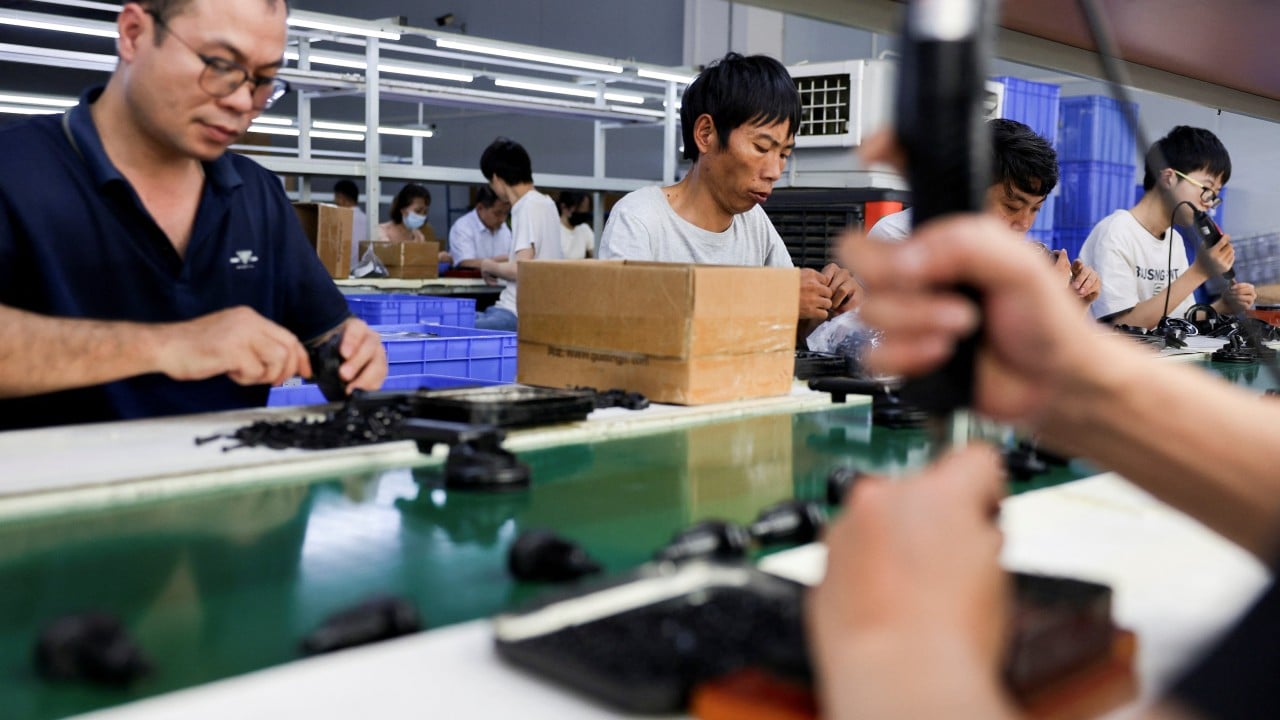
The lights in a small manufacturing hub outside of Guangzhou do not flicker when a tanker slows down thousands of miles away. There is no immediate siren. No sudden darkness. Instead, the change arrives as a whisper in a ledger. It starts with a decimal point shifting in the cost of heavy fuel oil, then crawls through the supply chain until it lands on the desk of a factory owner named Chen.
Chen does not think about geopolitics when he wakes up. He thinks about the three hundred souls on his payroll and the rising cost of the plastic polymers he needs to fulfill a contract for European medical supplies. But Chen is tethered to a strip of water he has never seen: the Strait of Hormuz.
This is the choke point of the world.
It is a narrow neck of water, barely twenty-one miles wide at its tightest grip, separating the jagged coast of Oman from the mountainous shores of Iran. Through this tiny needle’s eye passes one-fifth of the world’s liquid energy. When tensions flare here, the world holds its breath. For China, the world’s largest oil importer, that breath is becoming increasingly expensive to hold.
The Fragility of the Flow
We like to believe the global economy is a solid, immovable thing. We speak of "markets" and "indices" as if they are laws of nature. They are not. They are fragile webs of logistics held together by the grace of open seas.
Consider the math of a modern supertanker. These vessels are gargantuan, steel cathedrals of commerce carrying two million barrels of crude. When one of these ships is delayed, or when insurance premiums spike because of a "security incident" in the Persian Gulf, the ripples are felt instantly.
China relies on this specific corridor for roughly half of its total oil imports. It is a staggering vulnerability. While Beijing has spent a decade building pipelines through Central Asia and securing Siberian crude from the north, the sea remains the undisputed king of volume. You cannot replace a fleet of tankers with a few pipes and a hope for the best.
If the Strait of Hormuz closes, even for a week, the strategic petroleum reserves of the Great Powers begin to drain. Prices at the pump in Ohio might jump, but the industrial engine of the East faces a more existential threat. China’s "Economic Miracle" is fueled by carbon. Without a steady, predictable flow of Middle Eastern oil, the miracle grinds into a standstill.
The stakes are not just about the price of gas. They are about the stability of a nation. In the corridors of power, this is known as the Malacca Dilemma’s cousin—the Hormuz Headache. It is the realization that no matter how many high-speed rails you build or how many satellites you launch, your entire civilization still depends on the whims of a few coastal batteries and the shadows of naval destroyers in a distant, hot, salty sea.
A Legacy Written in Enamel
While the giants of industry fret over shipping lanes, life continues in the micro-realms of human endeavor. Sometimes, the most fascinating stories are not about the movement of millions of barrels, but the movement of a single family through time.
In a quiet corner of a bustling city, there is a brass plaque that has been polished so often the letters are softening at the edges. It marks the entrance to a dental practice that has seen three generations of the same bloodline peering into the mouths of the public.
We often view professions as individual choices. We go to school, we pick a path, we work. But for the Li family, dentistry is not a job; it is an inheritance, a physical trait passed down like blue eyes or a sharp chin.
The grandfather started the practice when anesthesia was a luxury and "preventative care" was a radical idea. He passed the steady hand and the quiet, clinical bedside manner to his daughter. She, in turn, raised a son who spent his Saturday mornings playing with discarded impression molds instead of action figures.
There is a profound, almost rhythmic beauty in this kind of generational specialization. In an era where "pivoting" is the buzzword of the day and young professionals change careers every four years, the Lis represent a different kind of human achievement: Mastery through continuity.
They have seen the tools change. The hand-cranked drills gave way to high-speed turbines; the grainy X-rays became 3D digital scans. Yet, the core of the work remains the same. It is the intimate, slightly uncomfortable, but deeply necessary act of one human being caring for the physical integrity of another.
The son, now the lead practitioner, speaks of his work with a humility that borders on the sacred. He isn't just filling a cavity. He is maintaining a bridge built by his grandfather. He is treating the grandchildren of his mother’s patients. This is the "invisible stake" of the local economy—the social capital that cannot be measured in GDP but defines the soul of a community.
The Great Disconnect
Why do we care about a family of dentists in the same breath as a global oil crisis?
Because they represent the two scales of our existence. We live in the tension between the "Macro" and the "Micro."
The "Macro" is the Hormuz oil crisis. It is cold, terrifying, and seemingly beyond our control. It is the world of heavy hitters, naval maneuvers, and billions of dollars. It makes us feel small. It makes us feel like leaves caught in a storm.
The "Micro" is the family of dentists. It is warm, personal, and defined by agency. It is about the work we do, the people we love, and the skills we perfect. It gives us back our humanity.
The tragedy of the modern era is that the "Macro" is increasingly encroaching on the "Micro." The dentist’s office needs electricity. It needs plastic gloves. It needs specialized resins and porcelains. All of these things are derivatives of the oil that flows through that narrow strait.
When the price of crude spikes, the cost of a check-up eventually follows. The dentist has to explain to a long-time patient why the fee has increased. The patient, who might be a factory worker for someone like Chen, has to decide if they can afford the crown this month.
The threads are all connected. The tanker in the Gulf is tied to the drill in the dentist's hand.
The Cost of Ignoring the Mundane
We are addicted to the spectacular. We click on headlines about "CRISIS" and "COLLAPSE" because they trigger a primal fear response. But the real stories—the ones that actually shape our lives—are often found in the "weekend reads" we tend to skip.
We skip the story about the dental family because it feels too quiet. We skip the deep dive into shipping logistics because it feels too technical. We prefer the drama of the conflict over the reality of the consequence.
But consider the consequence of the Hormuz situation for a moment longer. It isn't just about China. It's about the global realization that our energy security is a fairy tale we tell ourselves to sleep at night. We have built a world that requires a 100% success rate in one of the most volatile regions on earth.
One mistake. One miscalculation by a nervous captain. One political gambit gone wrong.
That is all it takes to trigger a systemic shock.
Is the answer more oil? Probably not. Is the answer a total shift to renewables? That transition is a marathon, not a sprint, and we are currently gasping for air at mile five. The actual answer lies in understanding our own vulnerability.
The Anchor in the Storm
What do we do when the world feels like a series of cascading crises?
We look to the Lis.
The family of dentists doesn't stop working because the price of oil went up. They don't shutter the windows because a strait half a world away is under threat. They focus on the one thing they can control: the quality of their service and the integrity of their name.
There is a lesson there for the rest of us. We cannot control the geopolitical tides of the Middle East. We cannot dictate the energy policy of a superpower. But we can understand the mechanics of the world we live in. We can stop being passive consumers of "news" and start being active observers of the systems that sustain us.
Awareness is the first step toward resilience.
If you know the plastic in your hand is a product of a complex, fragile journey through a twenty-one-mile gap in the ocean, you treat that object differently. You respect the chain of events that brought it to you. You begin to see the world not as a collection of random events, but as a living, breathing organism.
The Hormuz crisis is a fever. The dental family is the steady heartbeat.
We need both to understand the body of our society. We need to acknowledge the danger of the fever while drawing strength from the persistence of the heartbeat.
The sun sets over the Strait of Hormuz, casting long, golden shadows over the decks of tankers waiting for their turn to pass. In a small clinic thousands of miles away, the youngest Li dentist turns off the light, locks the door, and prepares to return tomorrow.
The world is precarious. The world is beautiful. The world is incredibly, stubbornly small.
The ledger in Guangzhou is still open. The plastic polymers are still expensive. But for tonight, the lights stay on. We should not take that for granted. The miracle of our modern life isn't that it is perfect—it's that it works at all, held together by the skill of a few, the sweat of many, and the grace of a very narrow passage of water.