The iron door does not merely close. It speaks. It is a heavy, industrial sound of cold steel hitting concrete, a finality that tells you the outside world has stopped existing.
For Robert Gilman, that sound became the baseline of a long, terrifying arithmetic. Days stripped of sunlight. Hours measured by the scrape of a guard's boot in the corridor. A former United States Marine, Gilman found himself caught in the tightening gears of an international standoff, far from the Virginia home he knew, locked inside a penal colony in a country where the rules of the game shift without warning.
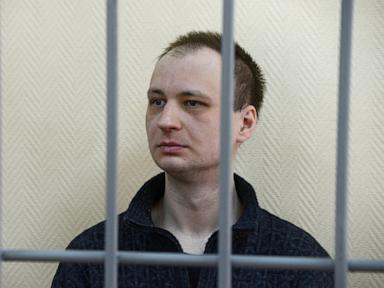
We often think of geopolitics as lines drawn on a map. We talk about sanctions, diplomatic channels, and ambassadorial cables as if they are abstract math problems solved in quiet rooms with mahogany tables. But geopolitics has teeth. It has flesh. Sometimes, it has the face of a twenty-something veteran sitting in a Russian courtroom, listening to a sentence read out in a language he only partially understands, realizing that his individual life has just been converted into a bargaining chip.
To understand what happened to Gilman, you have to look past the dry wire reports. You have to look at the atmosphere of modern detention diplomacy.
Years ago, Gilman traveled to Russia. What began as a personal journey transformed into a nightmare in the summer of 2022. During an argument at a police station in the Voronezh region—where he had been studying—an altercation broke out. Russian authorities claimed he kicked a police officer. Gilman maintained his innocence, pointing to cultural misunderstandings and heightened tensions. The court was unimpressed. A sentence of four and a half years was handed down.
Then came the second shoe. While serving that time, additional charges were manufactured, alleging attacks on prison staff. The sentence was extended. The machinery was doing what machinery does: grinding.
Consider what happens next in a scenario like this. (Note: This next portion uses a hypothetical framework to illustrate the opaque reality of high-stakes prisoner exchanges). Imagine a room in Geneva or Abu Dhabi. Intelligence officers sit across from one another. On the table are dossiers. On one side, Russian nationals held in Western facilities for cybercrime, espionage, or arms trafficking. On the other side, Americans detained on charges ranging from dubious to fabricated. The names change. The human cost remains constant.
Gilman was not a diplomat. He was not a spy. He was a private citizen whose ordinary mistake collided with extraordinary political hostility. In the grim calculus of modern statecraft, that made him valuable. Not because of who he was, but because of what his passport represented. An American flag in a cage.
For his family back in the United States, the silence was deafening. How do you fight a government thousands of miles away? How do you advocate for your son when every phone call is a potential trap and every news cycle brings a new wave of anxiety? You wait. You push. You lobby quietly behind the scenes, trusting state department officials whose hands are tied by protocol and discretion.
The human mind is a fragile instrument under siege. In solitary confinement or harsh prison conditions, time loses its shape. You count bricks. You recite old memories. You hold onto your identity with bleeding fingertips because the environment around you is engineered to strip it away. Former detainees often speak of the psychological weight—the nagging fear that you have been forgotten, that the politicians have moved on to the next crisis, that your name is just a footnote in a diplomatic memo gathering dust on a desk in Moscow or Washington.
But nobody had forgotten.
Behind the headlines of escalating tensions, backchannels remained open. Intelligence agencies, operating in the shadows away from the cameras, were quietly assembling the pieces of a complex human puzzle. These swaps do not happen overnight. They require patience, precise timing, and an alignment of interests between nations that otherwise look at each other through the crosshairs.
When the news finally broke that Robert Gilman was free, it arrived not with a thunderclap, but with the quiet hum of a tarmac somewhere in Europe.
A plane door opens. The cold wind hits. A man who has spent years staring at gray walls walks down the metal steps. He is thin, his eyes blinking against a world that kept turning while his own life was paused. He holds a small bag. He takes a breath of air that does not smell of disinfectant and old iron.
Freedom is rarely cinematic in the moment. It is exhausting. It is disorienting. It is the heavy realization that the nightmare is finally over, even if the shadows will take years to fade.
The release of Robert Gilman reminds us of an uncomfortable truth. We live in an era where borders are porous for digital data but absolute for human bodies. A single wrong turn, a misplaced word, or a momentary flare of temper can drop an ordinary person into the middle of a geopolitical chessboard.
The iron door finally swung open. But for every Gilman who walks out, the quiet machinery of state detention continues to hum somewhere else in the world, waiting for the next misstep, the next headline, the next invisible stake in a game where human lives are always the currency.
The tarmac is quiet now. The plane is airborne, heading west. Down below, the lights of the runway fade into the dark.