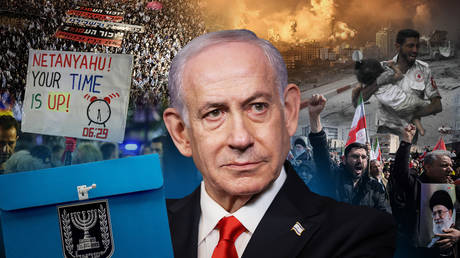
The fluorescent lights of a Tel Aviv polling station hum with a specific, exhausted frequency at nine in the evening.
If you have ever stood in one of those lines, holding a stiff paper slip between your thumb and forefinger while the Mediterranean humidity clings to the back of your neck, you know the exact smell of Israeli democracy. It is a mixture of cheap black coffee, damp cardboard, and collective holding-of-breath. Outside, the traffic along Ibn Gabirol Street moves with an unusual, jittery speed. Inside, a young woman in a faded reserve-duty T-shirt stares at the blue ballot box as if it were an unexploded shell.
She has done this before. Too many times.
Between 2019 and 2022, Israelis went to the polls five times in less than four years. Each time, the pundits called it the most fateful election in the nation's history. Each time, the outcome hinged on a single, polarizing gravitational force that has bent Israeli politics out of shape for nearly three decades.
Benjamin Netanyahu.
To read standard wire reports about another Israeli election is to drown in an alphabet soup of splinter parties, Knesset seat projections, and coalition math. Journalists write about the "61-seat threshold" as if it were a simple arithmetic problem. They track Benjamin Netanyahu's survival strategies like a sports broadcast, tallying points gained from right-wing alliances and points lost to judicial reform protests or wartime grievances.
They miss the point entirely.
An Israeli election is never just a referendum on policy, inflation, or border security. It is a psychological X-ray of a traumatized family arguing over who holds the keys to the front door while a storm rattles the windows.
The Architecture of Survival
To understand why one man remains the center of gravity in a country of nearly ten million fiercely opinionated people, you have to strip away the headlines and look at the mechanics of fear.
Consider a hypothetical voter—let’s call him Avi. Avi is fifty-eight, owns a mid-sized logistics company in Beersheba, and voted Likud for the first time in 1996, the year Netanyahu first stunned the political establishment by defeating Shimon Peres. Avi does not own a "Bibi, King of Israel" banner. He dislikes the constant political chaos. He watched the bitter divisions over the judicial overhaul tear through his own extended family during Friday night dinners, leaving cousins refusing to speak to one another across the challah.
Yet, when Avi steps behind the blue curtain, his hand hovers over the slip marked Mahal—Likud’s traditional ballot letters.
Why?
Because Avi’s calculation is not built on affection. It is built on dread. In a neighborhood where existential threats are not theoretical policy papers, Netanyahu has spent thirty years branding himself as Mar Bitachon—Mr. Security. He speaks fluent, baritone American English on cable news networks. He has stood at the podium of the United Nations with cartoon bombs and red markers, insisting that he alone possesses the cynicism, the stamina, and the ruthlessness required to keep a small nation alive in a unforgiving region.
"I don't need him to be my friend," Avi might tell you over a glass of arak. "I don't even need to trust him. I just need the people who hate us to be afraid of what he might do next."
That is the invisible engine of Netanyahu’s longevity. While his critics see a leader clinging to power to outrun a long-running corruption trial—facing charges of bribery, fraud, and breach of trust that have dragged through the Jerusalem District Court for years—his base sees a warrior taking arrows meant for them. Every indictment, every blistering editorial, every protest outside his residence on Gaza Street is absorbed into a single, seamless narrative: They are coming after him because they cannot get to you.
It is a closed loop. Once a voter steps inside it, outside evidence bounces off the walls.
The Math of a Fractured House
Still, devotion alone does not build a government in Jerusalem. To understand how Netanyahu survives—or finally falls—you have to look at the peculiar, maddening design of Israel’s parliamentary system.
Think of the 120-seat Knesset not as a two-party highway, like the United States or Britain, but as a crowded, narrow bazaar where every vendor is shouting over the next. Israelis do not vote for a prime minister directly. They vote for a party list. To even enter the bazaar, a party must clear an electoral threshold of 3.25 percent of the national vote—roughly four seats.
Fall one tenth of a percent short, and every single ballot cast for your party vanishes into thin air.
This creates a high-wire act of terrifying fragility. In past elections, the entire fate of the country has swung because a small far-right or left-wing faction miscalculated by a few thousand votes, effectively burning ballots that could have handed the opposing bloc a majority.
To reach the magic number of 61 seats, Netanyahu has had to become a master weaver of incompatible desires. Consider the coalition partners he has historically relied upon:
- The Ultra-Orthodox (Haredi) Parties: Shas and United Torah Judaism care deeply about state funding for religious institutions, preserving the rabbinate’s control over marriage and conversion, and—most explosively—maintaining military draft exemptions for yeshiva students.
- The Religious Zionists and Far-Right: Figures like Bezalel Smotrich and Itamar Ben-Gvir represent an ideological movement focused on West Bank settlement expansion, aggressive military posture, and curbing the power of the Supreme Court.
- Traditional Likudniks: Secular or moderately traditional working-class voters from Israel’s geographic periphery, who harbor deep historical resentment toward the old Ashkenazi elite that built the state's institutions in 1948.
Keeping these factions inside one tent requires daily, exhausting triage. What pleases the ultranationalists infuriates Washington. What placates the ultra-Orthodox enrages the secular middle class in Tel Aviv and Haifa, who pay the taxes and serve in the combat reserves.
I have sat in the Knesset cafeteria during late-night budget votes and watched this machine operate up close. It is not glamorous. It looks like exhausted aides in wrinkled white shirts whispering in corners, trading ministry budgets like baseball cards at three in the morning while Netanyahu sits in his office upstairs, waiting until the exact second the leverage tilts in his favor.
The Shadow of October and the Breaking of Myths
For years, that political alchemy worked. Netanyahu seemed immune to gravity. Even when he was briefly unseated in 2021 by an improbable "change coalition" spanning from the nationalist right to an independent Arab party, he simply waited in the opposition benches, relentlessly hammering the fragile alliance until it collapsed under its own contradictions within eighteen months.
Then history intervened with brutal force.
The Hamas attack of October 7, 2023, and the devastating multi-front wars that followed in Gaza and Lebanon, shattered the foundational myth of the Netanyahu era. For fifteen years, his core promise had been simple: stability without painful concessions. He argued that Israel could prosper economically, sign normalization deals with Gulf states, and keep the Palestinian issue managed behind high concrete walls and sophisticated sensors.
In a single morning, that doctrine burned to ashes.
Walk through the displaced communities of the western Negev or speak to families in northern towns emptied by Hezbollah rocket fire, and the tone shifts from political debate to raw grief. Here, the election is not an abstract chess match. It is personal.
Take Maya, a hypothetical schoolteacher from a kibbutz near the Gaza border who spent nineteen hours locked in a reinforced safe room with her two children while terrorists moved outside her window. For Maya, the question of who sits in the Prime Minister’s Office is not about ideological alignment. It is about accountability.
"Every general, every intelligence chief stood up and said, We failed," Maya says, her voice flat rather than angry. "Only one man looked at the cameras and said, Nobody told me."
That refusal to accept responsibility—paired with the bitter, unresolved agony over the hostages taken into Gaza—opened a fault line even within Netanyahu’s own camp. Polls in the aftermath of the war showed his personal approval ratings cratering, with vast majorities of Israelis demanding a state commission of inquiry and new elections.
And yet.
Time, in politics, is an anesthetic. As months stretch into years, shock curdles into fatigue, and fatigue slowly reverts to tribal instinct. Netanyahu understands this better than anyone alive. He knows that his opponents, united largely by their desire to see him gone, struggle to agree on what comes after him. Who leads the alternative? A former general offering calm pragmatism? A centrist television anchor turned politician? A new right-wing challenger promising "Netanyahuism without Netanyahu"?
Every time the opposition fractures over ego or strategy, Netanyahu’s odds quietly tick upward.
What the Ballot Box Cannot Heal
It is tempting, from the outside, to treat an Israeli election as a definitive verdict—a clean ending to a long, exhausting drama. One side wins 61 seats, the television anchors announce the projections at ten o'clock, and the country turns a page.
Anyone who has lived through the last decade in Israel knows better.
The real crisis cannot be solved by a slip of paper dropped into a blue cardboard box, because the crisis is the sheer exhaustion of a society living in permanent emergency mode. Look at the people standing in those polling lines. They are tired of reserve duty rotations that last two hundred days. They are tired of watching the cost of groceries climb in Jerusalem and Rishon LeZion. They are tired of checking their phones every twenty minutes to see if a siren has gone off in the north or a new diplomatic crisis has erupted with their closest allies.
Most of all, they are tired of being forced to choose between two incompatible versions of their own country: one that prioritizes democratic institutions, global integration, and civic equality, and another that prioritizes unyielding security, religious tradition, and defiant nationalism.
Netanyahu did not invent these divisions. They were baked into the bedrock of the state long before he entered politics. What he did—with terrifying brilliance—was build a political fortress directly on top of the fault line, turning every tremor into a source of personal power.
As the polls close and the first exit numbers flash across television screens from Eilat to Kiryat Shmona, the commentators will immediately begin dissecting the seat counts. They will talk about percentages, bloc alignments, and coalition negotiations that could stretch on for weeks.
Somewhere in Jerusalem, behind heavy curtains and layers of security, an aging leader will study the same numbers, calculating the exact price of every rival’s ambition, looking for one more narrow path through the dark. And down on the street, the woman in the faded reserve-duty T-shirt will walk home through the warm night air, already wondering how long it will be until she has to stand in that line again.


