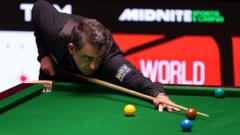
Ronnie O’Sullivan entering the Crucible Theatre at age 50 to hunt an eighth World Championship title represents more than a sporting milestone; it is a direct challenge to the physiological and psychological decay curves typical of high-precision sports. To understand the probability of success, one must move beyond the sentimental narrative of "The Rocket" and instead analyze the three critical variables governing snooker longevity: visual-motor coordination stability, cognitive load management, and the diminishing marginal utility of historical dominance.
The Biomechanics of the Fifty Year Old Cue Action
Snooker is a game of fractional tolerances. A displacement of one millimeter at the tip of the cue results in a failure to pot at the distance of the black spot to the pocket. Historically, players have seen a sharp decline in performance post-40 due to two primary biological factors: presbyopia and micro-tremors in the fine motor muscles of the bridge hand and cue arm.
O’Sullivan’s continued efficacy at 50 is rooted in a technical redundancy that most of his peers lack. His cue action relies on a "long-travel" delivery with a significant follow-through, which provides a larger margin for error in timing. While players like Stephen Hendry or Steve Davis relied on a "punchier," more compact delivery that required perfect timing—a trait that erodes with age—O’Sullivan’s fluid acceleration allows him to mask minor syncopation errors.
The primary threat to this mechanical stability is the "yips" or involuntary muscle spasms. Data from veteran players suggests that these are often psychological manifestations of a failing visual system. As the brain receives less certain data from the eyes regarding the contact point on the object ball, it introduces hesitation into the stroke. O’Sullivan’s shift toward a more instinctive, faster pace of play in recent years is likely a strategic adaptation to this; by reducing the time spent in the "address" position, he minimizes the window for neurological noise to disrupt the motor command.
The Cognitive Load of the Crucible Format
The World Snooker Championship is an outlier in professional sports due to its duration and format. A single match can span two days and 35 frames. This creates a specific "endurance of focus" requirement that is fundamentally different from the shorter, "best-of-7" formats found in the rest of the tour.
Winning an eighth title requires O’Sullivan to navigate the Crucible Cumulative Fatigue Function. This function accounts for:
- Sensory Deprivation: The isolated nature of the theater environment leads to heightened cortisol levels over a 17-day period.
- Decision Fatigue: Each frame involves roughly 20 to 50 high-stakes tactical choices. Over a tournament, this exceeds 1,000 critical decisions.
- The Intermittent Recovery Gap: Unlike a marathon, snooker involves long periods of sitting while the opponent is at the table. This "active waiting" prevents the heart rate from settling while simultaneously allowing muscles to cool, creating a physiological state of perpetual low-grade stress.
O’Sullivan’s strategy for mitigating this involves a radical simplification of the game tree. While younger players may over-analyze safety exchanges, O’Sullivan prioritizes "shot-making volatility." He takes higher-risk pots to end frames quickly. While this increases the chance of individual frame losses, it reduces his total "time on table" by an estimated 15-20% compared to a tactical grinder like Mark Selby. This saved cognitive energy is his primary asset in the later stages of the tournament (the semi-finals and final).
The Asymmetry of Modern Competition
The field O’Sullivan faces at 50 is numerically stronger but strategically homogenous. The modern "heavy scorer" era, influenced largely by O’Sullivan’s own career, has created a generation of players who are exceptional at break-building but often lack the "B-game" depth required when the conditions at the Crucible become difficult (e.g., heavy cloths, kicks, or atmospheric humidity).
The bottleneck for O’Sullivan isn't the skill level of the top 16; it is the Variance of the Short Session. In the early rounds, which are best-of-19, a younger opponent can produce a "hot streak" that exceeds O’Sullivan's baseline. However, the longer the match, the more the law of large numbers favors the player with the higher average safety success rate and superior cue ball control.
O’Sullivan currently maintains a "Pot Success" percentage hovering around 90-92% and a "Long Pot" success rate of approximately 60%. If these metrics remain stable through the first two rounds, the statistical probability of him reaching the one-table setup (the semi-finals) is over 65%, based on historical ELO ratings adjusted for age-related regression.
The Eighth Title as a Risk Management Problem
The pursuit of an eighth title is often framed as a "legacy" quest, but for the practitioner, it is a problem of managing diminishing returns. O’Sullivan has already achieved the "Triple Crown" multiple times. The incentive structure at 50 is no longer financial or reputational; it is purely about the "Optimal State" of performance.
The "Cost Function" of this title is the physical and mental toll required to maintain a practice regime that keeps his long potting competitive. Most players at 50 lose their "edge" because the ratio of effort to reward becomes inverted. O’Sullivan’s use of running and a strict nutritional protocol serves a dual purpose: it manages the systemic inflammation that would otherwise affect his grip and stance, and it provides a dopamine substitute that prevents the "competitive burnout" that retired his predecessors.
The Strategic Path to Victory
To secure the eighth title, O’Sullivan must execute a three-phase operational plan:
Phase 1: Energy Conservation (Rounds 1 & 2)
He must avoid "long-form" safety battles. If a frame exceeds 25 minutes, the statistical advantage shifts toward younger, more patient grinders. O’Sullivan must use "controlled aggression" to force errors early in the frame, even if it means taking 60/40 shots.Phase 2: Tactical Complexity (Quarter-Finals)
At this stage, opponents are usually elite scorers. O’Sullivan must shift his strategy to "containment," using his superior knowledge of "niche" safety escapes—placing the cue ball in areas that force the opponent into uncomfortable bridge positions.Phase 3: Psychological Dominance (Semi-Finals & Final)
The Crucible is a pressure cooker. O’Sullivan’s advantage here is the "Intimidation Premium." Younger players often suffer from "performance inhibition" when playing a legend on the one-table setup. By maintaining a high "Average Shot Time" (under 18 seconds), O’Sullivan can induce a sense of panic in his opponent, forcing them to speed up beyond their comfort zone.
The eighth title is not a matter of "talent"—that is a settled variable. It is a matter of whether O’Sullivan can maintain a sub-20-second shot average while keeping his pot success above 90% across 17 days. If the shot time slows, it indicates cognitive fatigue; if the pot success drops, it indicates mechanical failure. Watch the shot clock, not the scoreline, to predict the outcome.
The final strategic move is the exploitation of the "middle distance" game. Most modern players excel at long pots or short-range cannons. O’Sullivan’s mastery of the 4-to-6-foot range—the most common distance for frame-winning clearances—remains the highest in the history of the sport. As long as his eyes allow him to see the "thick" side of the object ball at this distance, he remains the statistical favorite regardless of age.