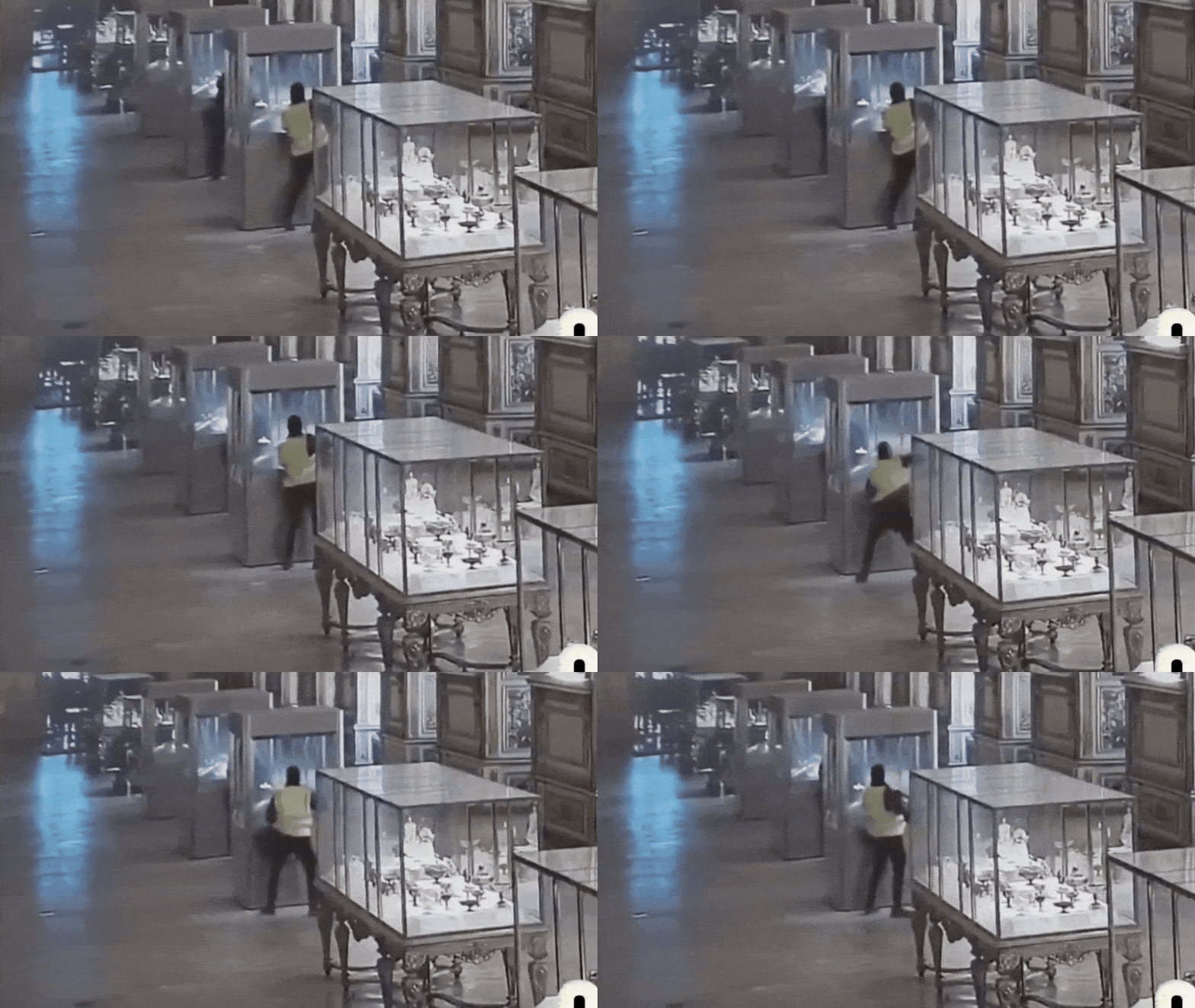
The media is losing its mind over a €88 million heist, treating a group of smash-and-grab burglars like the elite, hyper-calculated cast of Ocean’s Eleven.
They are printing breathless accounts of the "mastermind" who was reportedly unhappy with how the job went down. They are dissecting the blueprints, the timing, and the sheer audacity of stealing jewels from right under the nose of the world's most famous museum. They want you to believe we are witnessing a golden age of sophisticated criminal masterminds outsmarting cutting-edge security architecture.
It is a comforting narrative. It is also completely wrong.
As someone who has spent two decades auditing physical asset protection and advising institutional galleries on risk mitigation, I am going to tell you the brutal truth that the security industry prays you never realize: high-end museum security is largely a theatrical performance designed to lower insurance premiums, not stop determined thieves.
The €88 million Louvre heist didn't succeed because the criminals were geniuses. It succeeded because modern museum security is built on a foundational lie.
The Illusion of Invincibility
Every time a high-profile heist occurs, the public asks the same flawed question: How did they bypass the laser grids, the biometric locks, and the motion sensors?
The premise of the question is broken. You are thinking like a Hollywood screenwriter. In the real world, sophisticated tech isn't bypassed with cyber-warfare or acrobatic flips. It is bypassed by exploiting the lowest common denominator in any system: human operational fatigue.
Museums do not operate like military bunkers. They are public-facing institutions that must balance strict accessibility with asset protection. This creates a permanent, structural vulnerability.
The Security Theatre Stack
When you look at a high-security display, you are looking at layers of deterrence, not prevention:
- Laminated Security Glass: Rated by European Standards (like EN 356), even BR4-level bullet-resistant or P8B burglar-resistant glass is only rated to withstand a specific number of strikes from a blunt instrument or axe. It is designed to delay, not permanently prevent, entry.
- Volumetric Microphonic Sensors: These trigger an alarm when the glass is struck. But an alarm does not stop a hammer; it merely starts a timer.
- The Human Response Variable: This is where the entire stack collapses.
If a thief can breach a case and exit the perimeter in 120 seconds, and your armed response protocol requires 180 seconds to deploy, mobilize, and lock down the exit gates, the thieves win every single time. It is pure math, not magic. The Louvre burglars didn't hack the system; they simply ran faster than the administrative bureaucracy tasked with stopping them.
Why the Mastermind Was Actually an Amateur
The reports claiming the "mastermind was not happy" because the execution was sloppy miss the entire point of modern fence operations. If the mastermind were truly a high-level operator, they wouldn't be crying over the messiness of the extraction. They would be panicking about the liquidity of the haul.
Stealing €88 million worth of high-profile, historically significant jewelry is the easy part. Selling it is nearly impossible.
The Liquidity Trap
Let's dissect the reality of hot gems. You cannot walk into a diamond bourse in Antwerp or a dealer in Dubai with a recognizable, historically documented piece of jewelry from a major European museum. The moment an item enters the Art Loss Register or an Interpol Red Notice, its legitimate market value plummets to exactly zero.
To monetize this heist, the "mastermind" has only two options, both of which represent a massive failure of business strategy:
- The Chop Shop Method: They break the jewelry down. They melt the platinum or gold settings into generic bullion, and they recut the stones. The moment you recut a famous diamond to alter its refractive index and carat weight to hide its origin, you destroy up to 70% to 80% of its market value. Your €88 million haul is suddenly worth €15 million in raw materials, minus the massive cut demanded by the underground illicit broker who has the infrastructure to launder it.
- The Ransom Strategy: They attempt to sell it back to the insurance underwriters (art napping) for a fraction of the value. This requires complex, highly dangerous intermediary negotiation, where the risk of an elite sting operation increases exponentially every day the assets are held.
The fact that the crew left behind a messy trail and internal strife proves this was an operation driven by desperate opportunism, not institutional criminal capability. They ran a high-risk, low-yield play that relies on the archaic vulnerability of physical presence.
The Institutional Failure Nobody Wants to Admit
I have sat in boardrooms where institutions spend millions on dual-frequency infrared sensors while paying their frontline security guards minimum wage.
We see companies and cultural institutions blow fortunes on flashy, high-tech hardware while ignoring basic operational discipline. This is the corporate equivalent of buying a $10,000 smart lock for a door made of rotting wood.
If you want to understand why these heists keep happening, look at the security roster, not the tech spec sheet. High-turnover staff, inadequate active-shooter or active-theft drills, and systemic alarm fatigue mean that when a real sensor goes off, the initial human reaction is to assume it is a system glitch or a maintenance error. The thieves exploit those precious 30 seconds of cognitive dissonance.
Imagine a scenario where a proximity alarm triggers at 3:00 AM. In 99% of cases, it is a localized power fluctuation, a rogue rodent, or an improperly calibrated environmental control unit. The guard on duty, exhausted and undertrained, resets the panel. By the time they verify the visual feed, the display case is already shattered.
Stop Fixing the Wrong Vulnerabilities
If you are running an enterprise, a logistics firm, or a high-value asset vault, you are likely learning all the wrong lessons from this headline. You are probably thinking you need to upgrade your cameras, buy AI-driven anomaly detection software, or install biometric checkpoints.
You are wasting your capital.
Stop trying to build impenetrable walls. They do not exist. Instead, change the economics of the asset target itself.
If an asset cannot be rapidly authenticated, moved, or liquidated without immediate detection, it ceases to be a viable target. The future of protection isn't heavier glass; it is forensic marking, localized asset degradation systems (like smart ink or microscopic chemical tags that ruin asset utility upon unauthorized casing breaches), and decentralized custody.
The Louvre heist shouldn't terrify you because of the thieves' brilliance. It should terrify you because it exposes how easily multi-million-dollar defense systems crumble when challenged by raw, low-tech velocity.
Stop investing in the theatre of security. Start engineering for the reality of human failure.