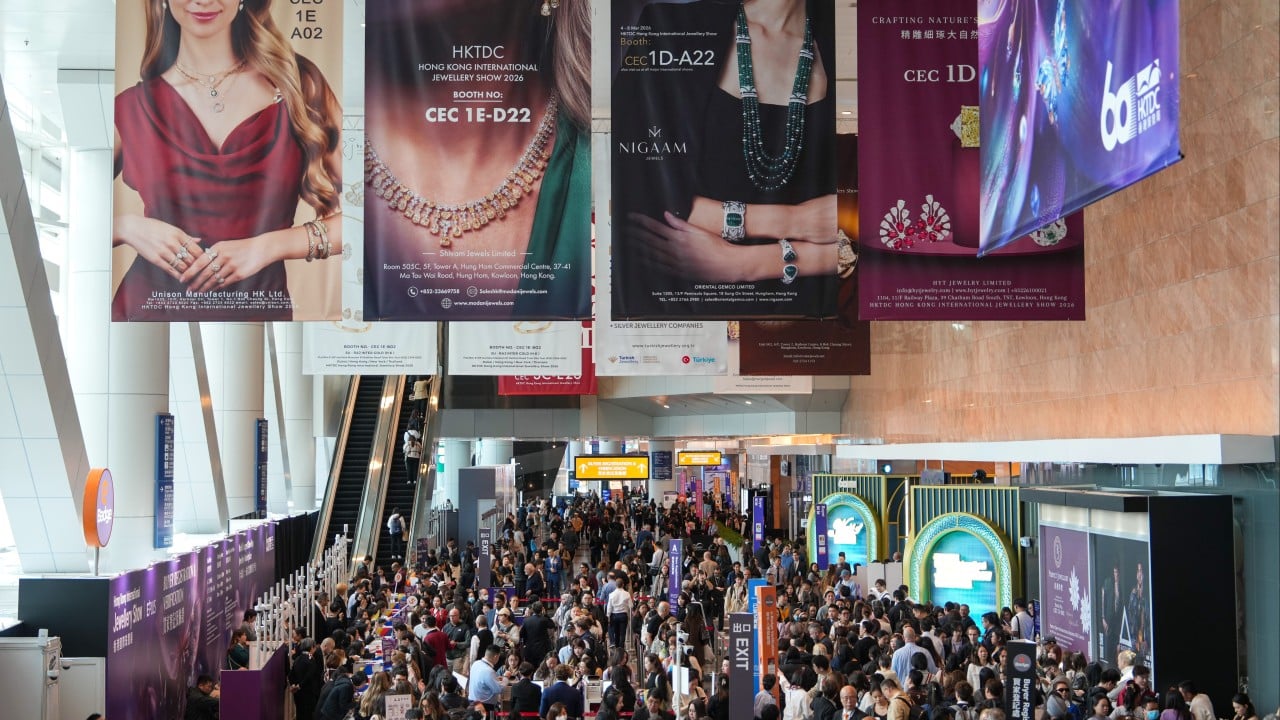
The headlines are predictable, soggy, and entirely wrong. They speak of "ruing" lower sales. They mourn the thinning crowds. They point at empty aisles in the Hong Kong Convention and Exhibition Centre as if they’re looking at a funeral procession for Middle Eastern trade.
If you are a diamond wholesaler from Dubai or a gemstone merchant from Riyadh and you’re crying over a 20% dip in foot traffic, you aren’t just losing money. You’re losing the plot.
The "lazy consensus" among trade journalists is that high attendance equals a healthy industry. That is a relic of the 1990s. In the modern high-end luxury market, "busy" is often just a synonym for "distracted." The death of the mass-market trade show isn't a crisis; it is a long-overdue filter.
The Myth of the High-Volume Lead
For decades, the Hong Kong Jewellery & Gem Fair was a chaotic bazaar where quantity masked a lack of quality. Exhibitors spent six figures on booths just to hand out brochures to "tire-kickers" and tourists who had no intention of moving a million dollars worth of unmounted emeralds.
Lower attendance doesn't mean the buyers are gone. It means the tourists are gone. It means the small-time retailers who were never going to survive the current credit squeeze have finally stopped pretending they can compete.
When a Middle Eastern exhibitor complains about "poorer sales," what they are actually saying is that their old, passive business model—waiting for a whale to swim into their net—is broken. The whales didn't stop buying. They just stopped showing up to crowded, noisy convention centers where they have to dodge selfie sticks.
The Geopolitical Ego Trip
Middle Eastern sellers often treat Hong Kong as a validation exercise. There is an obsession with "presence." They want to show the world that the GCC (Gulf Cooperation Council) is a dominant force. But dominance isn't measured by the size of your rug or the brightness of your LED screens in a rented hall.
We are seeing a massive shift in how the $300 billion global jewelry market functions. The real action has moved to private suites in the Mandarin Oriental or the Rosewood. The deals are happening in the months preceding the fair, via secure digital viewings and private consignments.
If you're relying on a trade show floor to meet your annual revenue targets, you are a dinosaur watching the asteroid enter the atmosphere. The "poor attendance" reported by the media is actually a signal that the serious money has moved to more exclusive, controlled environments.
The China Blind Spot
The competitor pieces love to blame "economic headwinds in China" for the lackluster turnout. This is a half-truth that hides a deeper reality.
Yes, the Chinese retail market has cooled. But the appetite for hard assets—specifically investment-grade stones—has never been higher among the ultra-high-net-worth (UHNW) segment in Asia. They aren't buying 1-carat engagement rings anymore; they are moving wealth into fancy vivid yellows and "pigeon blood" rubies.
Middle Eastern exhibitors who brought mid-market inventory to Hong Kong deserve to lose money. They misread the room. They brought a knife to a drone fight. The demand in 2026 isn't for "jewelry"; it is for portable, liquid wealth. If your sales are down, it’s not because the buyers are broke. It’s because your inventory is boring.
The New Math of the Jewelry Trade
Let’s look at the actual mechanics of a successful exhibition in the current climate. In the old days, the ratio of visitors to sales looked like a standard bell curve. Today, it is a power law.
Imagine a scenario where 10,000 people visit your booth. If your overhead is $200,000, you need a massive conversion rate to justify the expense. Now, imagine a scenario where only 500 people visit, but those 500 represent 90% of the purchasing power in the region.
- Old Model: High noise, low signal.
- New Model: Zero noise, pure signal.
The exhibitors "ruing" their luck are the ones who can't tell the difference. They are addicted to the dopamine hit of a crowded booth. They don't realize that every minute spent talking to a non-buyer is a minute they aren't spent deepening a relationship with a sovereign wealth fund representative or a private collector.
The Dubai Pivot
While people are crying in Hong Kong, Dubai is laughing. The Dubai Diamond Exchange has been systematically eating Hong Kong’s lunch for five years. Why? Because they understood that the future of the trade is about infrastructure and tax efficiency, not "foot traffic."
The Middle Eastern firms that are winning are the ones who treat Hong Kong as a three-day cocktail party and Dubai as the actual vault. They use the fair for "handshakes and heartbeats"—maintaining the human connection—but they close the massive, eight-figure deals back in the DMCC (Dubai Multi Commodities Centre).
If you’re an exhibitor and you haven't realized that your booth is just an expensive business card, you’re in the wrong profession.
Stop Blaming the "Climate"
Business owners love to blame the "economic climate." It’s the ultimate get-out-of-jail-free card. "Sales were down because the interest rates were high." "Attendance was low because of travel restrictions."
Stop.
Sales were down because your brand has no gravity. If you are selling a commodity, you are at the mercy of the market. If you are selling a story, a rare provenance, or a technical mastery that cannot be replicated in a Shenzhen factory, the "climate" doesn't matter.
I have seen firms in the same hall as these "complaining" Middle Eastern exhibitors record record-breaking quarters. The difference? They didn't wait for the fair to start to find their buyers. They spent six months data-mining their CRM, fly-outs to Singapore and Shanghai, and pre-selling 70% of their stock before the crates even hit the Hong Kong docks.
The fair should be your victory lap, not your Hail Mary.
The High Cost of Being "Normal"
The danger of the current narrative—that the Hong Kong fair is "struggling"—is that it encourages exhibitors to retreat. They think, "Next year, we’ll take a smaller booth." Or, "Next year, we’ll send fewer staff."
That is a loser's limp.
The contrarian move isn't to shrink. It’s to change the nature of the presence. Turn the booth into a black-box, invite-only lounge. Stop showing the product to the public. Create artificial scarcity. In a world of "poorer attendance," the only way to win is to make your 50 square feet of floor space the most exclusive 50 square feet in the city.
The "poorer attendance" is a gift. It’s the sound of the riff-raff being cleared out. It’s the sound of the industry finally maturing past its "souk" phase and into its "private equity" phase.
If you can't make money in a room full of the world's richest buyers just because there are fewer "lookers" in the hallway, you aren't a jeweler. You're a clerk.
Quit whining about the crowd and start looking at the signatures on the checks. If the signatures are there, the number of bodies in the room is irrelevant. If the signatures aren't there, the problem isn't the fair.
The problem is you.