Power is rarely grabbed with a loud roar. More often, it is negotiated in whispered stairwells, over cold coffee at dawn, and through calculated silence.
Consider the anatomy of a future that has not yet arrived. In American politics, ambition is currency. It is the fuel that drives men and women to memorize thousands of names, to smile through exhaustion under the white-hot glare of television lights, and to convince themselves that they alone hold the blueprint for a nation’s salvation. To possess that ambition and willingly place it in park is an unnatural act. It goes against every evolutionary instinct of the political animal.
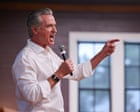
Yet, that is precisely what California Governor Gavin Newsom outlined when he drew a line in the sand regarding the 2028 presidential primary. His declaration was simple, stripped of the usual evasive hedging favored by ambitious executives: if Kamala Harris runs, he will not.
To understand the weight of those words, you have to step away from the cable news chyrons and walk the physical corridors where modern political power is forged. Picture a quiet hotel suite in Sacramento or Washington, late at night, the air humming with the low drone of an air conditioner while advisors shuffle polling printouts across a glass table. In those rooms, futures are traded like commodities. Every move is calculated years in advance. A primary contest is not merely an election; it is a brutal, tribal war that drains friendships, empties bank accounts, and leaves permanent scar tissue across state parties.
Newsom’s pledge is a fascinating study in political choreography. It is an acknowledgment of political geography and historical precedent. Both Newsom and Harris share a common womb in California politics, rising through the same hyper-competitive San Francisco ecosystem, navigating the same donor networks, and staring down the same progressive and moderate factions. To run against each other in an open primary would not just be a battle of ideas; it would be a civil war that could shatter the Democratic Party’s western anchor.
By stepping back under a specific condition, Newsom achieves something remarkable. He positions himself as a team player while retaining the optionality that every ambitious leader craves. He clears the board of a messy intra-party collision, preserves a vital alliance, and anchors his own timeline to the shifting tides of national mood.
To feel the gravity of this choice, imagine what it takes to quiet your own momentum. Newsom has spent decades building a national brand. He is a politician who treats executive office as a stage for policy innovation, pushing universal healthcare concepts, climate mandates, and social policy crusades that draw both fierce adoration and blistering critique from conservative America. He is a man accustomed to being the center of gravity in any room he enters. To subordinate that drive to another figure requires a level of tactical discipline that is exceptionally rare.
Politics is fundamentally about timing. A year in politics is an epoch. Four years is an eternity. When a leader declares their intentions years out, they are not predicting the future; they are trying to shape it. They are sending a signal to donors, bundlers, and organizers that the field is being managed, that chaos can be avoided, and that loyalty will be rewarded when the ledger is balanced.
Look closely at the mechanics of this dynamic. Harris occupies a unique space in contemporary political history. Her trajectory from San Francisco District Attorney to Attorney General, United States Senator, Vice President, and beyond has placed her at the absolute epicenter of the party's modern identity. She embodies the aspirations and the fractures of a diverse coalition. For Newsom to state that he will not challenge her if she seeks the nomination is an act of realpolitik disguised as chivalry. It recognizes that in a party desperate for cohesion, running against a sitting or former Vice President with deep national infrastructure is a path to mutual destruction.
There is a profound human element beneath these strategic calculations. Politicians are human beings operating under relentless public scrutiny. Every flaw is amplified, every ambition is weaponized, and every hesitation is diagnosed by millions of strangers on glowing screens. When a public figure makes a major declaration about their future, they are also managing the expectations of their family, their staff, and their own internal narrative of legacy.
What drives a man like Newsom to anchor his ambition to another person's trajectory? It is partly pragmatism, partly survival, and partly a recognition of the modern media ecosystem. In an era where outrage is monetized and division is the default setting of public discourse, a unified front projects strength. Conversely, a chaotic primary featuring two prominent figures from the same coastal state would provide endless ammunition to opponents who paint progressive governance as out of touch and self-absorbed.
Consider the ripple effects across the political ecosystem. Across the country, ambitious governors, senators, and rising stars are watching this chess match unfold. Every calculation made in Sacramento sends shockwaves through state committees in Iowa, New Hampshire, and South Carolina. Potential campaign managers update their spreadsheets. Fundraisers quietly adjust their portfolios. The invisible machinery of the next presidential cycle hums a little differently today than it did yesterday.
History teaches us that such pacts are fragile. Political alliances forged in convenience often dissolve when the wind changes direction. Circumstances shift, economic crises erupt, public sentiments turn on a dime, and what looks like an ironclad commitment today can become an asterisk tomorrow. But the statement itself matters more than its ultimate enforceability. It establishes a baseline. It sets the terms of engagement for an era of political transition.
We are living through a period of profound institutional anxiety. Voters across the spectrum feel a deep-seated fatigue with the endless churn of political combat. They are tired of the noise, the posturing, and the perpetual campaign mode that seems to consume governance. When leaders manage their ambitions with a degree of strategic restraint, it introduces a rare element of predictability into an unpredictable world.
Yet, restraint is not surrender. Newsom remains one of the most visible surrogates and vocal combatants in the national arena. Whether he is sparring with conservative governors on cable television, signing sweeping legislation in California, or rallying grassroots organizations across the country, he maintains a relentless pace. His brand is built on visibility, on taking the fight directly to his ideological opponents, and on positioning California as a laboratory for the future.
That visibility is precisely why his statement carries such weight. If he were a fading backbencher, his intentions would be irrelevant. Because he is a central pillar of the party's future, every word is weighed, measured, and analyzed by political scientists and party strategists alike.
Think about the psychological toll of carrying such ambition. To want the highest office in the land requires a staggering amount of ego, yet to achieve it often requires suppressing that very ego in favor of collective discipline. It requires knowing when to speak and, just as importantly, when to step aside. It requires walking a razor-thin line between showing strength and appearing overly eager.
The relationship between ambition and loyalty is the central drama of modern political life. Every aspiring leader must navigate the tension between their personal desire for power and the collective needs of their political family. When those two forces align, magic happens. When they collide, entire political movements fracture.
As the decade moves forward, the shadow of the upcoming electoral cycle will only grow longer. The names mentioned today will dominate the headlines tomorrow. Speeches will be fine-tuned, policy papers will be drafted, and millions of dollars will quietly change hands in the background. But beneath all the strategy, the polling data, and the tactical positioning remains the raw, human reality of individuals striving to leave their mark on a restless nation.
The stage is set, the players have taken their positions, and the invisible clock continues its steady, relentless countdown toward a future that belongs to no one yet.
In the quiet hours after midnight, when the cameras are off and the advisors have gone home, the political animal is left alone with his thoughts, staring into the dark, wondering if the compromises of today will be remembered as wisdom or hesitation when the history of tomorrow is finally written.