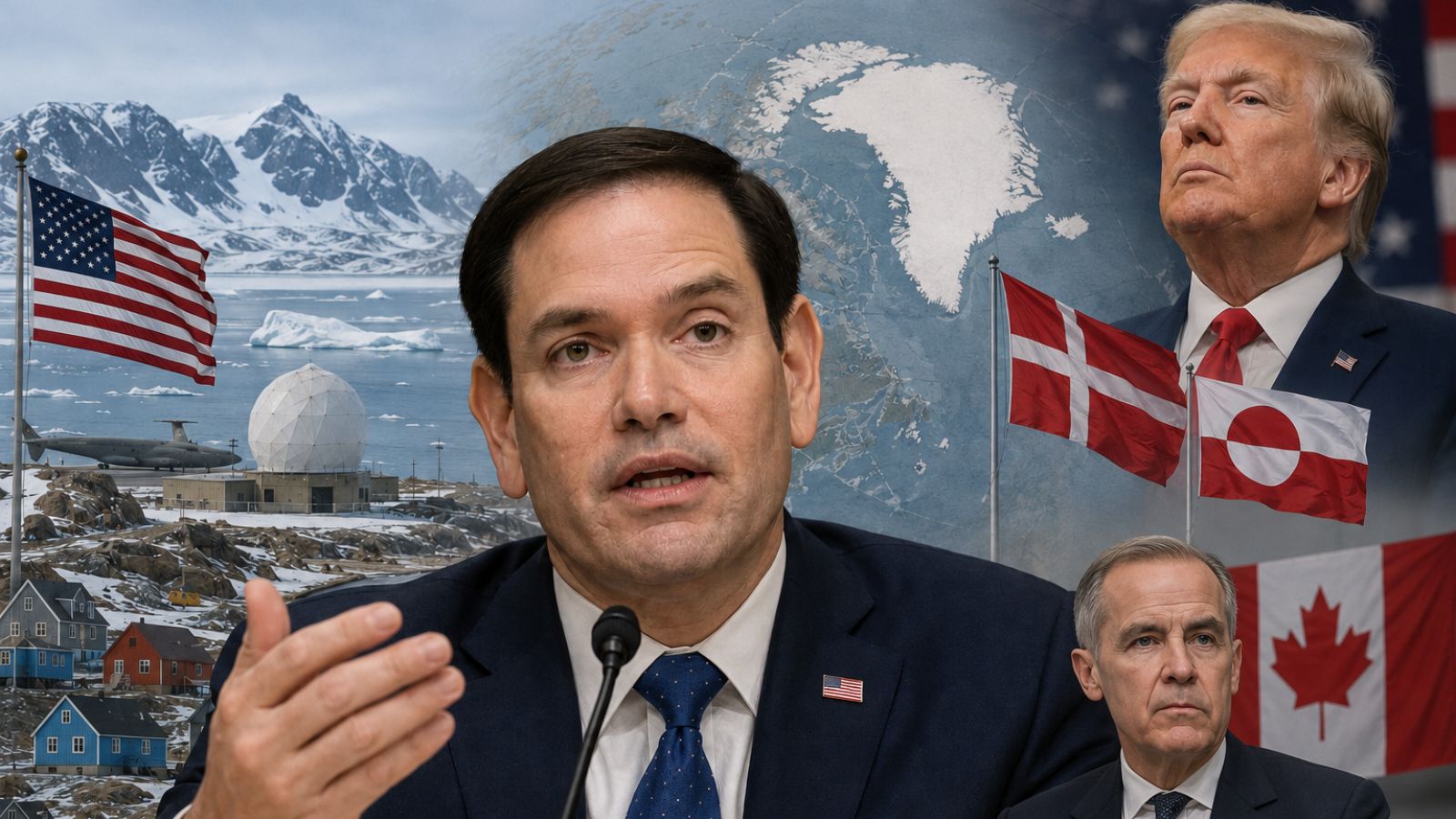
The corporate media is experiencing another collective meltdown over Donald Trump’s casual remarks about absorbing Canada and Marco Rubio’s comments that Greenland belongs to Denmark "for now." The talking heads are lining up to denounce these statements as dangerous diplomatic gaffes, erratic outbursts, or colonial throwbacks.
They are entirely missing the point. Discover more on a connected topic: this related article.
The lazy consensus among political commentators is that national borders in the West are permanent, sacred, and dictated purely by historical sentimentality. This view is naive. It ignores the cold, hard mechanics of resource scarcity, continental security, and demographic collapse. What the media frames as an unhinged Twitter-era provocation is actually a clumsy, blunt articulation of an inevitable 21st-century geographic realignment.
Stop viewing North American geography through the lens of 20th-century stability. The map is melting, both literally and geopolitically. More analysis by USA Today delves into similar views on the subject.
The Greenland Fallacy: Sovereignty is an Illusion Managed by the Highest Bidder
When Marco Rubio noted that Greenland is Danish "for now," the foreign policy establishment gasped. How dare a US Senator suggest a European nation might lose its territory?
Let us look at the math. Copenhagen heavily subsidizes Greenland. The Danish government injects hundreds of millions of dollars annually into the island via the block grant (bloktilskud), accounting for over half of Greenland’s public budget. This is not a sustainable long-term strategy for a European nation facing its own internal economic and demographic pressures.
Greenland sits directly on the frontline of the new Arctic theater. As polar ice recedes, trillions of dollars in untapped rare earth elements, critical minerals, and strategic shipping lanes are opening up. Denmark lacks the naval power, the capital, and the industrial capacity to secure this territory against aggressive Russian militarization and Chinese state-backed infrastructure bids.
If the United States does not eventually assume full administrative and defensive responsibility for Greenland, a hostile foreign power will project force directly into the North American perimeter. Thule Air Base—now Pituffik Space Base—is already a critical node in the US early warning system. To believe that a massive, resource-rich landmass vital to American continental defense will remain permanently tethered to a small European nation out of sheer politeness is historical blindness.
I have watched policy analysts spend decades pretending that international treaties prevent territory accumulation. They do not. Capital and security capability do. Greenland will eventually enter a formal compact of free association with Washington, not because of American imperialism, but because Copenhagen will ultimately choose to offload the fiscal and security burden.
Canada Is Running Out of Time to Prove It Is a Sovereign Superpower
The reaction to Donald Trump reviving the idea of Canada becoming a "state" or a client territory followed the exact same tired script. Analysts rushed to defend Canadian sovereignty, pointing to its vast geography and G7 status.
But sovereignty requires the ability to defend your own borders and sustain your own economy without relying entirely on your neighbor's charity. Canada is currently failing on both counts.
Consider the reality of Canadian defense spending. For years, Ottawa has treated NATO's 2% GDP defense spending target as an optional suggestion rather than a treaty obligation. Canada’s military is plagued by procurement failures, aging equipment, and severe recruitment shortages. The Canadian Armed Forces cannot reliably patrol their own massive Arctic coastline, let alone defend it from foreign incursions.
Country       Defense Spending (% of GDP)
United States  3.4%
United Kingdom 2.3%
Canada         1.3% (Estimated)
Canada enjoys the luxury of high-minded moral posturing on the world stage only because it is shielded by the US nuclear umbrella and the North American Aerospace Defense Command (NORAD). It is an economic protectorate masquerading as an independent global superpower.
Furthermore, the Canadian economic model is fracturing. The country has systematically stifled its own resource sector through regulatory strangulation, alienating its western provinces while relying heavily on real estate speculation and unsustainable population growth to juice its GDP numbers. When a nation cannot defend its territory, relies entirely on its neighbor for survival, and faces deep internal regional fractures, its borders become highly fluid concepts over a long enough timeline.
Dismantling the "People Also Ask" Delusions
The public queries surrounding this issue reveal just how deeply mainstream narratives have obscured basic geopolitical mechanics.
Can the US just buy Greenland?
The question itself is flawed because it views geopolitical acquisition through the lens of a real estate transaction. No one is going to hand over a giant novelty check to the Queen of Denmark. Instead, look at the historical precedent of the Republic of Iceland. During World War II, when Denmark was occupied, the US stepped in to defend Iceland, eventually leading to its full independence and integration into the Western security architecture. A similar economic and military dependency is already developing with Nuuk. The US buys Greenland through infrastructure investments, security guarantees, and economic integration, not a cash-for-dirt transaction.
Why does the US care about the Arctic?
Because the Arctic is the new Mediterranean. The northern trade routes will shave weeks off global shipping times between Europe and Asia. More importantly, Russia has spent the last decade reopening Soviet-era military bases above the Arctic Circle, outfitting them with icebreakers and missile systems. If the US allows a security vacuum to exist in Greenland or Northern Canada, it invites a direct threat to the homeland.
The Brutal Calculus of the New Continentalism
The shift toward a unified, American-dominated Arctic and North American landmass is not an ideological choice. It is a structural necessity driven by three unavoidable forces.
1. The Critical Minerals Chokehold
The transition to advanced computing, defense technology, and new energy grids requires massive amounts of lithium, nickel, cobalt, and rare earth elements. China currently dominates the processing of these materials. The largest untapped deposits of these minerals in the Western Hemisphere sit beneath the Canadian shield and the Greenlandic ice sheet. The US will not allow bureaucratic inertia or foreign policy sentimentality in Ottawa or Copenhagen to block access to these existential resources if supply chains break down globally.
2. The Failure of Middle-Power Diplomacy
For fifty years, middle powers like Canada and Denmark thrived under a globalized system secured by the US Navy. That system is deglobalizing. As international institutions like the UN and the WTO lose their teeth, regional hegemony becomes the only currency that matters. Small populations overseeing vast, undefended resource pools cannot survive independently in a multipolar world. They will be absorbed into the orbit of the nearest superpower, either via economic integration or outright administrative assimilation.
3. The Demographic Inversion
Both Denmark and Canada are facing severe demographic headwinds. Canada has attempted to bypass this via hyper-immigration, creating massive domestic housing crises and straining social infrastructure to the breaking point. Denmark has chosen a restrictive path but faces an aging population that cannot support global power projection. The United States, despite its internal political theater, possesses the deep capital markets, the demographic scale, and the raw military power to manage and develop these vast northern territories.
The Hidden Cost of Facing Reality
Admitting that borders are volatile comes with serious discomfort. The contrarian view acknowledges a dark truth: the erosion of Canadian and Danish autonomy over their northern territories will destabilize traditional alliances. It will breed resentment. It will force Washington to expend trillions of dollars in infrastructure development and border management that its own citizens might prefer to spend at home.
But the alternative is worse. A fragmented, weak northern perimeter is an open invitation to foreign adversaries.
The mainstream media will continue to hyperventilate over every quote, treating statements about Greenland and Canada as bizarre anomalies. They will comfort their audiences with platitudes about international law and historic friendships.
They are wrong. The pressure of geography, resources, and military reality always crushes sentimentality. The map of North America is changing, and no amount of polite diplomatic denial can stop it.
Stop looking at the borders drawn in 1945. Start looking at the resource maps of 2030. The integration has already begun.