There is a specific kind of cosmic joke tucked away inside the history of rock and roll, and it belongs entirely to Frank Beard.
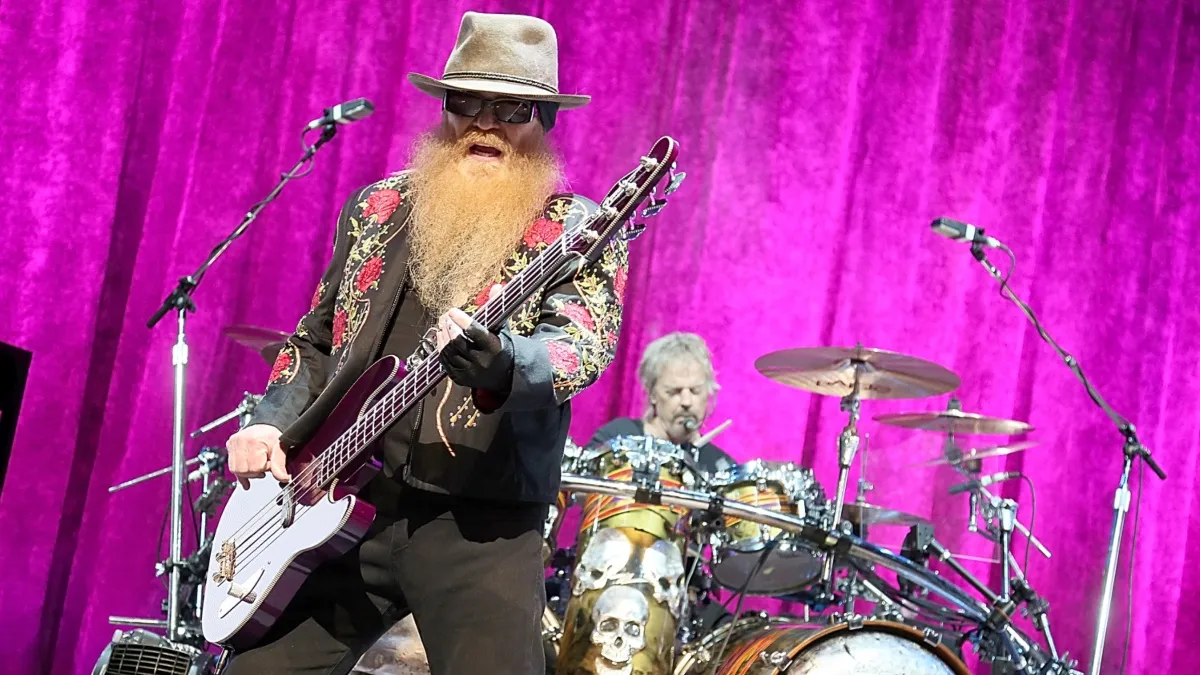
For more than half a century, millions of people stared at the most famous facial hair in American music history. They bought the records. They threw up their hands at stadium shows. They watched MTV videos featuring two men with chest-length, wizard-like beards swaying in unison, flanked by a pristine red hot rod and shimmering starlets. And right there behind the drum kit, anchoring the hurricane of Texas blues-rock with a steady, unyielding mechanical pulse, sat a man named Beard.
Clean-shaven.
Except for a neatly trimmed mustache, which he wore for most of his adult life, Frank Beard possessed the only face on stage that actually honored his surname in reverse. It was the kind of dry, self-aware irony that defined ZZ Top from their very inception in 1969. They were a band wrapped in myth, sunglasses, and dust, yet they possessed a wicked sense of humor about their own legend.
Now, the rhythm has stopped.
Frank Beard has died at the age of 77.
When the news broke, it didn't feel like a standard celebrity obituary. It felt like the fracturing of a monument. ZZ Top was never just a band; they were a singular organism. Billy Gibbons, Dusty Hill, and Frank Beard. For over fifty years, that trio remained completely intact without a single lineup change. Think about that for a second. In an industry defined by volatile egos, backstage brawls, and messy breakups, these three men from Texas stayed in the same room, making the same gritty, stomp-heavy music, for five decades.
Dusty Hill left us first, passing away in his sleep in 2021. When Dusty died, the band didn't end. At Dusty’s explicit blessing, their longtime guitar tech, Elwood Francis, picked up the bass. They kept rolling. Because that was what you did. You kept time. You hit the snare on the two and the four. You honored the groove.
Now Frank is gone, too. And the silence left in the wake of that shuffle beat is deafening.
To understand Frank Beard is to understand the architecture of cool. Billy Gibbons was the mystic, the guitar-slinging alchemist who pulled greasy magic out of a 1959 Les Paul named Pearly Gates. Dusty Hill was the thumping heartbeat, the grit and roar on the left side of the stage. But Frank? Frank was the engine block.
He didn't need to flash. He didn't need a five-minute drum solo to prove his worth. In fact, if you listen closely to the catalogue, from early deep cuts like Francine to global synth-rock juggernauts like Gimme All Your Lovin' and Sharp Dressed Man, what stands out is his restraint. Frank understood space. He understood that sometimes the most powerful thing a drummer can do is hold back, letting the heavy air hang between the notes before dropping the kick drum right where you least expect it, yet right where you desperately need it.
He grew up in Frankston, Texas, a place where the air smells of pine and red dirt, before finding his way into the fertile, humid music scene of Houston in the late sixties. Before ZZ Top, there was American Blues, and before that, The Moving Sidewalks. But once Gibbons, Hill, and Beard locked into each other in 1969, the chemical formula was complete.
They weren't an overnight success. They toured relentlessly, playing honky-tonks, sweaty high school gymnasiums, and Texas outdoor festivals where the heat could melt the rubber off a tire. They were road warriors long before MTV turned them into cartoon heroes of the 1980s.
And through it all, Frank was the steady hand.
Yet, life on the road has a way of exacting a toll. The rock and roll lifestyle isn't built for longevity, and in the 1970s and 1980s, the excesses caught up to everyone. Frank has spoken openly in past interviews about his battles with substance abuse during the height of the band's massive commercial peak. It is easy to look at archival footage of a stadium tour and see only the neon lights, the fuzzy guitars, and the MTV fame. It is much harder to see the human cost of living inside a touring machine that never slows down.
Sobriety came. It had to. To survive five decades in the music business, you have to learn how to adapt, how to heal, and how to look in the mirror without flinching. Frank did that. He cleaned up, stepped back into the groove, and reclaimed his place behind the kit with a renewed clarity.
When Dusty Hill passed, it felt like a heavy cloud had settled over the band. I remember talking to older music fans at the time, people who had seen them back in 1974 at a sweaty club in Austin, and there was a shared grief. Not just for Dusty, but for an era of American music that was slowly slipping away into the history books. We are losing the architects. The men who learned their craft directly from the old bluesmen, the ones who absorbed the delta mud and turned it into stadium thunder.
Now, Frank joins Dusty.
Think about what happens next in the grand, cyclical theater of rock and history. Billy Gibbons is still out there, clutching his guitar, whispering secrets to the strings. The music will live on, echoing through car speakers on lonely desert highways, blasting from jukeboxes in roadside diners, reminding anyone who listens what raw, unadulterated groove sounds like.
Frank Beard didn't need the namesake facial hair to be a giant. He didn't need the spotlight to drive the machine. He just sat at the back, smiling that quiet, knowing smile, holding the world together four beats at a time.
The stage lights have dimmed on the little old band from Texas as it was once known. But as long as a snare drum cracks in the dark, the rhythm remains.