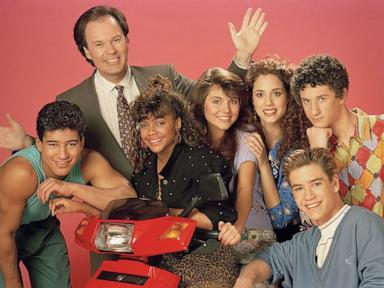
Dennis Haskins spent years answering to a name that belonged to millions of childhoods. When the actor passed away at the age of 75 in Burbank, California, following a battle with Parkinson's disease, he left behind an archetype that modern television no longer knows how to build. As Principal Richard Belding on Saved by the Bell—and its predecessor Good Morning, Miss Bliss, and its subsequent iteration Saved by the Bell: The New Class—Haskins was the ultimate anchor in a sea of Saturday morning teenage melodrama. He was not merely an authority figure; he was the comforting architectural constant of a television landscape that understood how to make viewers feel safe.
Long before he ever stepped foot onto Bayside High's soundstages, Haskins lived a life far removed from the strict hallway rules of television administration. Born in Chattanooga, Tennessee, in 1950, his early professional path wound through the high-stakes, high-volume corridors of the music industry. He worked as a concert promoter, music manager, and agent, handling heavyweights like Gregg Allman and Tom Jones. That background gave him an instinctive rhythm, an entertainer's pulse that he would later quietly inject into a character who could have easily been written as a two-dimensional obstacle for Zack Morris and company.
Instead, Haskins imbued Principal Belding with an infectious, self-effacing warmth. He understood the assignment of early-90s network television. He knew that the adults in youth-skewing sitcoms generally existed to serve two distinct functions: either to act as out-of-touch caricatures or to provide a safety net when the juvenile schemes inevitably spiraled out of control. Belding leaned heavily into the latter, balancing exasperation with a profound, foundational fondness for his students.
The television business changed drastically after the golden era of syndication wrapped. Shows like Saved by the Bell belonged to an era of appointment viewing, multi-camera setups, and comforting predictability. When the cameras stopped rolling, Haskins did not retreat into the typical isolation of a retired television star. He embraced the enduring cultural footprint of his most famous role with a rare, persistent humility. He became a fixture at local establishments like Burbank’s Dimples karaoke bar, where patrons and fans could regularly find him holding court, singing a tune, or posing for photographs. He treated his legacy not as a burden to escape, but as a genuine connection to people who had grown up alongside his work.
The industry often undervalues the performers who anchor ensemble comedies. The spotlight invariably targets the fresh-faced youths driving the primary storylines, while the adult character actors supply the gravity that keeps the entire enterprise grounded. Haskins played that vital role across multiple iterations of the franchise, cementing a tenure in a single television universe that few actors ever achieve. He remained Principal Belding for an entire generation, transitioning seamlessly from television screens into the collective cultural memory.
As the tributes roll in from former cast members and lifelong fans alike, the loss feels intensely personal because Haskins represented an unrecoverable era of media consumption. He was the familiar voice booming down the intercom, the booming laugh that punctuated a silly mistake, and the steady hand that reminded viewers that high school errors—no matter how catastrophic they felt at the time—were survivable. Dennis Haskins left the stage having given millions of people an imaginary home away from home, and television is a much colder place without him behind the desk.