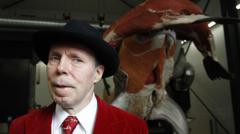
He wore a wide-brimmed hat, a heavy coat, and an expression that belonged to a different century. Gunther von Hagens did not look like a modern scientist. He looked like an alchemist who had wandered out of a gothic painting, carrying secrets he was far too eager to share.
When he introduced the world to plastination in the late nineteen-seventies, most people did not know how to react. They simply stared.
Imagine walking into a dimly lit gallery. You expect marble statues or framed canvases. Instead, you find human beings. Not ghosts. Not skeletons tucked away in a dusty medical drawer. Real people, preserved in perpetual motion. A runner frozen mid-stride, muscles taut and exposed. A poker player seated at a table, holding his cards for eternity.
The initial reaction was visceral shock. Critics recoiled. Tabloids christened him with a moniker meant to terrify: Dr Death.
Yet, beneath the sensationalism lay a quiet, radical shift in how humanity viewed its own fragile architecture. For centuries, the inner workings of the human body remained hidden behind a velvet curtain of medical secrecy. Doctors studied anatomy in cold, antiseptic basements, far from the public eye. Death was an ending. Decay was the final chapter.
Von Hagens changed the grammar of mortality.
To understand what plastination actually is, you have to strip away the macabre theatre and look at the sheer ingenuity of the process. Fresh biological tissue decomposes because of water and fat. Von Hagens realized that if you replace those fluids with reactive polymers like silicone rubber, you can halt time.
The process takes months, sometimes over a year for a single specimen. First, the body is embalmed with formalin to stop decay. Then, the water and soluble fats are extracted using a solvent like acetone. Finally, under a vacuum, the acetone is replaced by a polymer. The body becomes pliable, ready to be posed into lifelike postures, before being cured with gas, light, or heat.
It is meticulous. It is scientific. And, above all, it is profoundly human.
When Body Worlds exhibitions began touring the globe, millions of visitors lined up for hours. Why? Because we are inherently curious about the machinery that keeps us breathing. We spend decades inhabiting a body, yet most of us have never seen the intricate web of our own nervous system or the delicate geometry of a human heart.
Critics argued that displaying real bodies crossed an ethical boundary. They called it exploitation. They questioned whether the dead could truly consent. But von Hagens anticipated this. He established a body donor program, creating a registry where thousands of living people signed legal documents explicitly stating their wish to be plastinated after death.
Consider the mindset of a donor. Long before their heart stops beating, they make a conscious choice. They decide that their mortal remains should continue to teach, to inspire, and to demystify the physical self long after they are gone. That is not disrespect. That is a profound act of generosity.
Von Hagens himself was diagnosed with Parkinson’s disease in two thousand and ten. He spoke openly about his declining health, watching his own body slowly betray him while knowing its ultimate destination. There is a haunting poetry in that reality. The man who spent his life studying the mechanics of mortality had to face his own physical erosion with the same clinical, unyielding gaze he applied to his specimens.
When news broke of his death at the age of eighty-one, the headlines resurrected the old ghost stories. They remembered the white coat, the eccentric television appearances, the controversial public dissections. But they missed the deeper narrative.
He did not desecrate the dead. He rescued them from oblivion.
Before plastination, a body buried six feet under became a secret kept by the earth. A body on a medical school slab became a nameless tool for a handful of students behind closed doors. Von Hagens dragged anatomy out of the shadows and placed it squarely in the light of day. He made the invisible visible.
Walk through one of his exhibits today, and you will not find monsters. You will find smokers' lungs blackened like charred wood, standing beside healthy pink lungs. You will find arterial networks branching out like intricate root systems, showing just how delicate our circulation truly is.
People stopped, pointed, and whispered. Smokers stubbed out cigarettes outside exhibition halls. Sedentary office workers stared at the muscular strain of a displayed athlete and made mental notes to move more, to live better, to respect the vessel they were given.
That was the real legacy. Not shock value. Education wrapped in awe.
The man in the fedora is gone now. The workshops where silicone and formaldehyde worked their strange alchemy will continue without him. But the conversation he forced open will not close.
Every beating heart carries within it the quiet, ticking countdown of its own eventual stop. Gunther von Hagens did not invent that reality. He simply removed the blindfold and invited us to look right at it.
The gallery lights dim. The crowds drift toward the exit. On a steel table, a preserved hand rests, fingers curled slightly, holding nothing at all, while telling the entire story of everything we are.