The ink on a standard world map is cruelest to the fragments. If you look at the Atlantic Ocean, just off the coast of Senegal, your finger will likely glide right past Cape Verde. It is a cluster of volcanic volcanic dots, home to roughly six hundred thousand souls. For centuries, to the rest of the world, it was an itinerary footnote, a collection of postcard beaches, or a soft melody sung by Cesária Évora.
Then came the summer of 2026.
On a sticky afternoon in Houston, eleven men dressed in deep ocean blue stood on a manicured patch of grass, surrounded by tens of thousands of screaming fans. They were not supposed to be there. The script of modern football is heavily corporate, dictated by billionaire club owners and European academies. It does not leave room for fairy tales. Yet, when the referee blew the final whistle on a tense, exhausting scoreless draw against Saudi Arabia, the tiny archipelago broke reality.
Cape Verde had survived the group stage of the FIFA World Cup. Undefeated.
They drew with Spain. They traded punches in a 2-2 thriller with Uruguay. They locked down Saudi Arabia. Three matches, three points, zero losses. By the time the dust settled, this tiny nation had become the smallest country in human history to reach the knockout rounds of a World Cup.
The Weight of Being Invisible
To understand what this means, you have to look beyond the tactical formations or the scouting reports. Consider a hypothetical teenager named Joao, sitting in a dimly lit concrete home in Praia, the nation's capital. For his entire life, football meant watching someone else’s flag fly on television. It meant buying jerseys belonging to Portugal, Brazil, or France because those were the nations that mattered. Those were the countries that existed on the global stage.
When you belong to a micro-state, you grow accustomed to a quiet kind of erasure. You constantly explain where you are from. You watch your best talent leave for Lisbon or Rotterdam, swallowed by bigger economies and historic colonial structures.
But the real problem lies elsewhere. It is the internal belief that greatness is a luxury reserved for giants.
The national team, affectionately known as the Tubarões Azuis—the Blue Sharks—arrived in North America ranked 64th in the world. They were treated as a warm-up fixture, a mathematical guarantee of three points for traditional powerhouses. Instead, players like veteran goalkeeper Vozinha, defender Diney Borges, and midfielder Kevin Pina decided to rewrite the geography books.
They did it with a relentless, suffocating defensive discipline that felt less like a sport and more like a collective refusal to be forgotten. When Kevin Pina struck the back of the net earlier in the tournament, it was not just a goal. It was an eviction notice served to anonymity.
A Diaspora Built on Heavy Beats and Shared Hope
The sound of Cape Verde is the batucada—a frantic, hypnotic drum syncopation that forces your chest to vibrate. During those ninety-six agonizing minutes against Saudi Arabia, the drums did not stop in Praia. They did not stop in Mindelo. More importantly, they did not stop in Brockton, Massachusetts, or the suburbs of Rotterdam.
There are more Cape Verdeans living outside the islands than on them. The diaspora is vast, scattered across Europe and New England by generations of migration. For decades, football was a fragmented experience for these families.
Consider what happens next when a diaspora finds its center.
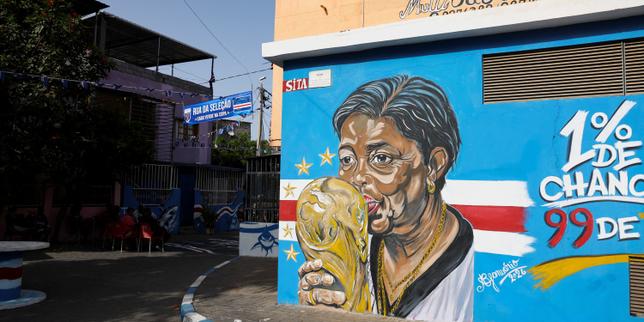
In the fan zones of New Jersey and the bars of New England, third-generation immigrants who spoke broken Portuguese wept openly. The explosion of local pride was so massive that the team's social media platforms gained hundreds of thousands of followers overnight. Suddenly, the Blue Sharks were a global trend.
"I usually watch games alone," a young man named Hery de Almeida admitted to a reporter amid the street celebrations in Praia, his voice hoarse from shouting. "But this time, I needed to be surrounded by people. I needed to fill my heart with this collective pride."
The team's manager, Bubista, has become the architect of this emotional awakening. He looks like a man who has spent his life studying the Atlantic winds, calm and immovable. While the world gasps at his team's defensive rigor, he remains unimpressed by his own miracle.
"Before the tournament, many thought it was impossible," Bubista shrugged during a recent press conference, his eyes focused. "But with work and combativeness, we are proving that we can look the best nations in the world straight in the eyes."
Standing Before the Myth
The reward for this historic defiance is beautiful and terrifying. The bracket has placed them on a direct collision course with Argentina.
On Friday, July 3, 2026, the Blue Sharks walk onto the grass of the Hard Rock Stadium in Miami. Across from them will be the reigning world champions. Across from them will be Lionel Messi, returning to the starting lineup after a resting period. It is a matchup so absurdly lopsided on paper that it reads like an ancient myth. One squad is valued in hundreds of millions of dollars; the other is fueled by players fighting for minutes in secondary European leagues.
But the fear is gone. It was washed away somewhere between the draws with Spain and Uruguay.
"To qualify for the next round and face Argentina is extraordinary," said Horácio Semedo, a local jurist whose eyes glistened with tears under the Praia night sky. "Playing against Messi, whether we win or lose, will be an immense moment for this small country."
There is no pressure on Cape Verde anymore. When you have already forced the world to memorize your name, you have already won the trophy that matters. The tactics will be drawn, the defensive blocks will form, and the Blue Sharks will hunt. But regardless of the scoreboard in Miami, the maps have already been redrawn. The world knows exactly who they are.