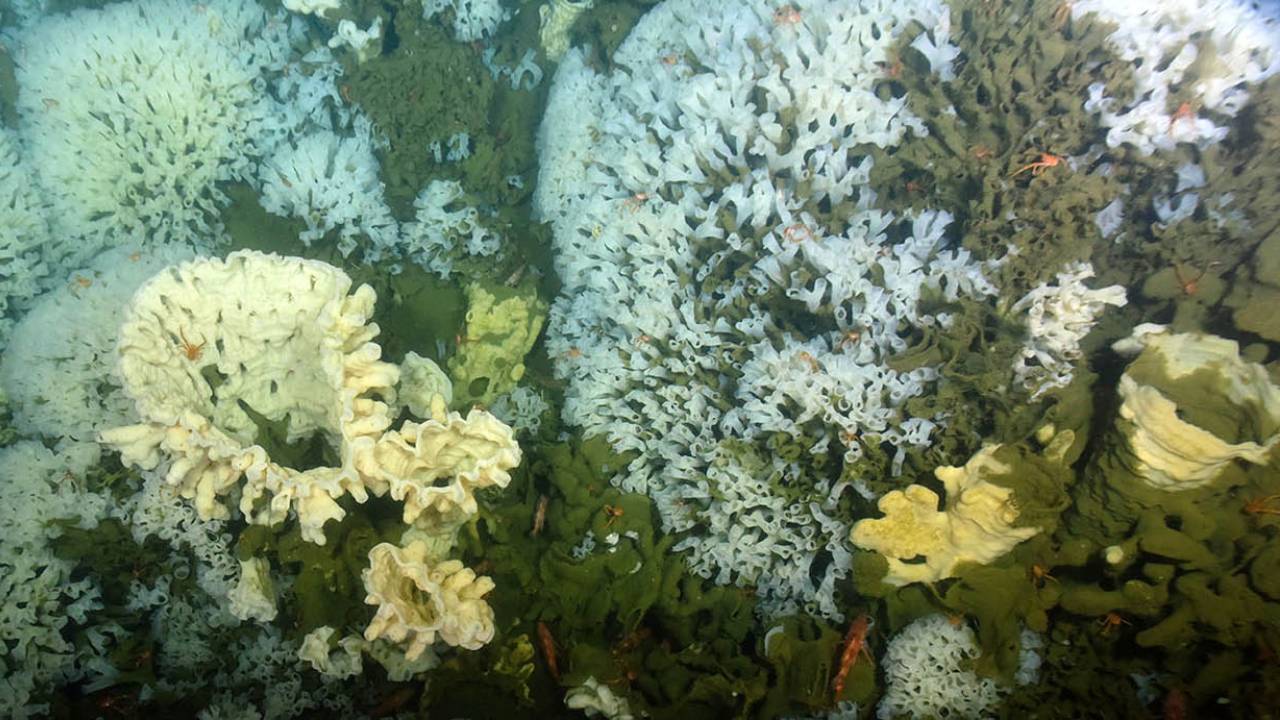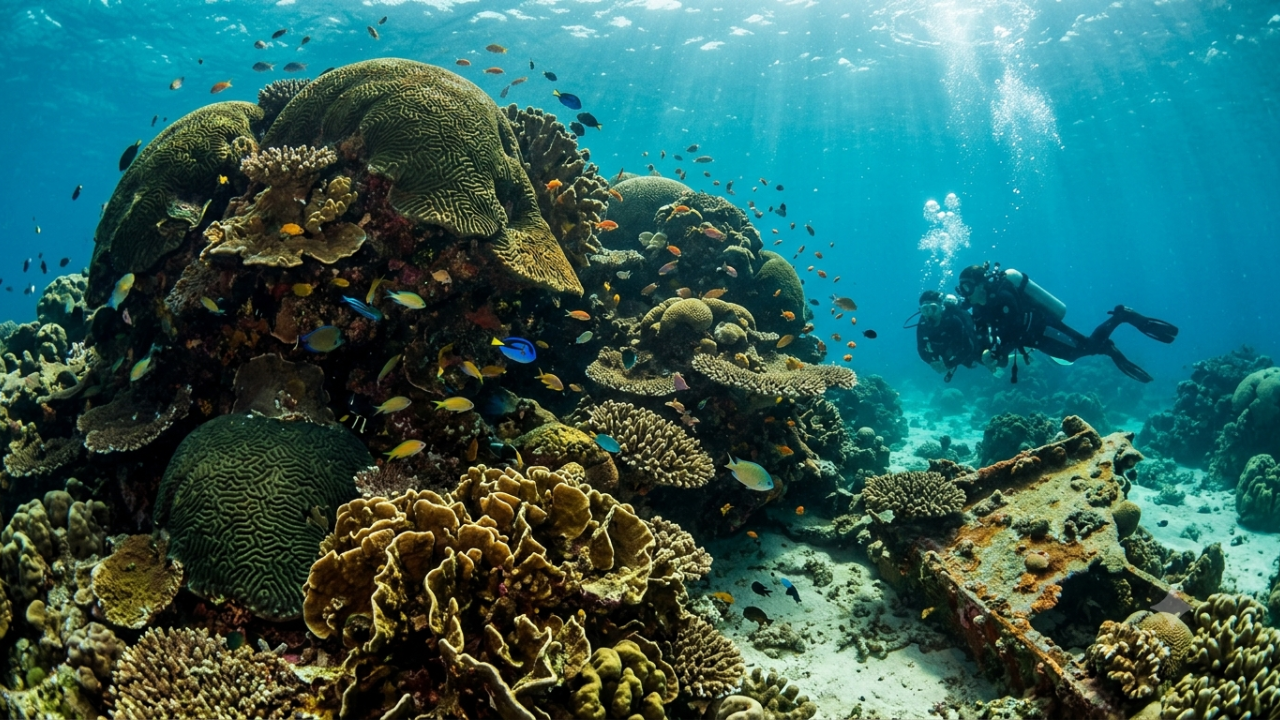
Decades after twenty-three thermonuclear detonations obliterated the marine ecosystems of Bikini Atoll, localized populations of scleractinian corals are not merely surviving; they are thriving in conditions that defy conventional radiobiological models. Standard ecological recovery frameworks assume that high-dose ionizing radiation coupled with catastrophic mechanical destruction resets succession clocks to zero. Yet, comprehensive benthic surveys reveal extensive tabular and branching coral colonies flourishing directly within former blast craters where background gamma and beta radiation levels remain exceptionally high. Deconstructing this anomaly requires moving past sensationalized narratives of miraculous healing and analyzing the physiological, genetic, and environmental variables driving high-radiation marine survivability.
The Biogeophysical Context of the Blast Craters
Bikini Atoll functions as a closed-loop marine laboratory characterized by extreme historical perturbation. Between 1946 and 1958, the United States military detonated twenty-three nuclear devices, including the 15-megaton Castle Bravo test on March 1, 1954. These detonations vaporized entire islands, carved massive craters into the carbonate platform, and saturated the lagoon sediments with unspent fissile material, strontium-90, and cesium-137.
To evaluate the persistence of life in this environment, analysts must categorize the stressors into three distinct vectors:
- Mechanical Deficit: The sheer physical demolition of the reef framework, turning complex structural matrices into shifting sand and rubble.
- Radiological Persistence: Continuous low-dose ionizing radiation emitted from legacy radionuclides bound to marine sediments and dissolved in the water column.
- Thermal and Chemical Alteration: Transient shifts in lagoon chemistry immediately following the tests, followed by decades of restricted human intervention which paradoxically created a marine sanctuary shielded from industrial overfishing and destructive local development.
The paradox of Bikini Atoll is that the cessation of human extraction pressures counterbalanced persistent radiological hazards. When evaluating the current ecosystem, biologists often commit a false dichotomy error, attributing total recovery exclusively to radiation tolerance while ignoring the absence of secondary anthropogenic stressors like destructive anchoring, coastal runoff, and commercial trawling.
Cellular and Genetic Defense Mechanisms in Irradiated Scleractinia
Ionizing radiation damages biological tissues primarily by generating reactive oxygen species (ROS) through the radiolysis of water, which in turn fragments DNA strands and denatures proteins. For corals to proliferate in high-dose zones, their cellular machinery must execute rapid and continuous remediation protocols.
Three primary physiological adaptations explain this resilience:
- Upregulated Antioxidant Pathways: Corals in the atoll demonstrate sustained overexpression of enzymatic antioxidants such as superoxide dismutase and catalase, alongside non-enzymatic scavengers like glutathione. This chemical buffer neutralizes radiation-induced ROS before lipid peroxidation can compromise cellular membranes.
- Enhanced DNA Repair Kinases: The genomic architecture of resilient coral holobionts—the coral animal plus its symbiotic algae and associated microbiome—exhibits elevated expression of double-strand break repair proteins. When ionizing radiation causes chromosomal fragmentation, homologous recombination and non-homologous end joining pathways operate at high efficiency.
- Symbiont Shuffling: Symbiodiniaceae populations within these corals undergo dynamic shifts. Certain clade profiles within the algae are more thermally and radiatively resilient. By altering the proportional dominance of these symbionts, the host animal secures a metabolic buffer against environmental stress.
The cost function of maintaining these repair pathways is high. Under normal baseline conditions, continuous DNA repair demands significant metabolic allocation, which can stunt linear extension rates or reduce reproductive output. However, in the nutrient-poor, high-energy environment of a tropical lagoon, these trade-offs are successfully managed through efficient recycling of metabolic waste products between the host and its algal endosymbionts.
Micro-Environmental Buffering and Sediment Dynamics
Radiation exposure within the Bikini lagoon is not distributed homogeneously. The physical geography of the blast craters creates micro-environmental shielding that alters biological exposure levels.
Radionuclides such as cobalt-60 and cesium-137 adsorb strongly to fine-grained carbonate muds and organic silts that settle in the deep, low-energy centers of the craters. Conversely, the shallow crater rims and consolidated reef pavements experience high hydro-dynamic flushing driven by wave action and oceanic tidal pumping. This continuous exchange dilutes suspended radioactive particulate matter and flushes the interstitial waters of the reef matrix.
Furthermore, self-shading and structural density play a critical role. Massive Porites colonies, which dominate portions of the revived reefs, possess high skeletal density. This physical mass acts as a minor attenuator of localized radiation while providing a stable, unmoving substrate that resists the abrasive action of radioactively hot shifting sands.
Re-evaluating Ecological Succession Models
Standard succession theory posits that ecosystems disturbed by acute cataclysms follow a predictable trajectory from opportunistic pioneer species to climax communities. Bikini Atoll disrupts this linear paradigm because the primary disturbance agent—radiation—is chronic rather than acute, acting as a constant selective pressure rather than a one-time reset.
Instead of selecting for complete genetic purity, the high-radiation environment acts as a genetic bottleneck. Surviving colonies represent a phenotype-selected subpopulation characterized by enhanced cellular repair efficiency, rapid somatic growth, and robust horizontal gene transfer via larval recruitment from adjacent, less-contaminated reef systems. The atoll functions less as a healed patient and more as an evolutionary crucible where radio-tolerance is rapidly selected for over standard baseline vulnerabilities.
The persistence of these corals provides valuable baseline data for understanding marine resilience in the face of persistent anthropogenic stressors, demonstrating that biological systems possess broader adaptive phenotypic plasticity than rigid radiobiological models previously predicted.
Optimize larval connectivity mapping between Bikini Atoll and surrounding undamaged atolls to quantify the degree of genetic rescue versus local adaptation driving the current benthic recovery.