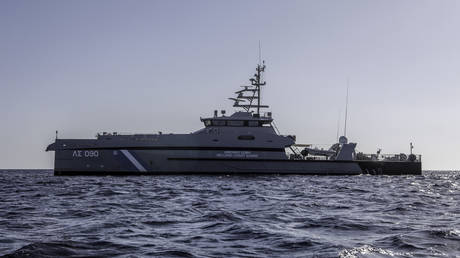
The discovery of a Ukrainian Magura-class uncrewed surface vessel (USV) off the coast of the Greek island of Agathonisi represents more than a stray piece of military hardware; it serves as a physical case study in the breakdown of geographic containment in modern maritime attrition. While initial reporting focused on the logistical mystery of how a Black Sea asset reached the Aegean, the strategic reality concerns the intersection of autonomous range, drift physics, and the escalating "gray zone" risk to NATO’s eastern flank.
The Mechanics of Drift and Range Extension
The primary variable in this incident is the delta between operational radius and total buoyancy endurance. A Magura V5, the likely candidate based on recovery imagery, utilizes a high-strength hull designed for low-radar cross-section (RCS) and high-speed interception. However, its propulsion system is constrained by a fuel-to-weight ratio optimized for approximately 800 kilometers of range.
Agathonisi is located significantly outside the standard operational envelope of a launch from Ukrainian-controlled territory. This distance necessitates an analysis of three specific transport mechanisms:
- Passive Drift Vectors: Post-kinetic or post-mechanical failure, a USV becomes a derelict vessel subject to the prevailing currents of the Black Sea. The surface currents generally move counter-clockwise (the Rim Current). For a vessel to exit the Black Sea and enter the Aegean, it must navigate the Bosphorus and the Dardanelles—a feat nearly impossible for an unpowered craft due to the heavy traffic monitoring and the complex hydrology of the Turkish Straits.
- The "Trojan" Deployment Model: Deployment from a non-military mother ship closer to the target zone. This would imply an expansion of the Ukrainian operational theater into the Mediterranean, a move with significant diplomatic friction for NATO members.
- Mechanical Persistence: The ability of these systems to remain buoyant for weeks after losing power. The hull integrity of Ukrainian USVs is high, allowing them to survive sea states that would founder smaller civilian craft.
The presence of the drone in Greek waters confirms that the "containment" of the naval war to the Northern Black Sea is a functional fiction. The kinetic lifespan of the drone is short, but its physical lifespan as a floating hazard or a technical intelligence (TECHINT) risk is indefinitely long.
Structural Anatomy of the Magura V5 Platform
Understanding the threat profile requires deconstructing the USV into its functional subsystems. Unlike traditional naval assets, the Magura is a composite of off-the-shelf commercial technology and bespoke military integration.
- Communication Architecture: The platform relies heavily on redundant satellite links (Starlink or similar LEO constellations) and inertial navigation systems (INS). The loss of signal leads to a "dead man's" state where the craft either scuttles or drifts.
- Payload Scalability: These units typically carry between 200kg and 300kg of high explosives. The Greek recovery indicates that the fail-safe mechanisms—designed to detonate upon tampering or impact—either failed or were not engaged, providing a rare opportunity for clean-room forensic analysis.
- Visual-IR Sensor Suites: The gimbaled cameras allow for high-definition targeting. The recovery of these sensors allows Greek and allied intelligence to reverse-engineer the detection thresholds of the vessel, effectively mapping what the drone "sees" before it is detected by traditional coastal radar.
The Mediterranean Security Bottleneck
The Greek investigation is not merely a local police matter; it is a critical assessment of Aegean vulnerability. The Aegean Sea is characterized by high island density and congested shipping lanes, environments where low-profile USVs are hardest to detect.
The Detection Deficit
Traditional maritime surveillance is calibrated for larger signatures. The RCS of a Magura V5 is comparable to a small piece of flotsam or a buoy. In a sea state above 3 (0.5 to 1.25 meters of wave height), these vessels disappear into the "clutter" on standard X-band marine radars. The Greek Coast Guard’s recovery highlights a gap in automated detection; the vessel was spotted by locals rather than intercepted by an integrated coastal defense network.
Proliferation and Proxy Risk
The second-order effect of this discovery is the precedent for non-state actors. If a USV can transit or be deployed within the Aegean, the cost of blockading a port or targeting critical infrastructure (undersea cables, LNG terminals) drops by orders of magnitude. The "Magura" becomes a blueprint for asymmetric naval warfare that bypasses the need for a conventional navy.
Strategic Intelligence Value of the Agathonisi Recovery
The Hellenic Navy’s technical assessment will likely focus on the "black box" data. If the onboard storage is intact, it contains the GPS waypoints and telemetry logs that reveal the vessel's point of origin. This data is the only way to distinguish between a mechanical failure during a Black Sea mission and a deliberate deployment in the Mediterranean.
The risk of "technological leakage" is paramount here. The hardware contains specific encryption modules and frequency-hopping logic used by Ukrainian forces. Should this data be compromised, it provides a roadmap for counter-measures (electronic warfare) that could be shared with or stolen by adversarial states.
The Cost Function of Asymmetric Defense
This incident forces a re-evaluation of the maritime defense budget. Defending against a $250,000 drone with a $2,000,000 missile is economically unsustainable. The Greek military must now consider the integration of:
- Acoustic Detection Arrays: Since USVs are quiet but not silent, underwater microphones (hydrophones) can identify the specific cavitation patterns of small jet-drive motors.
- Directed Energy Weapons (DEW): The use of high-intensity lasers or high-powered microwaves to disable the electronics of a USV without the collateral risk of high-explosive interception near civilian shipping.
- Autonomous Patrol Interceptors: Using "friendly" drones to loiter and physically interdict unidentified surface contacts.
Geopolitical Friction Points
The recovery places Athens in a delicate position regarding Turkey and the Montreux Convention. If it is determined that the drone bypassed the Turkish Straits, it suggests a failure in the monitoring regime of the Bosphorus. Conversely, if it was deployed from a vessel within the Mediterranean, it signals a new, clandestine phase of the conflict that utilizes international waters as a staging ground.
The "Sea Drone" is no longer a localized Ukrainian tool; it is a pervasive Mediterranean variable. The Greek investigation must move beyond the "how" and address the "what now." The Aegean is no longer a rear-area sanctuary; it is a front line of autonomous testing.
The immediate requirement for maritime security forces is the establishment of a specialized "Uncrewed Threat" protocol. This must include the deployment of mobile electronic warfare units to key island outposts and the mandatory integration of AI-driven visual recognition into existing coastal CCTV networks to bridge the gap left by traditional radar. Sovereignty in the 21st century is defined by the ability to police the small and the autonomous, not just the large and the manned.