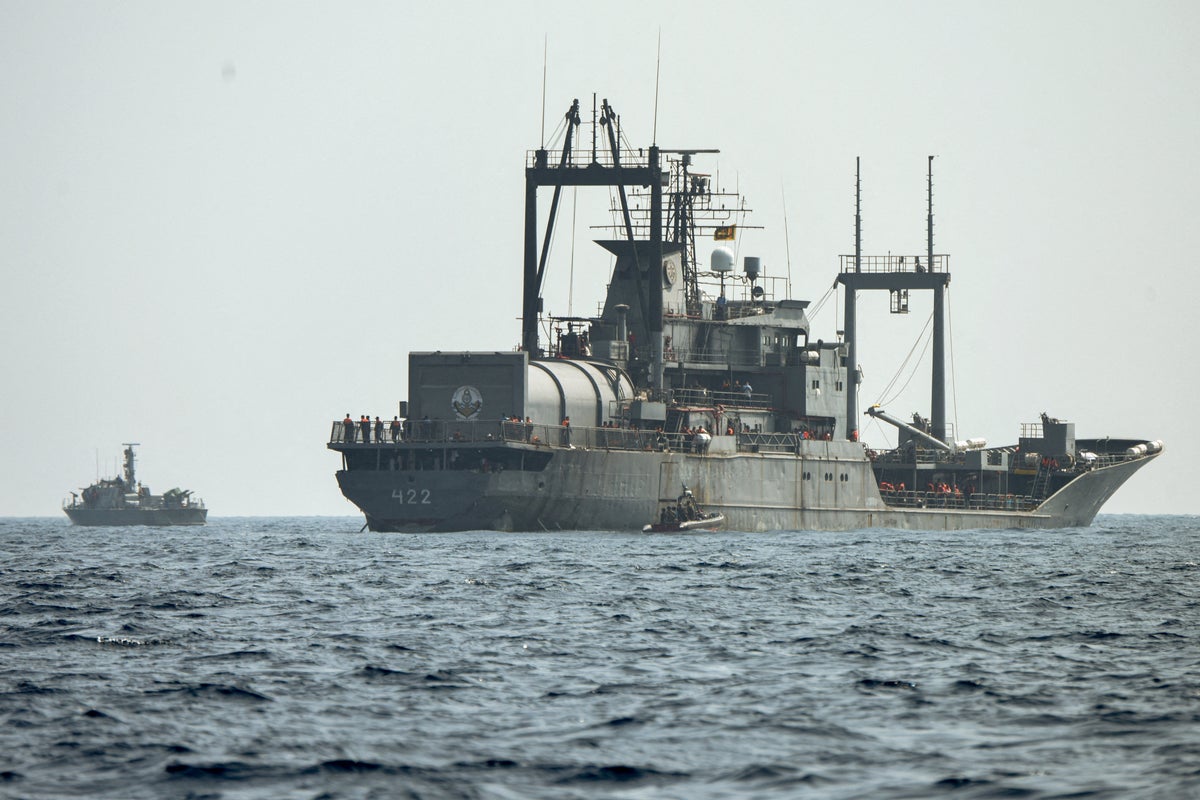
The return of hundreds of Iranian naval personnel from Sri Lanka marks the culmination of a logistics failure and a kinetic escalation that shifts the risk profile of the Indian Ocean. This event is not merely a repatriation of sailors; it is the physical manifestation of a collapsed naval mission and the destruction of a high-value state asset under controversial circumstances. To understand the gravity of the incident, one must look past the surface-level narrative of a routine voyage and analyze the structural vulnerabilities of the Iranian naval doctrine when projected into distant blue-water theaters.
The Triad of Operational Failure
The presence of a significant Iranian naval contingent in Sri Lanka, followed by the reported loss of a warship to a U.S. torpedo, highlights three specific failure points in regional maritime security.
- Force Projection vs. Survivability: The Iranian Navy's attempt to maintain a persistent presence in the Indian Ocean requires a logistics chain that is currently non-existent. When a primary vessel is neutralized, the remaining crew becomes a stranded liability rather than a strategic asset.
- Technological Disparity in Sub-Surface Warfare: The incident underscores a massive gap in acoustic signatures and torpedo defense systems. If a US-manufactured torpedo—likely a Mark 48 ADCAP or similar variant—successfully engaged the vessel, it confirms the Iranian surface fleet's inability to counter modern heavyweight torpedoes (HWT) which utilize advanced sonar and wire-guidance to negate electronic countermeasures.
- Diplomatic Isolation and Sovereign Risk: Sri Lanka’s role as a temporary harbor for the survivors illustrates the precarious balance smaller nations must strike. Providing sanctuary to sailors from a sanctioned nation while navigating the security interests of the U.S. and India creates a friction point that can lead to long-term port-access restrictions for the Iranian fleet.
The Mechanics of Kinetic Engagement
The loss of the vessel can be deconstructed through the lens of a Terminal Engagement Sequence. Standard naval defense involves a layered approach: Electronic Support Measures (ESM) to detect incoming threats, followed by hard-kill or soft-kill countermeasures. The failure to intercept or evade a torpedo suggests a total breakdown in the vessel’s acoustic monitoring suite.
A Mark 48 torpedo operates on a principle of thermal power and high-speed propulsion, achieving speeds exceeding 40 knots. Once the torpedo enters its terminal homing phase, the probability of hit (Pk) for a vessel lacking active sonar decoys or high-agility maneuvers approaches 90%. The structural damage caused by a modern torpedo is rarely the result of a direct hull impact; rather, it is the result of a bubble pulse effect—an under-hull explosion that creates a vacuum, causing the ship's back to break under its own weight. This mechanism explains why "sinking" occurs rapidly, often leaving minimal time for damage control.
Logistic and Repatriation Constraints
The weeks-long delay in the sailors' return to Iran was not a result of bureaucratic lethality but a symptom of Sanctioned Logistics. Iran lacks the airlift capacity and the international overflight permissions required for rapid military extraction.
- Commercial Transport Limitations: Most international carriers refuse to transport active military personnel from a sanctioned navy due to insurance risk and secondary sanctions.
- Sovereign Flight Pathing: Moving 200+ personnel requires dedicated transport aircraft. To fly from Colombo to Tehran, an aircraft must cross Indian or Pakistani airspace. Each crossing requires diplomatic clearance that becomes complicated when the "passengers" are survivors of a kinetic military engagement involving a superpower.
The cost of this delay is measured in more than just dollars; it is measured in the degradation of personnel readiness and the public-facing image of a navy that cannot "retrieve its own."
Geopolitical Friction Points
The Indian Ocean is no longer a passive transit zone. It has become a theater of Active Denial. The U.S. Fifth Fleet and its allies have transitioned from monitoring to proactive disruption of Iranian naval movements that are deemed to threaten freedom of navigation or violate international arms embargoes.
The strategic bottleneck for Iran is the Strait of Hormuz to the Bay of Bengal. By operating near Sri Lanka, Iran attempted to establish a presence outside its immediate sphere of influence. This overextension created a target of opportunity. For the U.S., the engagement serves as a demonstration of "Over-the-Horizon" strike capabilities, proving that they can neutralize Iranian assets without escalating to a full-scale regional war.
Structural Vulnerabilities in Iranian Naval Architecture
Iranian naval vessels, particularly older frigates and converted merchant ships, suffer from Internal Compartmentalization Deficiency. Modern warships are designed with redundant systems and blast-resistant bulkheads to survive a single hit and remain buoyant. Iranian designs often prioritize missile-launching capacity over hull integrity.
This creates a "Glass Cannon" profile:
- High Offense: Capable of firing anti-ship cruise missiles (ASCMs).
- Low Resilience: Entire internal systems (power, propulsion, steering) are localized, meaning a single hit to the midsection or stern results in a total loss of power (Dead in the Water).
The loss of the ship and the subsequent stranding of the crew in Sri Lanka suggests the vessel lacked the basic damage control infrastructure to remain afloat long enough to be towed to a friendly port.
Quantifying the Economic Impact
The sinking of a single frigate or corvette represents a loss of capital that Iran cannot easily replace. Under the current domestic economic pressure and international sanctions, the Replacement Cost Function is non-linear. Iran cannot simply buy a new hull on the open market; it must rely on domestic shipyards that are plagued by supply chain interruptions for high-grade steel and advanced electronics.
Furthermore, the loss of experienced sailors or their prolonged absence from the force creates a Human Capital Void. It takes years to train specialized technicians for sonar, engine maintenance, and weapons systems. Having a large portion of a specialized crew sidelined in a foreign country for weeks creates a ripple effect of unreadiness across the rest of the fleet.
Strategic Realignment and the Indo-Pacific Pivot
As the U.S. pivots toward the Indo-Pacific to counter Chinese expansion, it is simultaneously tightening the perimeter around Iranian maritime activity. This incident is a signal to regional players—specifically Sri Lanka, the Maldives, and Mauritius—that hosting Iranian naval assets carries a high risk of being caught in the crossfire.
Sri Lanka, currently navigating a delicate debt restructuring process involving Western creditors and the IMF, cannot afford to be seen as a safe haven for Iranian military operations. This creates a Diplomatic Barrier to Entry for Iran, effectively shrinking the number of friendly ports in the Indian Ocean where its ships can refuel or seek repairs.
Tactical Assessment of the Engagement
The report of a torpedo strike, if confirmed, marks a significant departure from the "shadow war" of limpet mines and drone strikes. A torpedo engagement is an overt act of war. The fact that this occurred without triggering a broader conflict suggests a tacit understanding of the Rules of Engagement (ROE) in the deep ocean.
The U.S. likely justified the action under "Anticipatory Self-Defense" or the enforcement of maritime security protocols. From a tactical standpoint, using a submarine-launched torpedo offers the advantage of Attribution Ambiguity in the immediate aftermath, although the technical signature of the weapon eventually reveals the source.
The strategic play for the Iranian Ministry of Defense is now forced into a binary: retreat to a littoral defense strategy (focusing on the Persian Gulf and Gulf of Oman) or invest heavily in a "Ghost Fleet" of civilian-flagged vessels to mask military movements. Given the catastrophic loss of the warship and the logistical nightmare of the Sri Lankan repatriation, the Iranian Navy must either secure a permanent basing agreement with a regional partner or accept that any blue-water deployment into the Indian Ocean is a one-way mission. Expect an immediate surge in Iranian domestic propaganda focusing on the "heroic return" of the sailors to mask the reality that their primary vessel sits on the ocean floor, proving that in the modern maritime theater, presence without protection is merely a liability.