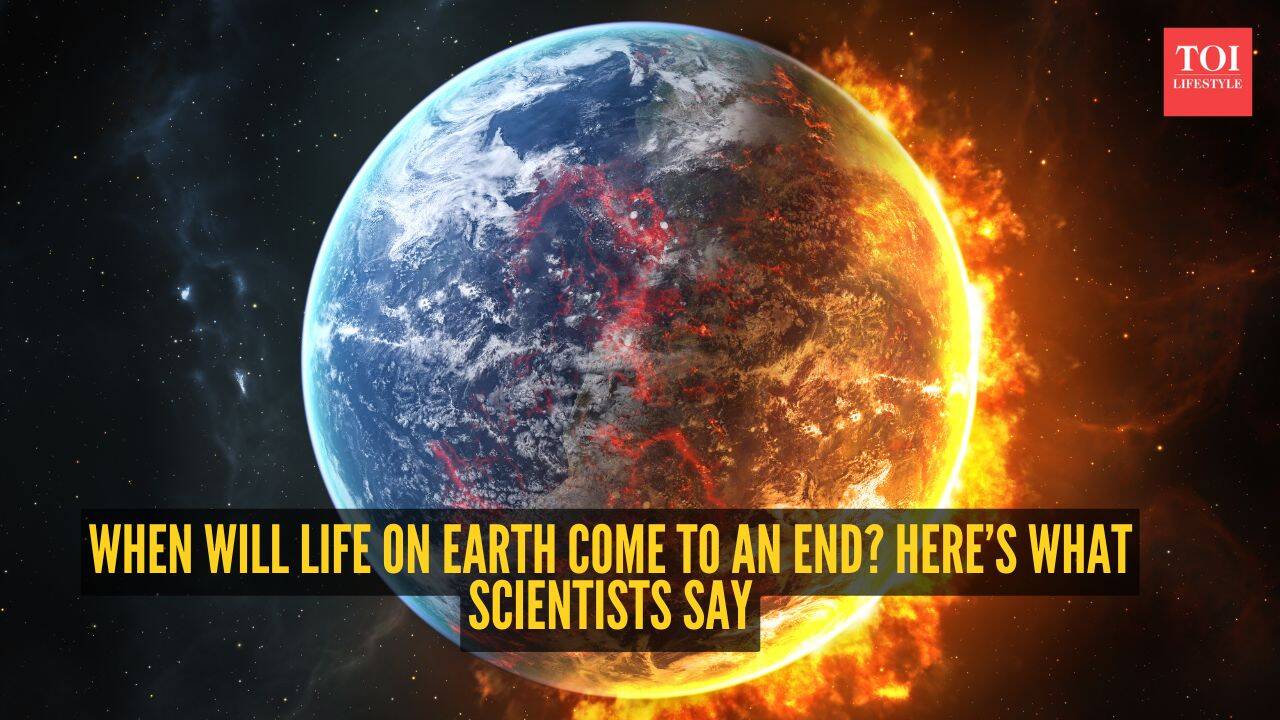
Clickbait headlines recently flared across the internet claiming that scientists have finally pinned down a single, definitive "doomsday date" for life on Earth. It makes for terrifyingly effective copy. It conjures images of a sudden, cinematic cataclysm—an asteroid strike, a rogue star, or a sudden thermal flash that wipes the slate clean on a Tuesday afternoon.
The reality uncovered by deep astrobiological modeling is far more unsettling. Life on Earth will not end with a sudden bang, but with a multi-million-year whimper driven by a inescapable drop in atmospheric carbon dioxide that will starve global plant life. According to current geophysical simulations, this terminal decline will cross its first irreversible threshold roughly 500 million to 1 billion years from now, ultimately rendering the planet an arid, microbial wasteland long before the sun physically engulfs it.
To understand the true timeline of Earth's demise, we have to look past popular apocalyptic tropes and examine the precise, merciless feedback loops governing our planet's habitability.
The Solar Engine and the Carbon Trap
The ultimate clock ticking in the background of our existence is the life cycle of our sun. As a main-sequence star ages, it fuses hydrogen into helium within its core. This process increases the core's density and temperature, causing the sun to brighten by roughly 10 percent every billion years.
This gradual increase in solar luminosity sounds benign. It is not. More solar energy hitting the Earth accelerates the planetary thermostat known as the silicate weathering feedback loop.
When solar radiation increases, global temperatures rise, increasing evaporation and rainfall. This excess rain, saturated with atmospheric carbon dioxide, reacts more rapidly with silicate rocks on the surface. The chemical reaction converts gaseous carbon dioxide into bicarbonate ions, which wash into the oceans and eventually lock away into sedimentary rock like limestone.
This is Earth's natural cooling mechanism. For billions of years, it has saved us. By stripping carbon dioxide out of the atmosphere as the sun grew hotter, the planet managed to maintain a relatively stable surface temperature capable of supporting liquid water.
But this thermostat has a fatal flaw. The sun keeps getting hotter, meaning the system must continually strip away more carbon dioxide to keep the planet cool. Eventually, the atmospheric reservoir runs dry.
The C3 Plant Bottleneck
We are already living in a carbon-depleted era compared to the deep geological past. Millions of years ago, carbon dioxide levels soared in thousands of parts per million. Today, even with human industrial emissions factored in, we measure background atmospheric carbon dioxide in hundreds of parts per million.
Astrophysicists modeling the long-term future of the biosphere point to a critical tipping point. When solar luminosity forces atmospheric carbon dioxide levels below roughly 150 parts per million, the primary mechanism of global primary production collapses.
This is the threshold for C3 photosynthesis. Roughly 85 percent of all plant species on Earth—including trees, rice, wheat, and soybeans—rely on this specific metabolic pathway to fix carbon into sugars. Below 150 parts per million, these plants can no longer photosynthesize. They starve.
A few resilient species will survive the initial drop. Plants utilizing the C4 photosynthetic pathway, such as corn, sugar cane, and certain grasses, can operate at much lower carbon concentrations, down to roughly 10 parts per million. But they are merely delaying the inevitable. Within a few hundred million years of the C3 collapse, C4 plants will also succumb as the weathering loop continues to strip carbon away to maintain thermal equilibrium.
The collapse of the plant kingdom triggers a rapid, cascading extinction event up the food chain. Herbivores vanish first. Carnivores follow. The complex, multicellular ecosystems that have defined the Phanerozoic Eon will fracture entirely, leaving behind a world dominated by detritivores and tough, subterranean organisms.
The Moist Greenhouse Shift
Many popular articles stop here, assuming the loss of plant life is the final chapter. It is only the halfway mark. The death of the biosphere fundamentally alters the planetary water cycle.
Without plants transpirating moisture into the atmosphere and stabilizing soils, the global weather architecture breaks. As the sun continues its inexorable brightening, surface temperatures will climb past 50 degrees Celsius (122 degrees Fahrenheit). At this stage, the Earth enters what atmospheric scientists call a moist greenhouse state.
In our current atmosphere, water vapor is confined mostly to the troposphere, the lowest layer of the atmosphere. The cold temperatures of the stratosphere act as a trap, condensing water vapor and freezing it back down to the surface. But as the planet heats up drastically, the troposphere expands, and the stratosphere warms.
Water vapor begins to flood the upper atmosphere.
Once water vapor reaches the stratosphere, it is exposed to intense, unfiltered ultraviolet radiation from the sun. This triggers photolysis, a process where UV photons violently split water molecules ($H_2O$) into hydrogen and oxygen atoms. The lightweight hydrogen escapes Earth's gravity entirely and bleeds off into space. The planet is slowly, irreversibly leaking its oceans into the vacuum of the cosmos.
The Blind Spots in the Models
It is tempting to look at these calculations and treat them as an absolute timeline. But an honest investigative look at geophysical modeling requires acknowledging the variables that scientists are still actively debating. Planetary evolution is rarely perfectly linear.
The Role of Plate Tectonics
The silicate weathering loop relies entirely on plate tectonics to push buried carbon back into the atmosphere via volcanic activity. If Earth's mantle cools faster than anticipated, tectonic activity could stall early. Without volcanism to replenish carbon, the photosynthetic bottleneck could arrive hundreds of millions of years ahead of schedule. Conversely, if tectonic activity persists longer, it might buffer the atmosphere against rapid carbon drawdown.
Microbial Adaptation
Geological history proves that life adapts to extreme stress in ways that mathematical models fail to predict. While complex multicellular life is exceptionally fragile, microbial communities have spent billions of years thriving in subterranean hyper-environments. Endoliths—microbes living kilometers deep inside solid rock—will likely endure for billions of years after the surface becomes a sterile desert. They require only trace moisture and chemical energy from mineral decay to survive.
The Final Evolutionary Reset
The closing chapter of Earth's habitability is a complete inversion of its beginning. The planet will revert to a purely microbial world, a lonely sphere of unicellular survivors clinging to deep crustal rifts and high-altitude brines.
Eventually, even this subterranean refuge will fail. Roughly 2 to 3 billion years from now, the oceans will have completely bled out into space via photolysis. The planet's core will cool, its protective magnetic field will decay, and the solar wind will strip away whatever residual atmosphere remains. Earth will spin as a dry, sterilized rock, completely indifferent to the complex civilization that once mapped its doom.
This long-term planetary forecast reframes our entire understanding of existential risk. The immediate threats we face as a species—climate volatility, nuclear proliferation, ecological collapse—are severe, but they are localized speed bumps on a track that has a firm, cosmic end date. The real lesson of deep-time astrobiology is that habitability is a temporary anomaly, a brief cosmic window that demands we either learn to navigate beyond our home world or accept an inevitable return to the dust.