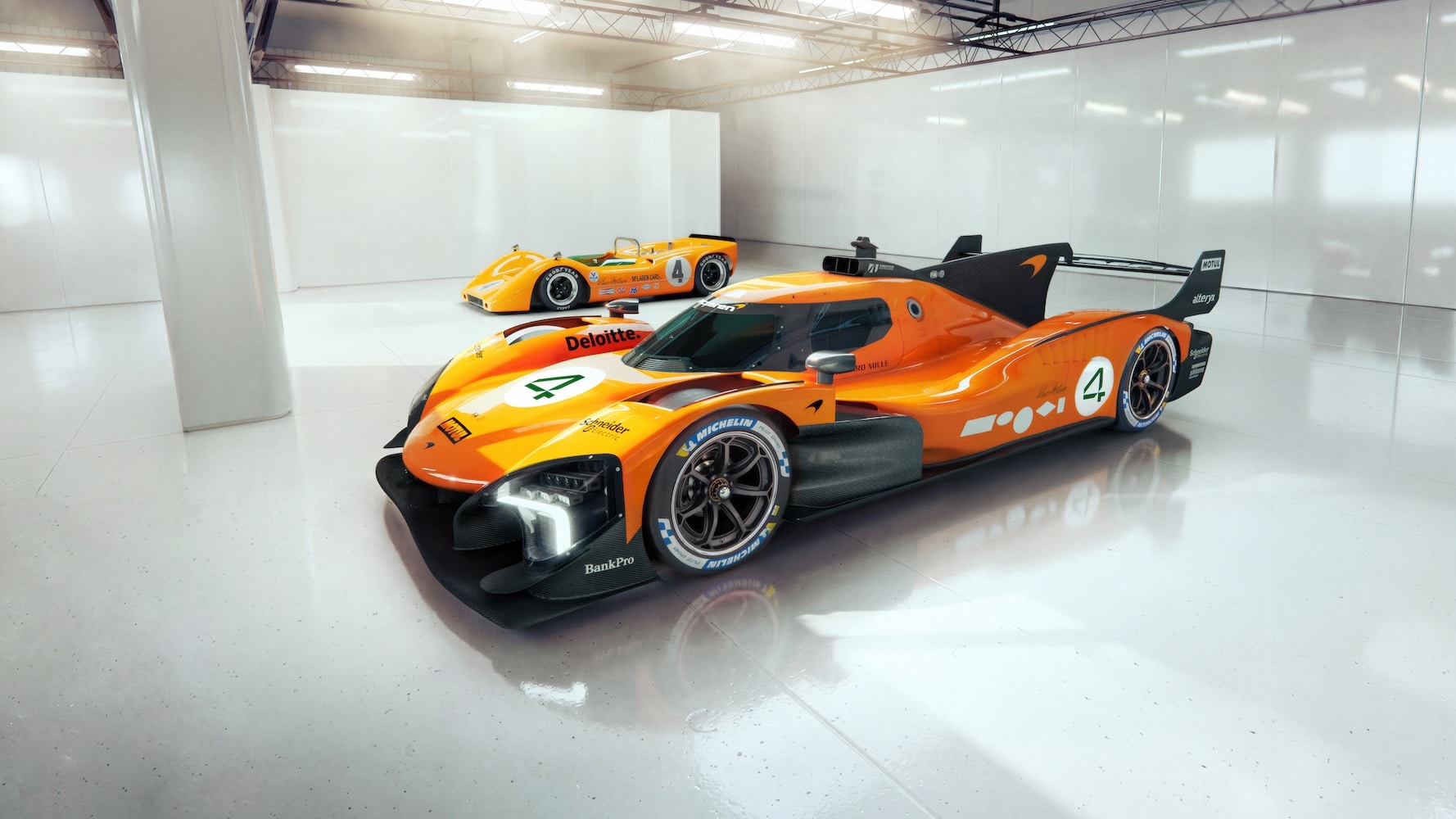
McLaren just signaled the end of its own era, and the world is clapping because the car looks fast.
The MCL-HY is being heralded as a triumphant return to Le Mans and the final piece of the Triple Crown puzzle. It is being sold as a pinnacle of engineering. In reality, it is a desperate pivot. While the press releases scream about "unrivaled performance" and "track-only purity," the engineering tells a story of a brand that has lost its internal compass.
We are witnessing the "Goldilocks Trap" of automotive design. McLaren is trying to build a car that is too heavy to be a true prototype, too restricted to be a Formula 1 car, and too expensive to be a sustainable racing platform.
The Hybrid Weight Lie
The industry is obsessed with total system output. "Over 1,000 horsepower!" the headlines shout. They conveniently forget to mention the anchor dragging behind the rear axle.
In the world of high-performance physics, mass is the only variable that cannot be cheated. You can add active aero. You can add torque vectoring. You can add carbon-ceramic brakes that cost as much as a family sedan. None of it changes the fact that batteries are heavy, inert, and a nightmare for weight distribution in a mid-engine layout.
When McLaren built the F1 in the nineties, Gordon Murray’s obsession with weight was pathological. The F1 weighed roughly 1,138 kg. Modern "hypercars" are ballooning toward 1,500 kg and beyond. By choosing a complex hybrid layout for the MCL-HY, McLaren isn't pushing the envelope; they are following the herd into a cul-de-sac of diminishing returns.
They claim the electric torque "fills the gaps" in the power band. I’ve spent enough time around track-side telemetry to know what that actually means: the internal combustion engine (ICE) isn't efficient enough on its own, so they’re using electrification as a digital Band-Aid for mechanical inadequacy. A lighter, pure-ICE car with 200 fewer horsepower would likely hunt this thing down in the corners of Circuit de la Sarthe.
Le Mans Is No Longer About Speed
The "return to Le Mans" narrative is the most cynical part of this rollout. The current Hypercar (LMH) and LMDh regulations are built on a foundation of Balance of Performance (BoP).
For the uninitiated: BoP is a socialist leveling of the playing field. If your car is too fast, the regulators give you a weight penalty or cut your power. If your aero is too efficient, they force you to change it.
McLaren isn't entering a race of engineering brilliance. They are entering a race of political negotiation. To frame the MCL-HY as a "technological breakthrough" is a fundamental misunderstanding of modern endurance racing. You don't win Le Mans by being the smartest engineer in the room anymore; you win by building a car that fits perfectly into the regulatory window without triggering a penalty.
The MCL-HY is a car designed by a committee to satisfy a rulebook, not a car designed by a visionary to break records. Calling it a "hypercar" is an insult to the machines that actually changed the world.
The Triple Crown Is Marketing Fluff
The Triple Crown—winning the Monaco Grand Prix, the Indy 500, and the 24 Hours of Le Mans—is a relic of a time when drivers were daredevils who hopped between chassis like they were changing shirts.
McLaren loves to talk about their heritage because their current balance sheet is a minefield. They are leaning on the achievements of Graham Hill and their 1995 win to distract you from the fact that their road car division has been struggling with reliability issues and ownership shifts for years.
Winning Le Mans with a factory-backed hybrid in 2026 is not the same as winning it in 1995 with a modified road car against purpose-built prototypes. The MCL-HY is a specialized tool built for a specific, sanitized environment. It has no soul because it has no risk.
The Downside of "Track-Only"
Why is the MCL-HY track-only? Because making it road-legal would expose the compromise.
If you put this car on the street, the cooling requirements for the hybrid system would necessitate massive, ugly radiators that ruin the drag coefficient. The ride height required to clear a speed bump would destroy the underbody ground effect. By keeping it "track-only," McLaren gets to hide behind a veil of "purity" while avoiding the grueling reality of homologation.
It is a toy for billionaires who want to feel like Lando Norris without the actual talent or the physical G-force tolerance.
The Missing Nuance: Software vs. Hardware
The real fight in the hypercar space isn't about carbon fiber or displacement. It’s about the silicon.
The MCL-HY’s greatest weakness isn't its engine; it’s its software architecture. I’ve seen manufacturers dump nine figures into vehicle dynamics controllers only to have them "brick" because a sensor in the hybrid harvest system didn't like the ambient humidity.
When you introduce high-voltage systems into a high-vibration racing environment, you aren't just building a car. You are building a rolling computer network. The competitor's article praises the "integration." I call it a single point of failure.
Imagine a scenario where the car is leading by two laps at 3:00 AM. A software glitch in the regenerative braking system miscalculates the state of charge. The car enters "limp mode" to protect the battery. That isn't racing. That’s an IT ticket.
Dismantling the "People Also Ask" Nonsense
Is the MCL-HY the fastest McLaren ever?
Define "fast." Around a short, technical circuit, a 750S might actually give it a run for its money because it isn't fighting the massive weight of a battery pack. On a straight line? Sure, the electric motors will win. But we don't race in straight lines. We race in three dimensions.
Why did McLaren choose a hybrid?
Because the investors demanded it. Hybrids are the "safe" middle ground between the internal combustion past and the electric future. It’s a hedge. And hedges rarely result in legendary automobiles.
Can it win the Triple Crown?
McLaren as an entity might claim the Triple Crown, but this car is just a piece of hardware. It’s the equivalent of a golfer buying an expensive new driver and claiming they’ve won the Masters.
The Engineering Dead End
The MCL-HY uses a mid-engine configuration that is becoming increasingly obsolete in the face of front-motor torque vectoring. By sticking to the traditional layout, McLaren is playing it safe.
If they actually wanted to disrupt the industry, they would have looked at solid-state battery technology or hydrogen-combustion experiments. Instead, they took the existing Formula 1 power unit philosophy and diluted it for a larger, heavier chassis.
The Brutal Truth
The MCL-HY is a beautiful piece of jewelry. It will look fantastic in a climate-controlled garage in Dubai. It will sound decent on a YouTube vlog.
But as a "hypercar"? It fails the primary test. A hypercar should redefine what is possible. It should make the previous generation look like farm equipment. The MCL-HY just makes the previous generation look simpler, lighter, and more honest.
McLaren is no longer the scrappy underdog out-engineering the giants. They have become the giant, bloated by marketing requirements and the need to please a diverse set of shareholders who care more about "brand equity" than lap times.
Stop pretending this is a revolution. It’s a brochure.
Go buy a T.50 if you want a driver's car. Go watch Formula 1 if you want to see actual hybrid development. But don't look at the MCL-HY and think you're seeing the peak of automotive progress. You're seeing the expensive gasp of a formula that has run out of ideas.
Build something lighter or don't build it at all.


