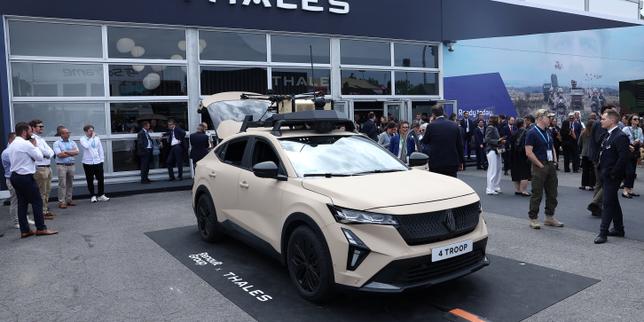
The partnership between Thales and Renault to manufacture the Toutatis military drone represents a fundamental shift in defense procurement, moving away from boutique, low-volume military production toward high-rate automotive manufacturing. Historically, the defense aerospace sector has operated under a low-volume, high-margin paradigm characterized by long development cycles and bespoke engineering. By contrast, the automotive industry optimizes for high-volume, low-margin, and highly integrated supply chains. The convergence of these two distinct industrial philosophies in the Toutatis program addresses a critical vulnerability in modern warfare: the inability of the traditional defense industrial base to rapidly scale the production of cheap, expendable unmanned aerial vehicles (UAVs).
Analyzing this alliance requires moving past superficial corporate rhetoric about cooperation. Instead, the venture must be evaluated through the lens of industrial bottlenecks, technological transfer, and capital efficiency.
The Dual-Engine Industrial Architecture
The Toutatis program splits its operational and manufacturing responsibilities along a clear line of competency. This division addresses the "high-mix, low-volume" limitation of traditional defense contractors by pairing them with the "low-mix, high-volume" capability of a mass-market automaker.
The Aerospace Core: Sensor Integration and Electronic Warfare Resilience
Thales commands the payload, communication, and software architecture. In modern electronic warfare environments, a military drone is only as viable as its resistance to GPS jamming and radio frequency spoofing. Thales contributes three non-negotiable variables to the Toutatis platform:
- Secure Data Links: Implementation of encrypted, frequency-hopping communication channels that prevent interception and overriding by adversarial electronic warfare units.
- Optronics and Sensor Fusion: The integration of lightweight, high-definition infrared and optical sensors capable of processing target data at the edge, reducing the bandwidth required to transmit telemetry back to the operator.
- Algorithmic Autonomy: Flight control software that allows the drone to navigate via optical terrain matching when GPS signals are completely degraded.
The Automotive Core: Bill of Materials Optimization and Geometric Scaling
Renault assumes responsibility for the structural cell, propulsion integration, and mass-assembly logistics. The primary constraint on military drone deployment is the cost-to-attrition ratio. If a drone costs $100,000 to produce, using it to destroy a $50,000 target is economically unsustainable. Renault's contribution focuses on driving the unit manufacturing cost down through specific automotive mechanisms:
- Stamped and Injection-Molded Components: Replacing expensive carbon-fiber composites with advanced polymers or stamped aluminum alloys that can be produced in seconds rather than hours.
- Supply Chain Cross-Pollination: Utilizing existing automotive tier-1 and tier-2 suppliers for electric motors, wiring harnesses, and battery cells, drastically lowering the component-level Bill of Materials (BOM).
- Design for Manufacture (DFM): Re-engineering the drone's chassis to fit within standard automotive assembly line steps, allowing robot-arm riveters and automated guided vehicles (AGVs) to handle the chassis precisely like a vehicle sub-frame.
The Cost Function of Attrition Warfare
To understand why this alliance is a strategic necessity, one must calculate the economic reality of modern battlefield attrition. Traditional defense procurement treats drones as miniaturized fighter jets. The Toutatis project treats the drone as a smart munition with an extended loitering time.
The economic viability of the Toutatis platform is governed by a strict equation: Total System Value must be significantly less than the Cost of Interception. If an adversary must expend a $1 million surface-to-air missile to down a Toutatis drone that costs $15,000 to manufacture, the economic asymmetry favors the operator.
Achieving this $15,000 target threshold is impossible within a standard defense facility. A defense aerospace plant features high overhead, specialized labor, and rigorous, slow quality-assurance cycles. An automotive assembly line amortizes its fixed costs over millions of units. By shifting the structural and mechanical assembly of Toutatis to a Renault-managed or inspired facility, the fixed cost per unit drops exponentially as cumulative production volume scales.
The technical bottleneck shifts from manufacturing the airframe to scaling the calibration of the sensor suites. While a robot can weld a chassis in minutes, calibrating an optical sensor for military-grade targeting requires specialized testing environments. The success of the Toutatis program depends on whether Thales can modularize its electronics into a "plug-and-play" cartridge that requires zero calibration on the Renault assembly line.
Technological Barriers and Operational Trade-Offs
This industrial cross-breeding introduces severe engineering compromises that both companies must navigate. Military hardware must withstand extreme environmental conditions, ranging from -40°C to 60°C, alongside intense vibration and electromagnetic interference (EMI). Automotive components are rugged, but they are not built to military specifications (Mil-Spec).
The first engineering friction point lies in component validation. Automotive electronics are rated for long lifespans (typically 10 to 15 years) under predictable stress profiles. Military drones require short lifespans (often measured in hours of flight time) but under extreme stress profiles. Renault and Thales must deliberately downgrade certain longevity requirements to achieve cost targets, accepting higher failure rates in storage in exchange for immediate manufacturing speed.
The second limitation is battery energy density. Electric automotive drivetrains prioritize cell longevity and thermal stability over raw weight reduction. A military loitering munition requires the absolute maximum energy density possible to extend its operational radius. If Renault uses standard automotive lithium-ion chemistries, the Toutatis drone will suffer from reduced flight times. If they adopt specialized, high-density pouch cells, they lose the cost benefits of the automotive supply chain.
The final bottleneck is regulatory and export control. Automotive components move freely across borders via global logistics networks. Military hardware is subject to strict International Traffic in Arms Regulations (ITAR) and European equivalents. By embedding Renault's commercial supply chain into a military drone, the alliance risks exposing commercial suppliers to severe defense export restrictions, potentially disrupting Renault's core automotive business operations if not strictly segregated.
Strategic Deployment Blueprint
For the Toutatis platform to achieve its stated objective of rearming European forces with mass-produced aerial systems, the venture must execute a three-stage operational rollout that isolates the commercial automotive business from defense liabilities while maximizing manufacturing throughput.
First, establish a dedicated, ring-fenced manufacturing facility separate from consumer vehicle lines, but entirely designed using Renault’s lean manufacturing architecture. This facility must utilize automated assembly lines fed by dual-use automotive suppliers who provide unclassified mechanical components (motors, bearings, structural stampings).
Second, Thales must decouple the electronic warfare and guidance software from the hardware assembly layer. The drone should be built as an inert mechanical shell at the primary facility, with the sensitive guidance, encryption, and targeting modules inserted as a final, modular sub-assembly at a secure, military-certified Thales site. This completely bypasses the security risks inherent in a high-volume manufacturing environment.
Third, the platform must standardize on an open-architecture payload bay. Warfare evolves faster than manufacturing lines can be re-tooled. By ensuring the Toutatis drone features a standardized physical and digital interface, field units can swap out sensors, cameras, or explosive payloads without requiring a redesign of the automotive-produced chassis. The chassis remains constant; the capability changes via modular updates.
The long-term trajectory of defense procurement belongs to the player who can manufacture attrition-ready systems at industrial scale. The Thales-Renault alliance will either prove that mass-market automotive engineering can out-produce traditional defense monopolies, or it will serve as a case study on how regulatory friction and incompatible engineering cultures can stall cross-industry innovation. The outcome hinges entirely on the rigid separation of complex software modules from high-rate mechanical assembly.