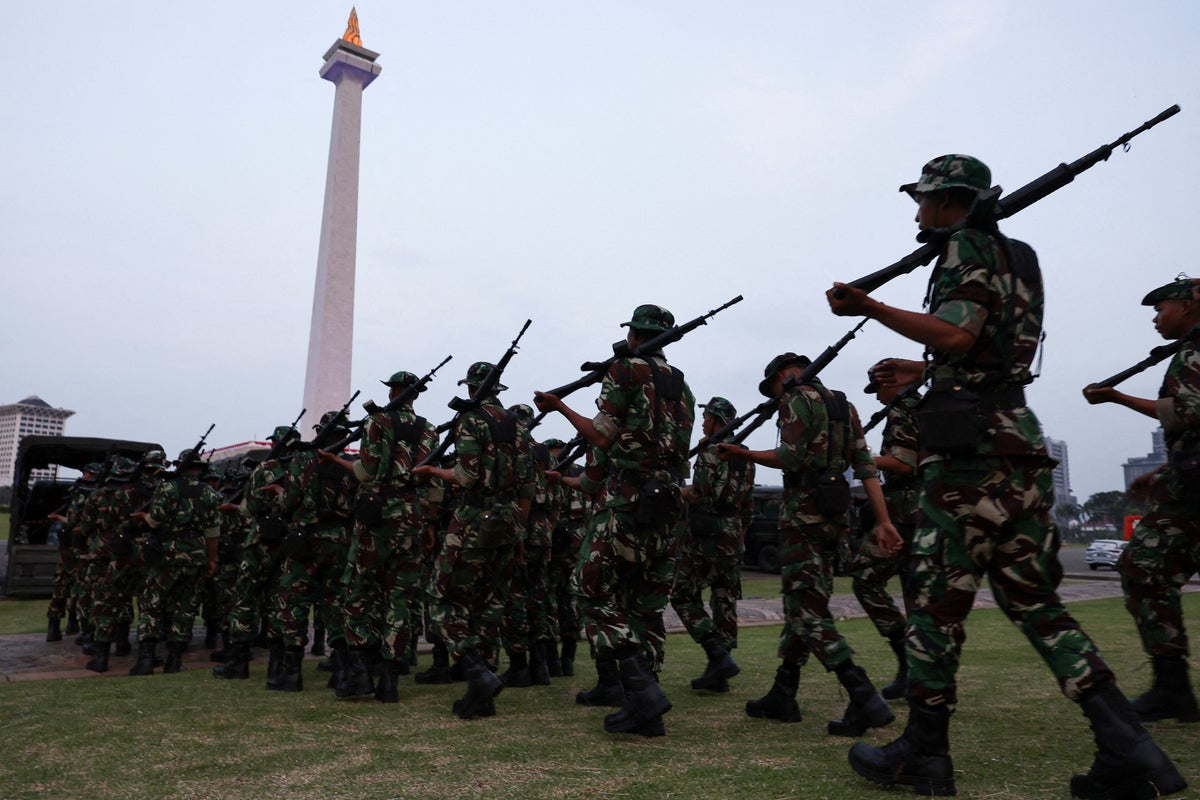
The recent escalation of civil-military friction in Indonesia represents a systemic breakdown of the post-Reformasi security consensus. While media accounts focus on the visceral nature of the street violence, the underlying driver is a fundamental dispute over the Monopoly on Legitimate Force in regions where military presence intersects with resource extraction and historical autonomy movements. This conflict is not a spontaneous eruption of anger; it is the manifestation of a structural bottleneck in the Indonesian state’s transition from a "dual-function" military (Dwi Fungsi) toward a modern, civilian-led security architecture.
The Three Pillars of the Military-Civilian Impasse
The demand for military withdrawal is rarely a singular policy goal. Instead, it serves as a proxy for three distinct friction points that define the current crisis.
- The Territorial Command Structure (KODAM) Paradox: Indonesia’s military retains a parallel administrative structure that mirrors civilian government down to the village level. This creates a redundant oversight mechanism that often competes with local leaders for authority and economic influence.
- Resource Securitization: In provinces like West Papua or parts of Sumatra, the military provides "Vital Object Protection." When state or private corporations operate in contested areas, the military acts as the primary security guarantor. Protesters view this not as protection, but as the enforcement of corporate interests at the expense of local land rights.
- Historical Accountability Deficits: The refusal to withdraw is interpreted by civil society as a strategy to maintain legal immunity. As long as military personnel remain the primary law enforcement presence in a region, they are subject to military tribunals rather than civilian courts, creating a perceived barrier to justice for alleged human rights violations.
The Cost Function of Kinetic Engagement
The decision-making process for both the Indonesian state and the protest organizers can be analyzed through a cost-benefit framework. When the state deploys kinetic force to disperse hundreds of protesters, it incurs several tiers of "soft" and "hard" costs.
Operational Hard Costs
The mobilization of police (Polri) and military (TNI) units involves significant logistical expenditure, including transport, riot gear, and the deployment of armored water cannons. However, the more significant hard cost is the disruption of local economic activity. Protests centered in urban hubs or near mining facilities create a direct negative delta in regional GDP for the duration of the unrest.
Institutional Soft Costs
Each violent clash erodes the "Democratic Legitimacy Capital" that Indonesia has built since 1998. This erosion has tangible impacts on foreign direct investment (FDI), as international firms often include "Political Stability" and "Human Rights Compliance" in their risk-weighting models. A sustained military presence that leads to frequent clashes effectively raises the "Country Risk Premium," making capital more expensive for Indonesian enterprises.
Bottlenecks in Policy Reform
The reason a withdrawal has not been negotiated is due to a series of strategic bottlenecks within the central government’s security apparatus.
The Security-Development Nexus
The current administration operates under the logic that security is a prerequisite for development. In this view, military presence is the "floor" upon which infrastructure (roads, bridges, schools) can be built. Protesters argue for the inverse: that development without local consent necessitates a military presence to quell the inevitable resistance. This creates a circular dependency where the military cannot leave because the area is unstable, but the area remains unstable because the military is present.
Information Asymmetry and Escalation
Conflict in Indonesia is often exacerbated by "Signal Distortion." Local commanders may over-report the threat of "Separatism" to justify increased budget allocations or troop surges. Conversely, protest leaders may under-report the presence of radical elements within their ranks to maintain the "Peaceful Civil Society" narrative. This asymmetry makes it nearly impossible for Jakarta to calibrate a proportional response, leading to the "Over-Correction" seen in the recent violent dispersals.
Structural Variables of Modern Indonesian Protests
To understand why these clashes reached a tipping point, one must look at the variables of mobilization. Unlike previous decades, the current movement utilizes decentralized digital coordination.
- Network Effects: The speed at which a local grievance in a remote province scales into a multi-city protest is now measured in hours. This compresses the government’s "Reaction Window."
- Narrative Ownership: In the past, the state controlled the narrative through state-run media. Today, real-time video feeds of clashes bypass state censors, creating an immediate international "Shaming Loop."
- The Youth Bulge: A significant demographic of protesters consists of post-Suharto youth who have no memory of the New Order's total military control. Their "Risk Tolerance" is higher because they view democratic norms as a baseline right, not a hard-won privilege.
Theoretical Framework of the Withdrawal Demand
The demand for "Military Withdrawal" is often misunderstood by analysts as a request for a total vacuum of security. From a structural perspective, it is actually a demand for Security Sector Reform (SSR). This involves three specific transitions:
- Functional Differentiation: Clearly defining that the TNI (Military) handles external defense while the Polri (Police) handles internal security. The "clashes" occur because this line is perpetually blurred, with soldiers often performing roles traditionally reserved for riot police.
- Judicial Integration: Moving toward a system where military personnel are accountable to civilian law for non-combat offenses.
- Fiscal Transparency: Ending the "Off-Budget" financing of military units through local business partnerships, which incentivizes units to remain in resource-rich areas.
The Escalation Ladder
The progression from peaceful assembly to violent clash follows a predictable kinetic ladder.
- Stage 1: Symbolic Occupation: Protesters gather at a site of power (e.g., a Governor’s office or a military base).
- Stage 2: Perimeter Contestation: Security forces attempt to establish a "No-Go Zone." The physical contact at this boundary is the primary catalyst for escalation.
- Stage 3: Projectile Exchange: The use of tear gas by security forces is met with the use of stones or molotovs by protesters.
- Stage 4: Kinetic Dispersion: The military/police move to "clear" the area, leading to the injuries and arrests reported in the media.
This ladder is often climbed not by design, but by the "Panic Threshold" of low-level officers on the ground who are poorly trained in non-lethal de-escalation.
Strategic Pivot: Decoupling Security from Presence
To resolve the impasse, the Indonesian state must pivot from a "Presence-Based" security model to an "Intelligence-Lead" model. A massive physical footprint in contested provinces creates a large target surface for grievance and attack. Reducing the visible footprint while strengthening the underlying rule of law—specifically local judicial systems—would decrease the friction points that trigger these clashes.
The military’s "Dual Function" ghost still haunts the administrative psyche of the nation. The ongoing violence is a symptom of a state that has modernized its economy but has yet to fully modernize its security philosophy. Until the TNI is moved from a "Regional Administrator" to a "Professional Defense Force," the street will remain the primary venue for constitutional negotiation.
The immediate strategic requirement is the establishment of a Tripartite Oversight Committee consisting of civilian government officials, independent human rights observers, and military leadership. This body must have the mandate to audit "Vital Object" security contracts and establish a phased, benchmark-driven drawdown of non-essential personnel in highly contested zones. Success will not be measured by the absence of protests, but by the absence of the military in the response to those protests.