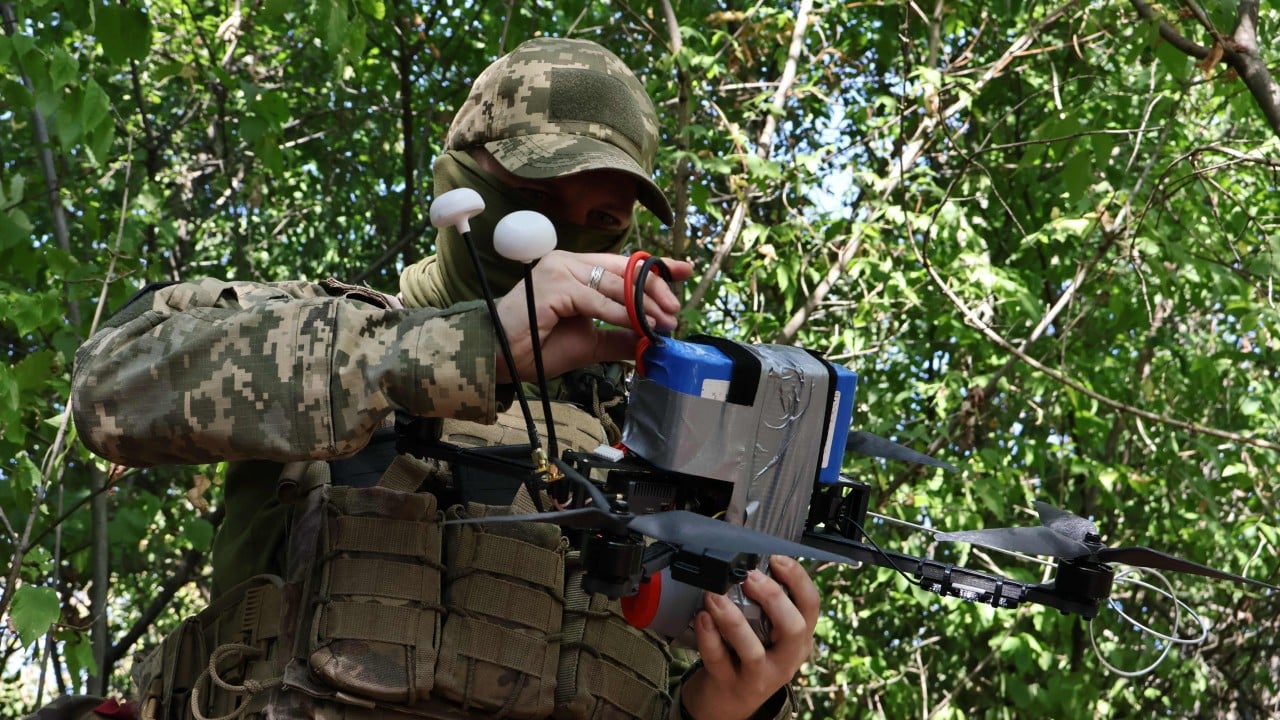
Military organizations do not learn from foreign conflicts at uniform speeds; they ingest tactical data through structurally constrained pipelines. When observing the protracted attrition between Russia and Ukraine, the People Liberation Army does not evaluate isolated hardware specimens. Instead, it measures operational loops, cost asymmetries, and the structural integration of uncrewed systems into existing command architectures. By mapping combat innovations directly against state-owned industrial output and institutional reorganization, Beijing has operationalized a feedback system that compresses years of traditional doctrinal iteration into months. Understanding this velocity requires examining the precise mechanisms by which battlefield telemetry transforms into institutional doctrine.
The foundational driver of this absorption rate is economic asymmetry. Military analysts within state organs do not treat high-volume, low-cost uncrewed aerial systems as disposable tactical additions; they view them as the baseline economic reality of modern force deployment. When state media and military journals document that a reconnaissance-strike loop can achieve high battlefield coverage at a fraction of the cost of a crewed platform, the institutional takeaway is absolute. This creates an economic feedback loop. Because the domestic industrial base already manufactures the vast majority of commercial drone components consumed by both sides of the European conflict, supply chain visibility grants military researchers near-real-time insight into which hardware iterations survive electronic attrition and which fail.
Tactical compression represents the second transmission mechanism. Traditional military doctrine historically required years to bridge the gap between experimental battlefield usage and institutional training manuals. In the context of uncrewed systems, this latency has shrunk significantly. When battlefield conditions introduce innovations such as fiber-optic guided first-person-view drones designed to bypass heavy localized radio frequency jamming, documentation appears within weeks in military publications, followed by specialized unit integration within a year. This compression is maintained by institutional structures like the specialized engineering colleges established within military academies to systematically study tactical shifts without requiring direct combat exposure.
The structural constraint in this feedback loop, however, lies in the friction of simulated validation. While observing electronic warfare degradation, signal interference management, and autonomous swarm coordination allows an external military to rewrite field manuals, it cannot fully replicate the psychological and operational pressure of a contested electromagnetic spectrum under active artillery fire. Consequently, institutional adaptation excels at acquiring hardware solutions and structural organization changes, yet it faces persistent bottlenecks in validating unproven operational concepts under terminal combat stress.
Institutional reorganization follows these technical observations with deliberate speed. The establishment of dedicated uncrewed engineering colleges and specialized operational brigades signals an administrative shift away from legacy army-centric command structures toward multi-domain tactical integration. Rather than treating uncrewed assets as auxiliary reconnaissance tools assigned to upper echelons, current doctrine pushes low-cost strike and sensing capabilities down to basic tactical units. This structural decentralization mirrors the tactical realities observed abroad, where localized autonomy dictates survival.
Defensive adaptation operates under an entirely separate analytical track. While offensive lessons focus on cost-per-strike efficiency and mass deployment, defensive research targets systemic vulnerability, particularly regarding harbor protection, critical infrastructure, and critical maritime chokepoints. Naval research institutes examining uncrewed surface vessel impacts on capital ships conclude that point defense mechanisms optimized for missile interception are structurally inadequate against swarming maritime drones. This has accelerated research into high-energy laser systems, localized capture nets, and automated interceptor swarms designed to operate without human reaction-time latency.
The ultimate test of this military mimetic velocity is not how fast an institution can write about a war, but how rapidly it can alter procurement and training pipelines to neutralize the vulnerabilities exposed within it. By bypassing traditional multi-year procurement cycles and leveraging a dominant commercial manufacturing ecosystem, external observers have constructed a functional framework for rapid tactical ingestion. The strategic consequence is an environment where military hardware and tactical doctrine evolve not through internal trial and error, but through the continuous, automated extraction of combat data from external conflicts.