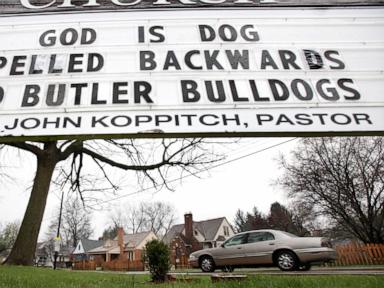
Physical real estate operating at zero marginal distribution cost remains rare in contemporary communication channels. Among the most ubiquitous yet analytically neglected instances of this phenomenon is the exterior church reader board. Positioned along arterial roads, these static letterboards function as low-tech, high-frequency broadcast nodes. While casual observers interpret witty ecclesiastical signage through the lens of folksy charm or accidental viral media fodder, a rigorous structural examination reveals a sophisticated exercise in local attention economics, behavioral signaling, and demographic filtering.
Analyzing the operational efficacy of a church sign requires discarding aesthetic sentimentality and evaluating it purely as an outdoor media asset. Every physical message board operates within strict spatial, temporal, and cognitive constraints. Understanding how institutions attempt to maximize return on attention within these limits exposes the underlying mechanics of modern localized institutional branding.
The Spatial and Temporal Economics of the Reader Board
Outdoor advertising typically commands significant capital expenditure, governed by high CPM metrics and precise audience targeting algorithms. In contrast, the traditional church sign operates on a sunk-cost physical infrastructure with near-zero variable costs per impression. However, this financial efficiency introduces severe operational bottlenecks governed by human transit dynamics.
Vehicle speed dictates the structural design of the message. At an average urban or suburban arterial speed of thirty-five miles per hour, a passing driver possesses a cognitive processing window ranging from 1.5 to 3.2 seconds. Within this tight temporal band, the eye must capture, decode, and comprehend the text while maintaining vehicular safety. Consequently, message architecture cannot afford syntactic complexity.
The physical constraints of the letterboard enforce extreme brevity. Standard boards accommodate between four and six lines, with finite character slots per row. This forces a rigid constraint on information density. The sender must compress complex theological propositions, institutional invitations, or cultural commentary into short-form epigrams.
[Vehicle Velocity: 35 MPH] -> [Cognitive Processing Window: 2.1 Seconds] -> [Character Limit: ~120 Chars] -> [Maximum Retention Threshold]
This structural limitation explains the reliance on punchlines, paradoxes, and wordplay. Humor acts as a cognitive compression algorithm. A well-constructed pun or unexpected juxtaposition accelerates semantic processing, bypassing the brain's standard ad-filtering defenses. The recipient does not merely read the text; they solve a miniature linguistic puzzle. That micro-engagement increases memory encoding, transforming a fleeting peripheral glance into an active cognitive impression.
The Taxonomy of Liturgical Humor
The content deployed on these boards is not randomly generated. Careful observation reveals a structured distribution of rhetorical strategies designed to elicit specific behavioral responses from the local populace. These strategies fall into distinct operational categories.
The Doctrinal Inversion
This approach utilizes theological concepts paired with secular idioms to create cognitive dissonance. By juxtaposing eternal salvation with mundane contemporary annoyances, the message disarms the cynical observer. The intent is to lower institutional defenses by demonstrating self-awareness and linguistic agility.
The Pun-Based Retention Heuristic
Puns represent the highest-frequency output across the medium. While culturally derided as low-form comedy, their structural utility in outdoor signage is unparalleled. Phonetic ambiguity forces the reader to pause momentarily to reconcile two conflicting meanings of a single word. That micro-pause anchors the brand name associated with the physical location in the local mental map.
The Cultural Topicality Play
During high-visibility events, seasonal shifts, or sociopolitical inflection points, signs pivot toward immediate cultural touchstones. This strategy leverages trending external attention pools. By tethering an eternal institution to a transient pop-culture phenomenon, the sign attempts relevance among younger demographic segments who view traditional religious spaces as culturally stagnant.
Each category serves a different position in the institutional acquisition funnel. While doctrinal inversions appeal to seekers already experiencing existential friction, puns maintain baseline local brand awareness, ensuring the institution remains a recognizable fixture in the geographic grid.
Signaling Theory and Institutional Differentiation
In economics and sociology, costly signaling theory dictates that individuals or institutions broadcast attributes through verifiable investments. However, in the realm of localized religious marketing, the church sign functions through low-cost, high-frequency signaling.
Churches operate in saturated markets characterized by high product homogeneity. From a consumer perspective, distinguishing between two Protestant denominations or non-denominational assemblies within a three-mile radius is functionally difficult based solely on structural architecture or operational schedules. The reader board serves as the primary differentiator of organizational personality.
A sign featuring dry theological assertions signals an orthodox, traditionalist, and internally focused institution. Conversely, a sign utilizing self-deprecating humor or pop-culture references signals a progressive, low-hierarchy, and externally facing community posture. The message acts as an ideological filter.
[Sign Content Tone] -> [Perceived Institutional Culture] -> [Demographic Self-Selection]
This filtering mechanism is deliberate. Modern church growth models emphasize cultural alignment over universal appeal. An institution that deploys edgy or humorous messaging is consciously selecting for a specific psychographic profile: individuals who value approachability, informal environments, and contemporary linguistic framing. The sign operates as an active recruitment filter before an individual ever steps foot inside the physical structure.
The Cost Function of Brand Misfire
Despite the low cost of deployment, the downside risk of poorly executed micro messaging is non-trivial. Outdoor communication lacks context, nuance, and the safety of dialogue. When a church sign miscalculates its local audience, the friction can generate immediate reputational degradation.
The primary failure mode is tonal dissonance. Humor relies on shared cultural assumptions. When an institution attempts irony or sarcasm without a precise understanding of its surrounding community demographics, the message is frequently misinterpreted as condescension, political belligerence, or exclusionary gatekeeping.
A secondary risk involves ideological alienation of existing congregants. While external acquisition is the primary objective of roadside visibility, internal retention remains the baseline requirement for organizational stability. A sign that prioritizes shock value or hyper-trendy references can alienate legacy members who view the physical property as a sanctuary from secular culture rather than an extension of it.
Furthermore, the permanence of physical plastic letters creates an execution hazard. Unlike digital ads that can be modified instantly based on real-time sentiment analysis, a physical letterboard requires manual labor to update. A message that seemed clever on Tuesday morning can become tone-deaf or offensive by Wednesday evening due to breaking external news cycles, leaving the institution visually locked into an embarrassing communicative posture for days.
The Local Conversion Funnel
Evaluating the success of a church sign requires mapping the conversion path from passive exposure to active participation. The funnel differs radically from digital acquisition channels.
- Impression Phase: The commuter registers the text within the two-second temporal window. No active data capture occurs; the metric is purely unverified visual retention.
- Resonance Phase: The message triggers an emotional response, typically amusement, mild annoyance, or intellectual curiosity.
- Attribution Phase: The observer links the clever phrase to the physical plant and, by extension, the brand name of the institution.
- Validation Phase: Over multiple repetitions, the cumulative impressions lower the perceived social barrier of entry. The church transforms from an anonymous architectural obstacle into a familiar neighborhood landmark.
- Conversion Phase: During a moment of personal or existential transition, the accumulated goodwill and perceived approachability tip the decision matrix, resulting in physical attendance.
Traditional marketing analytics cannot accurately measure this progression. The feedback loop is measured in months or years, relying entirely on qualitative self-reporting by new attendees who cite the roadside signage as a contributing factor to their initial engagement.
Operational Execution Protocol for Roadside Messaging
Maximize outdoor board engagement velocity by enforcing strict design constraints and eliminating low-yield messaging tropes.
- Limit character density: Never exceed ten words per message face. Readability at speed supersedes clever narrative complexity.
- Audit local sentiment cadence: Align messaging tone with the psychological state of passing traffic during peak transit windows. Monday morning commuters require a different rhetorical approach than Friday afternoon traffic.
- Eliminate insider jargon: Purge theological shorthand that requires specialized institutional literacy to decode. If the punchline relies on a biblical verse citation rather than universal human experience, the communicative utility collapses.
- Maintain physical letter hygiene: Degraded, mismatched, or missing plastic letters project operational incompetence. The visual execution quality must match the intended cleverness of the copy.
- Deploy asynchronous testing: Gauge local reception through social media amplification before committing text to the physical roadside board, utilizing digital channels as a low-risk testing sandbox for outdoor creative assets.