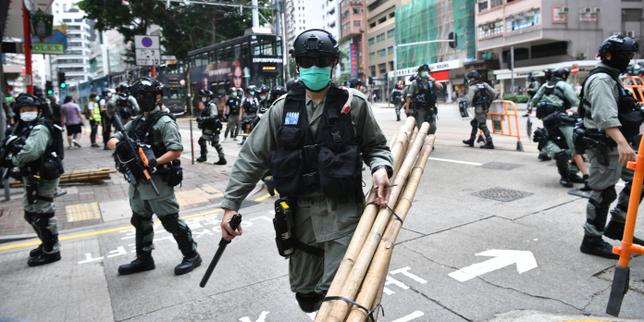
State interference in the production of documentary cinema is no longer confined to domestic borders; it has evolved into a sophisticated, multi-vector strategy of transnational repression. The recent attempts to suppress a documentary regarding Hong Kong’s political crackdown demonstrate a shift from passive censorship to active, extraterritorial disruption. By deconstructing the methods used—ranging from digital intimidation to the weaponization of diplomatic channels—we can identify a repeatable framework of state-sponsored suppression designed to increase the "friction cost" of sensitive storytelling until the project becomes economically or physically unviable.
The Triad of Extraterritorial Interference
State actors utilize three primary pillars to disrupt media production outside their sovereign jurisdiction. Each pillar targets a specific vulnerability in the filmmaking lifecycle: personnel safety, financial stability, and distribution logistics.
1. Kinetic and Psychological Intimidation of Human Capital
The most direct method involves targeting the "nodes" of the production—directors, producers, and their families. This is not merely about silence; it is about psychological attrition.
- Proxy Harassment: Utilizing family members within the home territory as leverage. This creates a moral dilemma for the filmmaker, effectively outsourcing the state's enforcement to the subject’s own social circle.
- Digital Surveillance and Doxing: The deployment of state-aligned botnets to reveal private addresses or financial data. This serves to increase the perceived personal risk, forcing the production to divert budget from creative assets to physical security.
2. Administrative and Institutional Sabotage
When direct intimidation fails, the strategy shifts to the institutional level. State actors leverage their economic weight to pressure third-party entities that the production relies upon.
- Visa and Travel Restrictions: Systemic denial of entry or threats of "legal consequences" upon arrival in neutral territories.
- Venue Pressure: Contacting film festivals or private screening spaces with vague warnings of "damaged bilateral relations." This turns a creative decision for the venue into a geopolitical risk assessment.
3. Digital Denial of Service (DDoS) and Metadata Poisoning
In the post-production and distribution phase, the attack surface shifts to the digital infrastructure.
- Targeting Cloud Infrastructure: Repeated attempts to breach servers containing raw footage (rushes). The goal is either the theft of sensitive data to identify anonymous sources or the total erasure of the project.
- Algorithmic Suppression: Flooding search engines and social platforms with "noise"—pro-state content—to bury the documentary’s digital footprint.
The Cost Function of Independent Documentary Production
To understand why these tactics are effective, one must quantify the "Breakeven of Silence." Independent documentaries operate on razor-thin margins. State interference acts as a massive, unplanned tax on the production.
The total cost of production $C$ is typically defined by:
$$C = P + D + M$$
Where $P$ represents production costs, $D$ is distribution, and $M$ is marketing. State interference introduces a fourth variable, $S$ (Security and Legal Defense). As $S$ increases, it consumes the resources allocated to $D$ and $M$. When $S$ exceeds the available contingency fund, the project faces "structural collapse."
The state’s objective is not always to stop the film entirely but to ensure that the cost—both financial and emotional—of making a second film is prohibitive. This is "censorship by exhaustion."
Analyzing the Mechanism of Diplomatic "Soft" Pressure
The interference described in the case of the Hong Kong documentary often manifests as "informal inquiries" from consulate officials. This is a calculated use of ambiguity. By not issuing a formal legal demand, the state actor avoids a public diplomatic incident while simultaneously signaling to local authorities that the production is a "point of friction."
This creates a Chilling Ripple Effect:
- Direct Contact: The consulate contacts the filmmaker or the festival.
- Perceived Risk: The festival organizers, fearing loss of future sponsorship or state-aligned partnerships, "voluntarily" implement restrictive measures.
- Self-Censorship: Future filmmakers, observing the difficulties faced by the current production, pivot to less controversial subject matter to ensure their own career longevity.
This chain of events demonstrates that the state does not need to win a legal battle; it only needs to introduce enough uncertainty to trigger the risk-aversion instincts of the market.
Technical Vulnerabilities in Radical Transparency
Filmmakers documenting repression often rely on "radical transparency" to garner public support. However, this creates a data-rich environment for state intelligence.
- Public Crowdfunding Data: Analyzing the list of small donors to identify potential dissidents or supporters within the diaspora.
- Social Media Footprints: Mapping the network of associates to identify the "weakest link" for social engineering attacks.
The shift toward encrypted workflows and decentralized storage is a necessary evolution, but it adds another layer of technical complexity and cost to an already burdened production.
The Failure of Current Institutional Protections
Existing frameworks for the protection of journalists and filmmakers are largely reactive. They rely on "naming and shaming," a tactic that loses efficacy when the state actor is indifferent to international reputational damage or holds significant economic leverage over the "shamers."
The bottleneck in protecting these productions is the lack of a Sovereign Legal Shield. Most filmmakers operate as individuals or small LLCs, which are easily crushed by the legal departments of state-backed entities. Without an institutionalized legal and technical "buffer" (e.g., a non-profit entity that holds the copyright and assumes the liability), the individual remains a vulnerable target.
Structural Requirements for Resilient Storytelling
To counter the state’s strategy of attrition, the production model for sensitive documentaries must move toward a "Distributed Risk Model."
- Jurisdictional Arbitrage: Incorporating the production entity in a jurisdiction with high legal protections for the press and no extradition treaties with the state actor.
- Anonymized Supply Chains: Using pseudonymous credits for sensitive roles (editors, colorists, researchers) to prevent individual targeting until the project is finalized.
- Encrypted Cold Storage: Maintaining physical, air-gapped copies of all footage in multiple geographic locations to negate the impact of digital sabotage.
The evolution of state interference requires a corresponding evolution in the business of truth-telling. If the cost of production continues to be inflated by state-sponsored friction, the market for independent documentary film will consolidate into two extremes: state-sanctioned fluff or underground, high-risk guerrilla media. The middle ground—the professional, high-impact investigative documentary—is currently the primary target of these mechanical pressures.
Strategic resilience depends on the professionalization of security protocols. Filmmakers must treat their metadata as a high-value asset and their logistics as a counter-intelligence operation. The era of the "unprotected observer" has ended; the modern documentarian must now function as a systems architect, building a production structure that can withstand the targeted weight of a sovereign state.