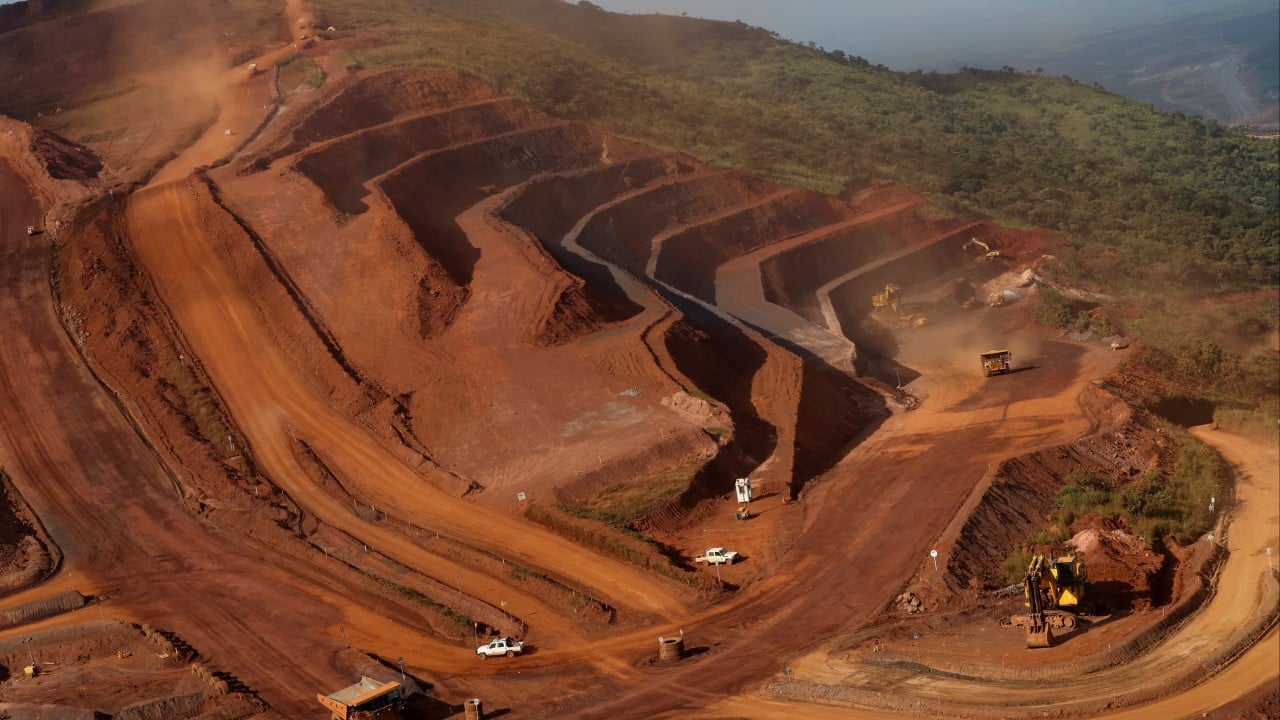
The commercial scaling of the Simandou iron ore deposit in southeastern Guinea alters the structural architecture of the seaborne iron ore market. Historically characterized as a duopoly anchored by Western Australia’s Pilbara region and Brazil’s Carajás complex, the global supply curve is absorbing volumes from a $23 billion infrastructure corridor designed to yield up to 120 million tonnes per annum at full capacity. While mainstream narratives frame Simandou as an immediate catalyst for the decarbonization of Chinese steel production, a rigorous metallurgical and financial assessment reveals a more complex reality. The project introduces distinct operational friction points, driven by chemical composition constraints and deep structural misalignments between raw extraction and downstream processing technologies.
The operational reality of Simandou is defined by a dual-consortium structure operating over a unified 650-kilometer heavy-haul rail corridor and the Morebaya port terminal. Blocks 1 and 2 are managed by the Baowu Winning Consortium Simandou, controlled primarily by China Baowu Steel Group. Blocks 3 and 4 are developed under Simfer, a joint venture between Rio Tinto, Chinalco, and the Guinean government. Following the initial commercial shipment in late 2025, export volumes accelerated from under 600,000 tonnes per month in the first quarter of 2026 to 2.2 million tonnes in May 2026. This trajectory positions total 2026 annualized shipments to potentially exceed 20 million tonnes, demonstrating an accelerating operational learning curve despite seasonal West African monsoon disruptions from July to September.
The Metallurgical Constraint Function
The foundational economic value proposition of Simandou rests on its high Fe (iron) content, which averages between 65% and 66%. This chemical purity places it in the top quartile of global cost competitiveness, theoretically reducing the energy inputs required during the reduction phase of steelmaking. However, raw iron grade is an incomplete metric for blast furnace optimization. A critical limiting factor in early-stage Simandou shipments is the elevated alumina ($\text{Al}_2\text{O}_3$) concentration, which averages approximately 2.7%.
To understand the operational bottleneck this introduces for Chinese steel mills, the chemical mechanics of the blast furnace slag must be isolated. In a standard blast furnace, slag fluidity is critical for the removal of impurities and the consistent flow of molten iron. The relationship between alumina content and slag performance is governed by a precise chemical mechanism:
$$\text{Slag Viscosity} \propto \left[ \text{Al}_2\text{O}_3 \text{ Concentration} \right]$$
When alumina levels exceed optimal thresholds, the viscosity of the slag increases significantly at standard operating temperatures. This thickening behavior reduces the desulfurization efficiency of the slag and alters the thermal profile of the furnace lower zone. To counteract high viscosity, blast furnace operators must increase the slag rate by adding fluxing agents, primarily limestone ($\text{CaCO}_3$) or dolomite ($\text{CaMg(CO}_3)_2$). This corrective action triggers a secondary penalty function:
$$\text{Flux Input} \uparrow \implies \text{Thermal Energy Demand} \uparrow \implies \text{Coke Rate} \uparrow$$
The additional thermal energy required to calcine and melt the supplementary flux increases the overall coke consumption per tonne of hot metal. Consequently, rather than lowering carbon emissions, direct utilization of unblended high-alumina Simandou ore in conventional blast furnaces elevates the carbon intensity of the process.
This chemical reality explains the divergent procurement behavior observed among Chinese steelmakers. Mills in northern and eastern China, which possess diversified blending beds, are utilizing Simandou ore solely in low-percentage trial runs, blending it with low-alumina Australian fines to dilute the total alumina concentration to an acceptable benchmark of less than 1.5%. Conversely, southern Chinese mills, whose infrastructure is structurally optimized for lower-alumina inputs, face prohibitive costs when attempting to adapt their furnace chemistries to raw Guinean ore, limiting immediate domestic absorption.
The Decarbonization Misalignment
The assertion that Simandou serves as an immediate feeder for "green steel" assumes a direct compatibility with Direct Reduced Iron (DRI) and Electric Arc Furnace (EAF) pathways. DRI production eliminates the coal-fired blast furnace entirely, utilizing hydrogen or natural gas to reduce solid iron ore. This method yields a carbon emissions reduction exceeding 50% relative to traditional blast furnace routes.
The technical bottleneck lies in the physical specification of the iron ore feedstock required for DRI towers. DRI technology cannot process fine ore directly; it demands high-density pellets or calibrated lump ore with stringent mechanical strength and low decrepitation characteristics. Furthermore, DRI-EAF metallurgy requires a combined silica ($\text{SiO}_2$) and alumina ($\text{Al}_2\text{O}_3$) content of less than 3.5% to prevent excessive slag volumes in the electric furnace, which lacks the slag-handling capacity of a blast furnace.
While Simandou's in-situ reserves contain segments that meet DRI chemical thresholds, the current export architecture is optimized for mass seaborne shipments of unpelletized direct shipping ore (DSO). The domestic Chinese steel industry remains overwhelmingly anchored in traditional Basic Oxygen Furnace (BF-BOF) infrastructure, which accounts for approximately 90% of its domestic output. China’s transition toward DRI-EAF production is constrained by domestic energy scarcity, specifically the high cost of electricity and the lack of cheap natural gas or industrial-scale green hydrogen infrastructure. The near-to-medium-term utilization of Simandou ore within China will therefore be restricted to conventional blast furnaces, acting as a volume supplement rather than a green technology enabler.
Resource Nationalism and Value Chain Economics
The structural evolution of the Simandou project is heavily influenced by the Guinean state’s strategic framework, formalised under the "Simandou 2040" national development policy. This framework represents a systematic shift from traditional extraction-export models toward mandatory domestic value addition. Historically, West African mineral assets have functioned as raw export enclaves, generating minimal local economic multipliers. The Guinean state holds a non-dilutable 15% free-carried equity stake in the mining, rail, and port infrastructure, which it is leveraging to enforce downstream industrialization.
Under the co-development frameworks ratified by the Ministry of Mines and Geology, the industrial partners are legally obligated to transition from raw ore export to localized processing. In June 2026, the ministry initiated the formal review of a joint feasibility study submitted by Simfer and China Baowu for a 2-million-ton-per-year iron ore pelletization plant. This regulatory milestone represents the initial phase of a structured sequence intended to mandate either a pellet plant or a 500,000-ton direct steel manufacturing facility within two years of sustained commercial operations.
The execution of this localized industrial strategy faces structural deficits in basic infrastructure. The primary constraint is the severe deficit in domestic power generation. Guinea features a national electrification rate of approximately 53%, with severe distribution disparities between urban centers and industrial corridors. A 2-million-ton pellet plant requires consistent, high-load thermal and electrical energy inputs to sustain the induration furnaces required to harden the green pellets. The current feasibility frameworks have not publicly reconciled this demand function with Guinea's grid capacity, creating a capital expenditure bottleneck.
To resolve this without destabilizing domestic electricity access, the project developers must design dedicated, off-grid captive power plants—potentially hydro-powered or gas-fired via imported Liquefied Natural Gas (LNG)—which introduces supplementary capital requirements that compress the net present value (NPV) of the downstream asset.
Global Market Dynamics and the Price Floor
The integration of Simandou volumes into the seaborne market occurs during a structural deceleration in Chinese crude steel consumption. China's domestic property market contraction has permanently altered the peak demand trajectory for construction-grade steel, shifting focus toward high-value manufacturing and export markets.
The arrival of 120 million tonnes of annual capacity from Guinea will not precipitate a total structural collapse of the global iron ore market, which transacts over 1.5 billion seaborne tonnes annually. Instead, the introduction of this asset establishes a structural cap on premium iron ore pricing.
| Metric | Project Specification / Operational State |
|---|---|
| Total Capital Expenditure | ~$23 Billion USD |
| Current Export Run-Rate (May 2026) | 2.2 Million Tonnes/Month |
| Targeted Peak Annual Capacity | 120 Million Tonnes / Annum |
| Average Iron (Fe) Grade | 65% – 66% |
| Average Alumina ($\text{Al}_2\text{O}_3$) Content | 2.7% |
| Sovereign Equity Stake (Guinea) | 15% (Free-Carried) |
The global cost curve for iron ore is anchored by the major producers in Western Australia (Rio Tinto, BHP, Fortescue) and Brazil (Vale). The Pilbara operations maintain cash costs at the lower end of the global curve, frequently below $20 per wet metric tonne, supported by fully depreciated, highly automated rail-and-port networks. Simandou’s initial cash cost profile will be burdened by the amortization of its $23 billion infrastructure cost and the logistical complexities of operating a 650-kilometer trans-Guinean transit line through mountainous terrain.
The strategic value of Simandou for Chinese state enterprise investors is not driven exclusively by direct asset-level profitability. It functions primarily as a macroeconomic hedge against import concentration. By controlling 75% of the equity across Simandou's four mining blocks, Chinese industrial planners have successfully engineered a mechanism to dilute the market dominance of Australian supply chains, which currently satisfy nearly 70% of China's seaborne iron ore requirements. This structural alternative provides Chinese procurement entities with significant leverage in annual price negotiations, effectively lowering the global clearing price floor toward an estimated $85 per tonne over a three-year horizon.
Strategic Recommendations for Market Participants
Downstream steel producers and global commodity trading desks must abandon the assumption that Simandou ore will immediately trade at parity with premium Brazilian high-grade fines (such as Carajás IOCJ). The 2.7% alumina penalty requires a sophisticated blending strategy. Procurement teams must mathematically optimize their sinter feed matrices by securing low-alumina, high-silica balancing ores to neutralize the slag viscosity increases caused by Simandou inputs.
International infrastructure financiers and engineering consortiums should focus capital allocation toward West African energy infrastructure. The Guinean government’s statutory enforcement of local pelletization within the "Simandou 2040" mandate means that mining operators cannot rely indefinitely on raw DSO exports. The critical path to preserving the project's long-term export licenses lies in resolving the industrial power gap. Developing captive, low-carbon energy solutions—such as dedicated run-of-river hydroelectric facilities or localized natural gas networks—will emerge as the primary commercial opportunity supporting the next phase of West African resource development.