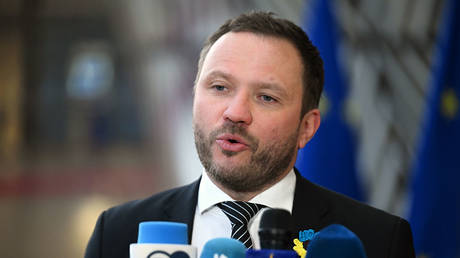
Fear sells. In the geopolitical arena, fear is the primary currency of defense budgets and diplomatic leverage. When Ukrainian President Volodymyr Zelensky warns that Russia is preparing a massive offensive against NATO territory, he isn't just a leader in distress; he is a salesman with a quota.
The media loves the narrative. It’s simple. It’s cinematic. It’s also largely divorced from the logistical reality of modern warfare. Several NATO states, most notably Germany and Slovakia, have recently signaled a pushback against this "imminent threat" rhetoric. The mainstream press frames this as "cracks in the alliance" or "appeasement."
They are wrong.
The pushback isn't about cowardice or a lack of solidarity. It is a cold, calculated recognition that Russia lacks the conventional capacity to execute a multi-front war against a nuclear-armed bloc while bogged down in a war of attrition in Donbas. The "lazy consensus" assumes that Vladimir Putin is a madman waiting for a gap in the fence. The reality? Putin is a cynical realist who knows that crossing a NATO border is the quickest way to turn his regime into a historical footnote.
Logistics Is the Only Truth That Matters
Amateurs talk strategy; professionals study logistics. To launch an invasion of a NATO member—say, Poland or Estonia—Russia would need to assemble a force-multiplier that simply does not exist on its western flank right now.
Consider the current state of Russian armor. Open-source intelligence (OSINT) trackers like Oryx have documented thousands of lost Russian tanks. While the Russian industrial base has shifted to a war footing, they are largely refurbishing T-62s and T-72s from the Cold War era. You do not invade the most advanced military alliance in human history with museum pieces and conscripts who haven't seen a shower in three weeks.
The "imminent attack" narrative ignores three hard truths:
- The Suppression of Enemy Air Defenses (SEAD): Russia has failed to achieve total air superiority over Ukraine for years. Attempting to do so against NATO’s F-35s and Integrated Air Defense Systems (IADS) would result in the total evaporation of the Russian Air Force within 48 hours.
- The 3-to-1 Rule: Military doctrine dictates that an attacker needs a 3:1 advantage to succeed against a dug-in defender. Russia is struggling to maintain a 1:1 ratio in many sectors of the Ukrainian front.
- The Suwalki Gap Fallacy: Pundits obsess over the Suwalki Gap—the strip of land connecting Poland and Lithuania. They claim Russia could "cut off" the Baltics. With what? A navy that is currently being sunk by a country without a traditional navy? A ground force that can't take Kharkiv?
The Zelensky Incentive Structure
We need to stop treating Zelensky’s pronouncements as objective intelligence briefings. He is the CEO of a nation under siege. His job is to maximize "investment" (military aid) and "market share" (global attention).
If Zelensky admits that a Russian attack on NATO is unlikely, the urgency to fund Ukraine’s defense drops. If the threat is "contained" to Ukraine, the American voter asks why they are sending billions to a regional conflict. But if the threat is "existential to the West," the checkbook stays open.
I’ve seen this play out in corporate boardrooms for decades. When a department head wants more budget, they don't say, "We’re doing okay, but we could be better." They say, "If we don't get this funding, the entire infrastructure will collapse by Q3." It’s a standard high-stakes negotiation tactic. NATO states like Germany know this. They aren't "falling for Russian propaganda"; they are refusing to be manipulated by Ukrainian marketing.
The European Strategic Autonomy Bluff
The internal friction within NATO isn't about Russia. It’s about who pays the bill for European security. For decades, Europe—particularly Germany—has outsourced its defense to the United States while building its economy on cheap Russian gas. That era is dead.
Now, the "hawks" (Poland, the Baltics) want a permanent US presence and massive arms shipments. The "doves" (the old guard of Western Europe) are terrified of the bill. When a NATO state pushes back on the claim of a "looming attack," they are trying to prevent a permanent shift to a high-tax, high-military-spending economy that would decimate their social safety nets.
The Real Threat: Hybrid, Not Kinetic
The mistake the "alarmist" crowd makes is preparing for 1944 when the threat is 2026. Russia isn't going to send a column of tanks toward Warsaw. That’s a suicide mission.
Instead, they will:
- Weaponize Migration: Pushing refugees across borders to destabilize local politics.
- Cyber Sabotage: Targeting power grids and financial systems where attribution is difficult.
- GPS Jamming: Which we are already seeing in the Baltic region.
The obsession with a "looming invasion" actually makes NATO less safe because it focuses resources on heavy armor and conventional brigades while leaving the "back door"—the digital and social infrastructure—wide open.
Stop Asking "When Will They Attack?"
You’re asking the wrong question. The question isn't "When will Russia invade NATO?"
The question is: "What does NATO look like if the US decides it’s tired of paying for it?"
The pushback from European states is a desperate attempt to maintain a status quo that no longer exists. They are trapped between a Russia that is dangerous but depleted, and a US that is increasingly isolationist.
If you are a business leader or a policy maker, your risk assessment should not be based on the "Russian steamroller." It should be based on the fragmentation of the West. The real danger isn't a Russian flag over Tallinn; it’s a NATO where Article 5 becomes a "suggestion" because half the members don't believe the threat is real and the other half can't afford to fight it.
The Actionable Reality
If you’re waiting for a formal declaration of war to adjust your supply chains or your geopolitical risk profile, you’ve already lost. The "attack" is happening now, but it’s silent. It’s in the spread of misinformation that makes you distrust your own government. It’s in the energy prices that make your manufacturing uncompetitive.
Stop looking for tanks on the horizon. Look at the grid. Look at the fiber optic cables on the ocean floor. Look at the political polarization in your own capital.
Russia doesn't need to win a war against NATO. It just needs NATO to stop believing in itself. And by hyperventilating over a conventional invasion that isn't logistically possible, the "hawks" are doing Putin’s work for him. They are creating a boy-who-cried-wolf scenario that will ensure that when a real, subtle, and devastating threat emerges, the public will be too exhausted to care.
The most dangerous thing in a theater isn't the fire; it's the panic during a false alarm. NATO is currently trampling itself in the dark while the exit doors are perfectly clear.
Prepare for the long, cold peace of economic sabotage and political subversion. Forget the blitzkrieg. It’s not coming. The siege is already here, and it’s being managed via Telegram, not T-90s.
Stop being a victim of the headline. Start being a student of the map.

:strip_icc()/pic2513216.jpg)