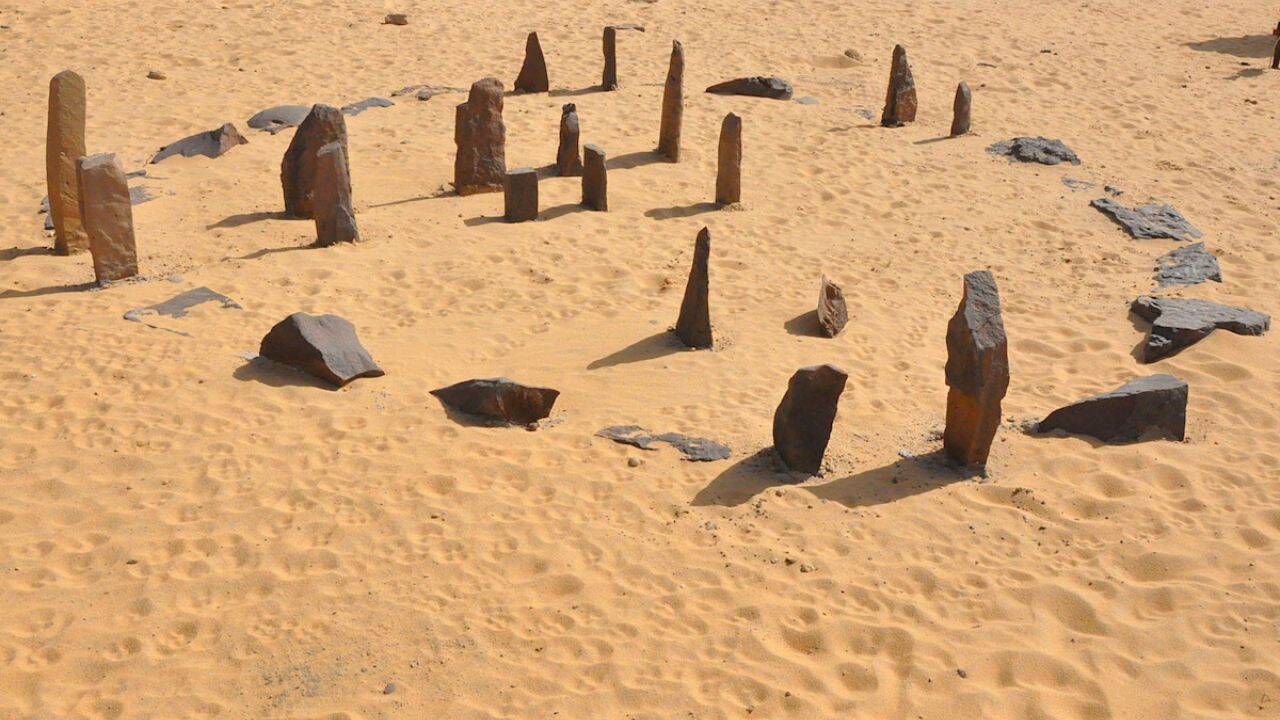
Long before the first stone was hoisted at Stonehenge or the Great Pyramid rose above the Giza plateau, a group of nomadic cattle herders built a complex calendar in the middle of a desert. Deep in the Egyptian Sahara, about 60 miles west of the Nile, lies Nabta Playa. It's roughly 7,000 years old, easily beating Stonehenge to the punch by at least two millennia.
Most people haven't heard of it. That's a shame, because it completely shatters the old narrative that complex astronomy started with sedentary farming communities. Don't miss our previous coverage on this related article.
When archaeologist Fred Wendorf stumbled across the area in the 1970s—stopping for a quick break during a desert drive—he almost dismissed the scattered stones as natural formations. It took years of excavation alongside Polish scholar Romuald Schild to realize what they had. These weren't just random rocks. They were part of a sophisticated ceremonial center designed to track celestial movements.
What Makes Nabta Playa So Unique
The heart of the site features a modest stone circle, only about twelve feet across. Don't let its size fool you. Unlike the towering monoliths in England, Nabta Playa wasn't about raw structural scale; it was about precision. If you want more about the background of this, National Geographic Travel provides an informative breakdown.
The circle has two distinct sightlines. One points north-south, while the other lines up directly with the summer solstice sunrise as it appeared around 4900 BC.
Why did a group of prehistoric nomads care about the summer solstice? Survival.
Around 9000 BC, the Sahara wasn't the dry, lifeless expanse of sand it is today. Monsoon rains moved north every summer, creating seasonal lakes—or playas—that filled with water and sprouted rich vegetation. Herders brought their cattle to graze during these wet months. Knowing exactly when the rains were going to arrive meant the difference between thriving and dying of thirst in the wasteland.
The calendar circle gave them a reliable clock. When the sun rose through the solstice stones, they knew the monsoon was right around the corner.
The Cattle Cult and the Roots of Egypt
Nabta Playa wasn't just an observatory—it was a sacred landscape.
Excavators found a series of subsurface chambers capped with heavy stone mounds, known as tumuli. When Wendorf’s team dug into the largest mound, expecting human bones, they found something else entirely: a young cow buried inside a clay-lined chamber, carefully covered with tamarisk wood.
For pastoral nomadic communities, cattle were everything. They provided milk and blood, representing wealth and life itself. Slaughtering a young cow was a massive sacrifice.
This deep reverence for cattle at Nabta Playa didn't vanish when the desert eventually dried up around 3500 BC. As the climate shifted and water sources disappeared, these nomadic groups migrated east toward the Nile Valley. They brought their beliefs with them. Scholars now consider these early Sahara pastoralists to be the foundational root of Pharaonic Egypt, pointing out direct ties between Nabta Playa's cattle cult and the later worship of Hathor, the Egyptian cow goddess.
The Star Alignments Controversy
While the summer solstice alignment is widely accepted, larger stone alignments radiating out from the main site triggered intense debate in archaeoastronomy.
In the early 2000s, astrophysicist Thomas Brophy suggested that the megaliths mapped out specific stars over thousands of years, including the constellation of Orion and Sirius. Some of his theories claimed the builders were tracking the precession of the equinoxes—a complex 26,000-year wobbling cycle of Earth's axis.
Other researchers, including archaeoastronomer J. McKim Malville, took a more grounded view. Malville agreed the site tracked stars—specifically bright ones like Sirius, Arcturus, and stars in Orion's belt—which would have served as night navigation points across the featureless desert. However, he pushed back against claims of hyper-advanced ancient physics.
You don't need wild theories to appreciate Nabta Playa. The verifiable truth is impressive enough: thousands of years before cities existed, nomadic people organized massive community efforts to haul sandstone blocks, engineer subterranean chambers, and map the night sky with startling accuracy.
How to Experience Ancient Astronomy Today
If you want to study or visit the legacy of Nabta Playa yourself, keep these practical points in mind:
- Visit the Nubia Museum in Aswan: The original stone calendar circle was removed from the desert to protect it from vandalism and weather damage. It's now reassembled and on display at the Nubia Museum in Aswan, Egypt.
- Plan ahead for desert travel: The original site in the Nubian Desert remains extremely remote and requires military permits, a local guide, and 4x4 vehicles to reach safely.
- Compare it to other early sites: Look into the Goseck Circle in Germany or Göbekli Tepe in Turkey to get a fuller picture of how prehistoric humans interacted with monument building and the cosmos long before writing was invented.
Nabta Playa proves that our obsession with the stars didn't start with urban civilizations. It started in the quiet, dark nights of the ancient wilderness, driven by the practical need to survive and the human urge to understand the sky.
Nabta Playa's Amazing Archeoastronomy
This video explores the complex archaeoastronomical alignments of Nabta Playa and explains how early desert cultures tracked the stars long before other major megalithic sites were built.