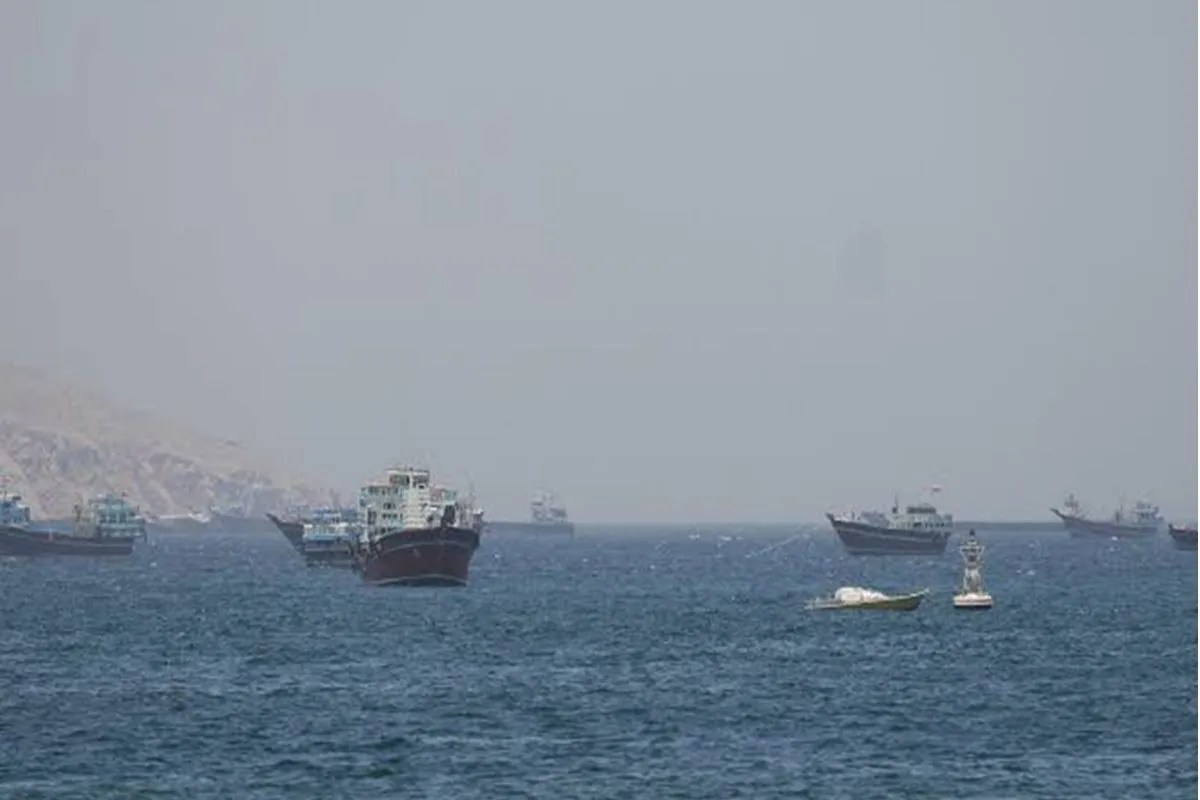
The heat in the Persian Gulf does not merely surround you; it occupies you. It fills your lungs with heavy, salt-choked air that tastes faintly of old diesel and boiling metal. Out on the water, twenty-one miles wide at its absolute narrowest point, the Strait of Hormuz looks deceptively tranquil. A sheet of hammered copper under a merciless sun. But appearances are a luxury reserved for tourists, not for the sailors who patrol this aquatic bottleneck.
To understand what happened when the radar screens suddenly lit up with violent, erratic signatures, you have to understand the geography of survival. Imagine a funnel. At the wide end lies the vast expanse of the Indian Ocean and the Arabian Sea. At the narrow spout lies this twenty-one-mile corridor, squeezed between the jagged, sun-bleached mountains of Oman on one side and the sprawling, arid coast of Iran on the other. Through this literal needle's eye passes roughly a fifth of the petroleum consumed on planet Earth. Every single day, supertankers loaded with millions of barrels of crude oil glide through these two-mile-wide shipping lanes like lumbering beasts moving through a narrow alleyway.
It is the most fragile, high-stakes choke point in human history.
And on a night where the stars were swallowed by a thick, humid haze, the fragility cracked.
Consider the perspective of a hypothetical sonar operator stationed aboard a United States naval vessel cutting through the dark water. Let us call him Petty Officer Vance. He is twenty-four years old, standing in the dim, blue-lit glow of the Combat Information Center, smelling stale coffee and ozone. For hours, the screen has been a predictable dance of slow-moving commercial hulks—tankers hauling fuel toward Singapore, container ships crawling toward Rotterdam.
Then, the geometry changes.
Fast attack craft. Low-profile, highly maneuverable speedboats operated by the Islamic Revolutionary Guard Corps Navy come slicing out of the coastal shadows. They do not carry cargo. They carry mounted heavy machine guns, rocket-propelled grenades, and an unmistakable aura of aggressive intent. Accompanying them, an uncrewed aerial vehicle—a drone—buzzes through the lower altitude, an electronic eye seeking vulnerability, trying to map the blind spots of the warship’s radar array.
This is not a diplomatic seminar. This is a game of sub-seconds played in real-time.
In maritime warfare, distance is time, and time is life. When hostile small craft converge at high speeds, closing the gap between tactical caution and catastrophic collision in minutes, the rules of engagement shift from abstract legal briefs to raw, kinetic reality. The Iranian boats surged forward, attempting a maneuver designed to disorient, to probe, to test the perimeter of a superpower's patience. Simultaneously, the drone dropped lower, its optics locked on the vessel's deck, attempting an aerial seizure of electronic data or airspace dominance.
There was no time for committee meetings. There was no room for hesitation.
When the order was given, it was executed with the cold, mechanical precision of modern military hardware. The response was not a warning shot across the bow; it was immediate, overwhelming defensive action. The night sky fractured with blinding flashes of light and the concussive roar of ordnance. In a matter of moments, two of the fast attack craft were blown apart, their burning hulls hissing as they sank into the dark depths of the Gulf. High above, the attempted drone seizure was intercepted and shattered, its electronic pulse flatlining instantly as it tumbled into the water.
Silence returned to the Strait, save for the crackle of radio static and the rhythmic slap of waves against the hull.
But the silence is deceptive. Because every time metal meets ocean in this volatile corridor, the shockwaves travel far beyond the Middle East. They vibrate instantly through the trading floors of New York, London, and Tokyo.
Oil futures do not trade on abstract economics; they trade on fear. When the Strait of Hormuz stumbles, the cost of a liter of petrol in Mumbai spikes within hours. Freight rates for cargo ships carrying everything from microchips to wheat skyrocket. Factories in Germany and assembly plants in South Korea feel the friction. We live in a world intricately stitched together by invisible supply chains, and every single thread runs directly through this narrow, contested throat of water.
To look at this incident merely as a tactical skirmish between two geopolitical rivals is to miss the human tragedy humming beneath the surface. This is a slow-motion chess match played with real lives and fragile global stability. On the Iranian side, young conscripts and seasoned commanders operate under an ideological framework that views the presence of foreign warships as an intolerable affront to national sovereignty. On the American side, sailors thousands of miles away from home operate under the constant, crushing burden of knowing that a single miscalculated second could ignite a regional conflagration.
History hangs heavy over these waters. Veterans of the 1980s Tanker War remember the sea mines, the burning oil rigs, the frantic Mayday calls echoing across the same radio frequencies. The names of the ships change, the technology upgrades from crude radar to sophisticated autonomous drone swarms, but the fundamental human dynamic remains terrifyingly unchanged. We are trapped in a loop of mutual suspicion, where both sides are perpetually bracing for the worst while hoping the other blinks first.
The attempted drone seizure and the subsequent destruction of the fast attack boats are symptoms of a deeper, chronic malady. It is the friction of a transitioning global order. As traditional power dynamics shift, as nations test the boundaries of international maritime law, the edges of the map become jagged and sharp. The Strait of Hormuz is not just a geographical feature; it is an open nerve ending of the modern world.
When you wake up tomorrow morning and fill your car with fuel, or purchase a manufactured good shipped across oceans, remember the dark water of the Persian Gulf. Remember Petty Officer Vance standing in the blue glow of his monitor, watching a fast-moving blip on a screen. Remember the split-second between peace and absolute chaos.
The surface of the ocean is smooth again. The oil slick has drifted away with the tide. But deep below, in the quiet dark, the currents of history continue to churn, waiting for the next spark to ignite the deep.