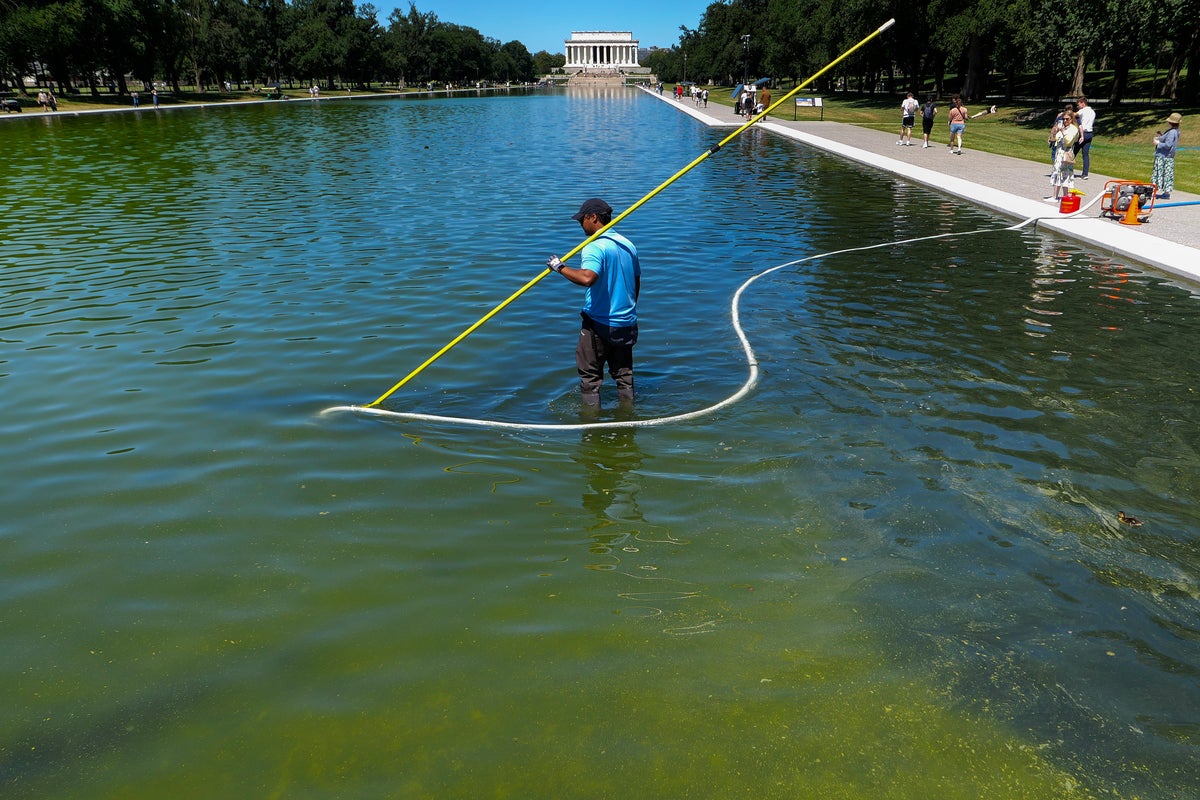
The mainstream media is hyper-fixating on social media blitzes showcasing aesthetic updates to iconic Washington infrastructure. They are missing the entire point. When public figures brag about the "beautiful" surface-level renovations of sites like the Lincoln Memorial Reflecting Pool, they are celebrating a cosmetic band-aid on a deeply cracked foundation.
This isn't just about politics. It is about a fundamental misunderstanding of civil engineering, asset management, and the true cost of public works.
The lazy consensus screams that shiny new water filtration systems and pristine stone alignments equal success. They do not. In asset management, if you are bragging about how pretty a 100-year-old pool looks after a multi-million-dollar taxpayer-funded facelift, you are usually covering up a legacy of systemic operational failure.
The Aesthetic Trap of Public Works
Most people look at a monument and see history. Civil engineers look at a monument and see a never-ending war against hydrostatic pressure, biofilm accumulation, and structural settling.
The Lincoln Memorial Reflecting Pool, originally constructed in the 1920s, has historically been a logistical nightmare. It holds roughly 6.75 million gallons of water. For decades, it relied on stagnant domestic water supplies, leading to massive algae blooms, pest infestations, and a bottom coated in thick sludge.
When major overhauls occur, the public relations machine immediately pivots to visual dominance. They show you crisp reflections of the Washington Monument. They praise the blinding white stone.
What they hide is the catastrophic inefficiency of reactive maintenance.
Imagine a scenario where a fortune 500 manufacturing plant only repairs its primary assembly line when the conveyor belt snaps in half, and then throws a massive press conference to show off the fresh coat of paint they added while the line was down. You would fire the plant manager immediately. Yet, in the public sector, this exact behavior is rewarded with viral engagement and political points.
The Math Behind the Mirage
True infrastructure health is measured by two metrics: Life-Cycle Cost Analysis (LCCA) and Mean Time Between Failures (MTBF).
Let us break down the actual mechanics of a massive reflecting pool. It requires:
- High-capacity ozone filtration loops to eliminate organic matter without dumping tons of corrosive chlorine into a historic ecosystem.
- Subsurface structural piles driven into unstable Potomac riverbed silt to prevent the entire basin from tilting and cracking.
- Automated backwash systems that minimize water waste during sediment removal.
When you look at the economics of the 2012 Reconstruction—which cost over $30 million—the goal was to transition the pool from a stagnant dump to a sustainable closed-loop system. The system was designed to pull water from the nearby Tidal Basin, filter it, circulate it, and reduce potable water consumption by millions of gallons annually.
But here is the brutal truth nobody admits: advanced filtration systems fail faster than basic ones if your operational budget does not scale alongside your capital expenditures.
If you install a state-of-the-art filtration plant but keep the same understaffed, underfunded maintenance crews running it, the system degrades exponentially. Within years, the pumps choke on debris, the ozone generators lose efficiency, and you are right back to square one. A "beautiful" photo on social media does not mean the pumps are drawing the correct amperage. It just means the algae hasn't bloomed yet.
Why Pristine Infrastructure is Often a Warning Sign
In my years analyzing capital allocation, I have seen organizations sink millions into the things people can see while entirely starving the things they can't.
The Visibility Bias
Politicians and executives love visible assets. A new roof, a polished facade, a glittering pool. They hate invisible assets. Main sewers, electrical switchgear, structural tie-backs, and foundation underpinning get zero votes and zero clicks.
When an entity goes on a media blitz to highlight a pristine surface asset, it is almost always a diversion from a crumbling interior portfolio. The National Park Service faces a multi-billion-dollar deferred maintenance backlog. While a highly visible pool gets fast-tracked for a high-profile photo op, critical wastewater systems, retaining walls, and bridges across the national park ecosystem are quietly rotting away out of sight.
The True Downside of the Premium Fix
There is a massive downside to over-specifying aesthetic renovations. When you use highly customized, historically accurate materials rather than standardized modern equivalents, you trigger an exponential spike in future maintenance costs.
If a custom-cut granite slab cracks three years from now, you cannot just order a replacement from a local supplier. You have to commission a specialty quarry, wait months for fabrication, and pay a premium that eats up the entire regional maintenance budget for the quarter. You have traded a short-term public relations win for a long-term fiscal chokehold.
Dismantling the FAQs of Public Renovations
Why shouldn't we celebrate the preservation of historic landmarks?
Because celebration breeds complacency. When the public believes an asset is "fixed," scrutiny drops to zero. True preservation is not an event; it is a continuous, boring, expensive process. Celebrating a single renovation milestone is like celebrating a car wash while ignoring a knocking engine block.
Don't these upgrades save water and taxpayer money long-term?
Only on paper. The projected savings of closed-loop filtration systems rely on a critical, flawed assumption: perfect operational execution. In reality, the complexity of these systems introduces dozens of new single points of failure. When a highly specialized pump breaks down, the cost to repair it often completely wipes out the utility savings achieved during its operational window.
Isn't visual appeal critical for national pride and tourism?
This is the ultimate distraction. A tourist does not care if the water is filtered via ozone or manually treated with copper sulfate, as long as it looks blue in a selfie. Designing and executing infrastructure projects around the aesthetic demands of a camera lens rather than the rigorous demands of hydraulic engineering is a recipe for fiscal ruin.
Stop Looking at the Water
Next time you see a high-profile figure posting slick, high-contrast images of a newly renovated public monument, stop looking at the water. Look at the edges. Look for the damp spots on the retaining walls that indicate weeping joints. Look at the operational logbooks, if you can get them through a freedom of information request.
True structural integrity is silent, invisible, and completely unphotogenic. If an asset requires a public relations campaign to prove its value, the project was built for vanity, not longevity.
Stop validating the cosmetic theater. Demand to see the pump room data, or do not look at all.