The smell of burning solder sticks to the back of your throat. It tastes like zinc, cheap coffee, and a cold basement floor. In a nondescript garage somewhere on the outskirts of Kyiv, three men are hunching over a workbench under the glare of a single, buzzing fluorescent tube.
Outside, the air is freezing. Inside, the heat comes from the whirring cooling fans of four consumer-grade 3D printers. They work nonstop, spitting out layer after layer of matte-black carbon filament.
A year ago, these men were civil engineers, software developers, and auto mechanics. Tonight, they are building a fleet of heavy bomber drones from scratch.
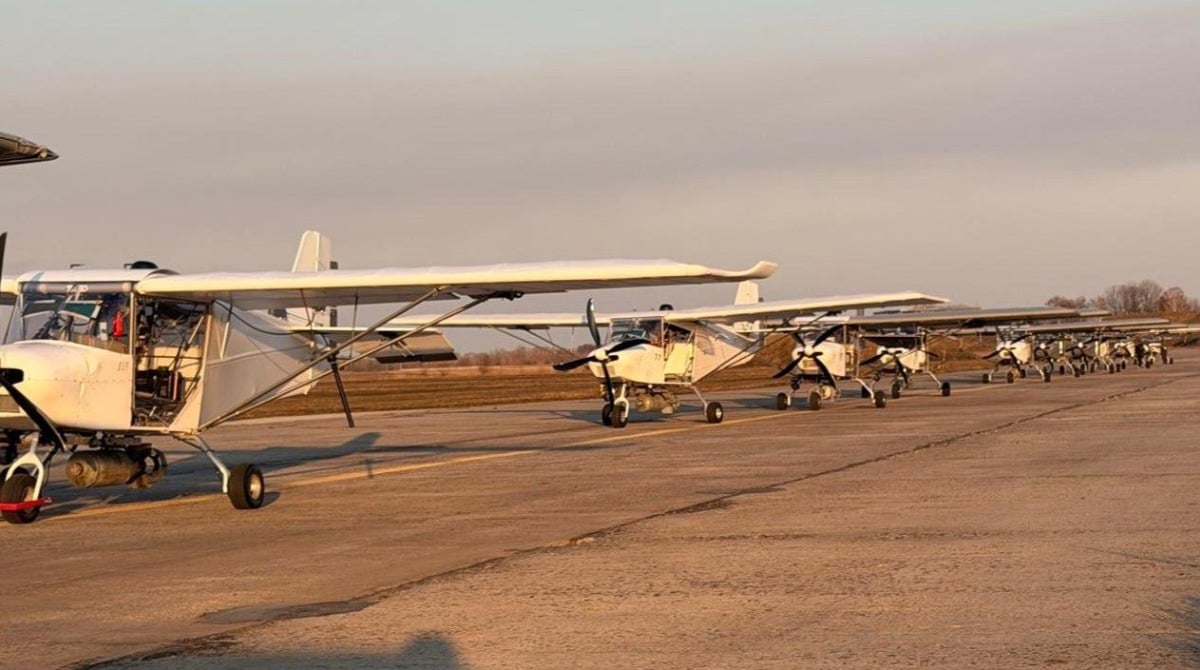
Mainstream news outlets covered the event with sterile detachment. "Ukraine shows off a squadron of homemade bomber drones," the headlines read. They showed shiny video clips of twelve-foot hexacopters lined up on a tarmac, their carbon-fiber arms gleaming under a grey sky. The reports spoke of payload capacities, flight ranges, and strategic defense initiatives. They treated the fleet like it rolled off a state-of-the-art assembly line in Seattle or Munich.
But state-of-the-art implies a budget. It implies a supply chain. It implies time.
None of those luxuries exist here. This is not industrial manufacturing; it is a desperate act of communal survival.
The Anatomy of an Improvised Ghost
Consider the machine itself. To understand why these homemade bombers matter, you have to look past the official press releases and examine the literal nuts and bolts.
The drones are massive. They are not the small, buzzing quadcopters that hobbyists use to film weddings. These are heavy agricultural platforms, radically re-engineered to carry thirty pounds of explosives through the dead of night. The frontline soldiers call them "Baba Yaga," named after the terrifying witch of Slavic folklore who flies through the woods in a mortar.
Let us track the journey of a single component.
The electric motors that spin the massive rotors are often sourced from commercial cargo drones bought through European shell companies. The batteries are sometimes stripped from wrecked electric cars, re-soldered by hand into custom power packs that can withstand freezing temperatures. The flight controllers—the digital brains of the craft—run on open-source code modified by twenty-somethings who used to build mobile video games.
Every single screw is tightened by hand. Every wire is sealed with electrical tape.
This creates a bizarre paradox. On paper, these machines look crude. They lack the sleek, radar-absorbent coatings of Western military hardware. They do not have multi-million-dollar sensor suites. But out in the mud of the Donbas, their simplicity is their greatest strength.
When a multi-million-dollar military drone gets hit by electronic jamming, it often loses its signal and crashes. Its proprietary software is too rigid. But when a homemade Ukrainian drone encounters a Russian jamming field, its custom-written software adapts. It might drop its altitude, switch to an entirely different radio frequency, or simply use basic visual tracking to guide itself home.
It is cheap. It is ugly. And it works.
The Human Toll Behind the Controls
To truly grasp the weight of these machines, we must look at who flies them.
Let us use a hypothetical composite of the operators on the ground, whom we will call Oleksandr. Before the full-scale escalation, Oleksandr managed a regional logistics office. He spent his days looking at spreadsheets and worrying about delivery times. Now, he sits in a damp trench under a canopy of camo netting, staring at a scratched tablet screen.
His fingers are raw from the cold. He hasn't slept more than three consecutive hours in four days.
Flying a homemade bomber drone is an agonizingly slow exercise in tension. Unlike the fast, agile First-Person View (FPV) kamikaze drones that scream across the sky at ninety miles an hour, these heavy bombers are slow. They move through the night sky like ghosts, their deep, low-frequency hum vibrating through the cold air.
Oleksandr watches the thermal feed. The world on his screen is a wash of grays and blacks. White hot spots indicate engine blocks or human bodies.
The real danger for Oleksandr isn't just the incoming artillery. It is the psychological weight of the delay. When he presses the button to release a payload, there is a long, breathless pause. The bomb falls for several seconds. On his screen, he watches the silent flash of light. Then, he has to turn the heavy, sluggish craft around and fly it back across miles of hostile airspace, praying the battery holds out against the headwind.
If the drone doesn't make it back, the garage team will have to spend another forty-eight hours building a replacement. The pressure on the operators is immense. They are fully aware that each machine represents thousands of dollars raised through online donations, built by their friends, and transported to the front in the back of a battered civilian van.
The Math of Asymmetric Warfare
The official media reports focus heavily on the spectacle of the drone squadron, but they miss the cold, mathematical reality that drove Ukraine to this point.
For decades, modern warfare was dictated by the defense procurement cycle. A government would sign a contract with a massive defense conglomerate. Engineers would spend five years designing a prototype. Testing would take another three years. By the time the weapon reached the battlefield, it was already obsolete, costing hundreds of thousands of dollars per unit.
Ukraine changed the math because it had to.
Consider the cost equation. A traditional, Western-guided artillery shell can cost anywhere from $3,000 to $100,000 depending on its precision system. A single long-range missile can easily top $1 million. Ukraine simply does not have the deep pockets or the endless stockpiles to compete on those terms.
A homemade bomber drone costs roughly $10,000 to assemble.
But the real disruption lies elsewhere. If a $10,000 drone made from carbon fiber, 3D-printed plastic, and used car batteries can successfully disable a $3 million main battle tank or a multi-million-dollar air defense radar, the economic balance of the war shifts entirely. It turns traditional military doctrine upside down.
This isn't a temporary stopgap measure. It is the birth of an entirely new philosophy of defense.
The volunteer groups building these fleets aren't operating under corporate hierarchies. They don't have human resources departments or marketing budgets. If a pilot on the frontline notices that a specific Russian electronic warfare system is blocking a certain radio frequency, he doesn't file a report with a committee. He sends a message on encrypted Telegram to the garage workshop in Kyiv.
By the next morning, the software engineers have rewritten the code. By the next evening, a software patch is sent over the internet to every drone team along a seven-hundred-mile front line.
This level of adaptability cannot be bought with a defense budget. It can only be forged through absolute necessity.
The Ghostly Echo
The drone squadron showcased by the Ukrainian military is impressive on television, but its true power isn't visual. It is psychological.
Imagine standing in a frozen trench on the other side of the line. The night is pitch black. You cannot see more than five feet in front of your face. Then, you hear it. A distant, deep, mechanical thrum. It sounds like a lawnmower engine muffled by a wet blanket. You know it is out there, somewhere above the clouds, looking down at you through an infrared lens. You know it carries enough explosives to obliterate a bunker.
You cannot shoot it down because you cannot see it. Your radar struggles to pick it up because it is made mostly of plastic and carbon fiber.
That terror is what those men in the Kyiv garage are actually manufacturing. They aren't just assembling pieces of plastic and metal. They are manufacturing a profound sense of vulnerability for their adversaries. They are reclaiming their skies, one soldered wire at a time.
When the sun rises over Ukraine, the 3D printers in the garage finally click off. The air is thick with plastic fumes. The mechanics wipe grease from their hands, pack the finished components into cardboard boxes, and load them into a battered SUV.
The news will continue to report on the grand strategy, the geopolitical shifts, and the official military statements. But the real story of this war will always belong to the cold basements, the burning solder, and the people who refused to wait for someone else to save them.


