Imagine flying back from a relaxing holiday in Tenerife, only to find yourself circling in pitch-black darkness over London. You’ve been in the air for hours, way longer than scheduled. Suddenly, the pilot's voice crackles over the intercom, announcing a diversion because Gatwick’s runway is completely blocked. Then, you track the flight on your phone and see that not just your plane, but eight other aircraft around you are simultaneously "squawking" emergency code 7700.
That is exactly the nightmare scenario that unfolded for hundreds of passengers.
A single broken-down aircraft on the tarmac sparked a chain reaction of fuel panics, midnight diversions, and widespread travel chaos. This incident exposed a major vulnerability in London’s aviation network and left passengers stranded across the UK.
The Midnight Gridlock on Gatwick's Single Runway
It all started just after midnight. British Airways flight BA2673, an Airbus A320 arriving from the Spanish holiday island of Palma de Mallorca, touched down at Gatwick. But instead of taxiing to the gate, the plane ground to a halt right on the runway.
Emergency crews and airport fire trucks rushed to the scene. Rumors flew on social media about landing gear failures and fuel leaks, but British Airways later downplayed the panic, calling it a "technical fault" and stating that the aircraft landed safely.
The real issue is Gatwick's design.
Gatwick relies almost entirely on a single main runway for its daily operations. When that runway gets blocked, the entire airport grinds to an immediate halt. Because the other runway was closed for scheduled maintenance that night, there was absolutely nowhere for incoming planes to go.
The runway remained blocked for nearly five hours, trapping a massive wave of late-night arrivals in the sky.
Why Nine Planes Sounded the Alarm at the Same Time
As the minutes turned into hours, circling planes began running dangerously low on fuel.
When you're stuck in a holding pattern, you can only burn through your reserve fuel for so long before safety dictates you must land immediately. To get priority routing to alternative airports like London Stansted, Luton, or Heathrow, pilots had to declare emergencies.
They did this by transmitting "squawk 7700"—the international radio code for an immediate emergency.
Within a brief window, nine different flights squawked 7700:
- EasyJet flights from Agadir, Valencia, Fuerteventura, Athens, and Rome.
- British Airways flights from Bari and Tenerife.
- Jet2 and TUI flights arriving from Lanzarote and Rhodes.
For aviation enthusiasts watching online, the radar map looked like a disaster movie. Having nine commercial airliners declaring emergencies simultaneously in the same airspace is incredibly rare. It wasn't because the planes were broken, but because they were flat-out running out of gas while waiting for Gatwick to clear.
What Happens to Passengers in a Midnight Diversion?
If you are ever on a flight that gets diverted due to a runway closure, you need to prepare for a logistical mess.
During this Gatwick incident, a total of 14 flights were forced away from the airport. Some planes landed as far away as Birmingham and Bristol.
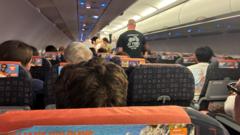
Once these diverted planes landed at alternative airports, passengers were stuck sitting on the tarmac for hours. Because these flights landed at airports they weren't scheduled to visit, there were no free gates, no baggage handlers, and no customs staff ready to receive them. Many travelers spent the night sleeping on plane seats, wondering how they would get home.
Eventually, Gatwick reopened its runway at 4:58 AM. For 11 of those diverted flights, the airline simply kept the passengers on board, refueled the plane, and flew them back to Gatwick early the next morning.
Your Action Plan for Diverted Flight Chaos
If your flight gets diverted, don't just sit there and hope the airline handles everything. Take these immediate steps to protect yourself:
- Keep your phone charged: You'll need to monitor flight tracking apps like Flightradar24 to see where your plane is actually heading before the crew even makes an announcement.
- Don't leave the airport prematurely: If you get diverted to an airport like Stansted, don't immediately book an expensive taxi home. The airline will often refuel the plane and fly you to your original destination once the runway clears. If you leave, you forfeit that ride.
- Keep your receipts: Under UK aviation law (UK261), if your flight is diverted and delayed by hours, the airline is responsible for providing food vouchers, hotel accommodation, or transport back to your original destination. Keep every single receipt for food, water, and transport to claim them back later.
- Check your compensation rights: While you might want to claim cash compensation for a delay, be aware that airlines usually won't pay out if the delay was caused by "extraordinary circumstances" outside their control—such as another airline's plane blocking the runway. However, they still absolutely owe you duty of care, meaning food and transport must be covered.