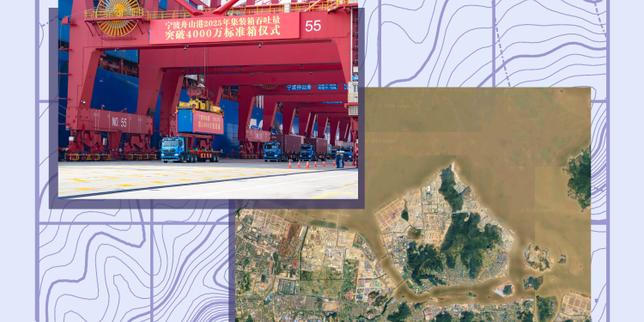
The global logistics sector is obsessed with raw volume. Every year, industry analysts drool over the shipping statistics coming out of Zhejiang province, pointing to the Port of Ningbo-Zhoushan as the undisputed heavyweight champion of global trade. They look at the towering gantry cranes, the endless stacks of colored containers, and the sheer tonnage moving through the East China Sea, declaring it the ultimate monument to unstoppable economic dominance.
They are looking at the wrong metric.
Measuring a port's strength solely by gross tonnage is like judging a tech company's health entirely by its headcount. It is a vanity metric designed to look impressive on state television and in corporate brochures. The lazy consensus insists that Ningbo’s massive throughput represents an unbreakable stranglehold on global supply chains. The reality is far more fragile. Ningbo-Zhoushan is not a monument to invincible trade; it is a highly vulnerable bottleneck operating on razor-thin margins, dangerously exposed to domestic economic stagnation and rapid geopolitical decoupling.
The Tonnage Trap: Why Volume Does Not Equal Value
To understand why the mainstream narrative is flawed, we have to look at what actually moves through Ningbo.
Yes, Ningbo-Zhoushan handles over 1.2 billion tons of cargo annually. But look closer at the cargo mix. A massive percentage of that weight consists of low-value, heavy dry bulk commodities—iron ore, coal, and crude oil destined for domestic industrial processing.
- Dry Bulk vs. High-Value Containerization: Shoveling millions of tons of iron ore off a bulk carrier is a low-margin, high-volume endeavor. It does not generate the high-value logistics services, sophisticated maritime financing, or tech-driven supply chain management that fuels true maritime power.
- The Transshipment Deficit: True maritime hubs like Singapore generate immense wealth because they are transshipment powerhouses. They act as complex, high-margin routing switchboards for global trade. Ningbo, despite its size, remains primarily a gateway port. It functions as a massive, industrial conveyor belt moving raw inputs in and cheap manufactured goods out.
When you strip away the low-margin bulk cargo, the picture changes. London and Singapore dominate maritime finance, insurance, and legal services. Ningbo merely moves heavy objects. If global trade flows shift even slightly, a port built on sheer physical volume faces massive fixed costs with rapidly evaporating revenues.
The Geography Myth: The Double-Edged Sword of Deep Water
Defenders of the Ningbo supremacy narrative always point to its deep-water channels. Because the port can handle 400,000-ton mega-vessels, observers assume it holds a permanent physical advantage.
I have spent years analyzing supply chain infrastructure, and I can tell you that physical scale is becoming a liability, not an asset.
[Mega-Vessel Obsession] ➔ [Extreme Port Congestion] ➔ [Single Point of Failure]
The obsession with massive container ships has forced Ningbo into a cycle of constant, capital-intensive expansion. But here is the catch: when a single 24,000 TEU (Twenty-foot Equivalent Unit) vessel berths, it places an excruciating strain on local landside infrastructure.
The Landside Chokepoint
A port does not exist in a vacuum. To function, the cargo cleared from a ship must be dispersed via highways, rail, and inland waterways.
Imagine a scenario where a single terminal clears three mega-vessels simultaneously. The resulting surge of trucks paralyzes the surrounding regional highway network. The port becomes a victim of its own scale.
During peak shipping seasons, the congestion around Ningbo doesn't just delay local deliveries; it sends shockwaves through the entire global manufacturing ecosystem. By concentrating so much volume in one geographic coordinate, global supply chains have created a massive, fragile single point of failure. When a typhoon hits the Zhejiang coast—an increasingly frequent occurrence—or when a sudden localized lockdown occurs, the entire world's inventory grinds to a halt. This isn't efficiency. It is systemic risk masquerading as progress.
Decoupling is Real, and Ningbo Will Pay the Price
The standard business reporting on Ningbo assumes that the trade lanes between China, Europe, and North America are permanent fixtures of the global landscape. This is wishful thinking.
The Western world is actively re-architecting its supply chains. Nearshoring and "friendshoring" are no longer just buzzwords thrown around at Davos; they are active capital expenditure strategies.
- The Rise of Alternative Hubs: Manufacturing is migrating to Vietnam, India, Mexico, and Poland.
- The Dilution of Chinese Export Dominance: As factories diversify away from the Yangtze River Delta, the massive export volumes that Ningbo relies on to justify its existence will begin to fragment.
What happens to a port designed for infinite growth when global demand plateaus or shifts elsewhere? The massive capital investments made to dredge channels and build automated terminals turn into stranded assets. You cannot easily pick up a deep-water terminal and move it to Vietnam or Mexico. Ningbo is locked into a heavy-infrastructure bet on a version of globalization that is rapidly expiring.
How to Actually Assess Maritime Power
If you want to know who actually controls global trade, stop looking at port rankings sorted by cargo weight. Start looking at the data that matters.
| Metric | The Vanity View (Ningbo) | The Reality View (Singapore/London) |
|---|---|---|
| Primary Driver | Gross Tonnage & Physical Volume | Maritime Services & Capital Flows |
| Value Capture | Low-margin terminal handling fees | High-margin legal, insurance, & finance fees |
| Flexibility | Rigid, localized physical infrastructure | Dynamic, globalized asset-light networks |
| Resilience | Highly vulnerable to localized disruptions | Easily rerouted through digital coordination |
The true rulers of global trade are the entities that control the flow of information, capital, and insurance—not the ones operating the cranes. A strike, a blockade, or a climate event can render a physical port useless overnight. But the digital and financial systems that coordinate global shipping can adapt instantly, routing ships to entirely different regions without losing a dime.
Stop Chasing the Giant
The conventional wisdom tells logistics directors to secure space on the biggest vessels routing through the biggest ports to achieve economies of scale.
That advice is outdated and dangerous.
The companies that will survive the next decade of supply chain volatility are those actively reducing their exposure to massive, centralized bottlenecks like Ningbo. They are diversifying their shipping lanes, utilizing smaller, more agile regional ports, and investing in localized manufacturing.
Relying on the world's largest port because of its sheer size is a lazy strategy. It confuses scale with security, and volume with value. The smart money is already quietly diversifying, leaving the lumbering giants of the Yangtze River Delta to carry the heavy, low-value weight of a bygone era.
If your supply chain strategy relies on the permanent, uninterrupted flow of goods through a single megaport in East Asia, you aren't managing risk. You are gambling on a system that is one crisis away from collapse. Diversify your entry points now, or prepare to watch your inventory sit stranded in the middle of the world's most crowded harbor.

