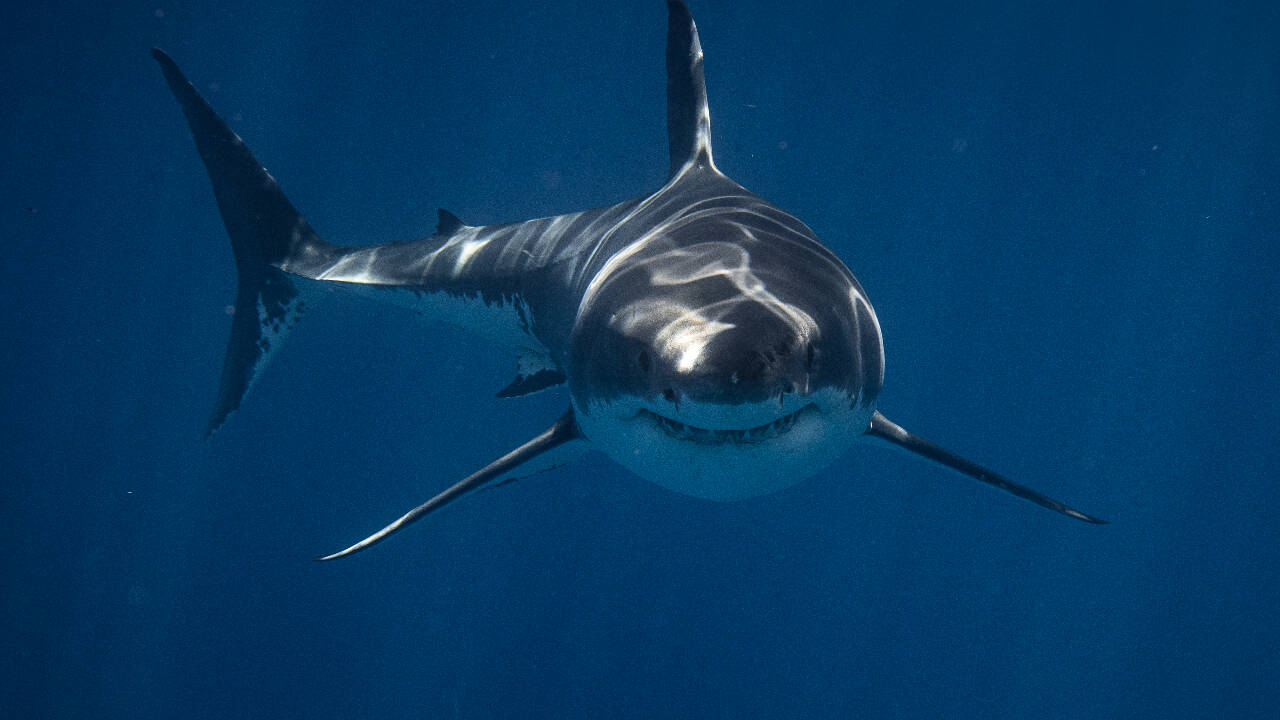
You are floating forty feet below the surface. The sky above is a fractured ceiling of white glass, shimmering and shifting with the swell. The water around you is heavy, thick with salt and the ancient, metallic smell of deep pressure. It is silent. Truly silent. Or so you think.
To your human ears, the ocean is a quiet blue cathedral. But beneath that placid skin, the sea is a riot of noise. It hums with the groan of tectonic plates, the distant percussion of cargo ships churning thousands of miles away, the frantic clicks of snapping shrimp, and the low, resonant thrum of whale song. And cutting through that underwater bedlam is something else. Something older.
Something listening.
Nearly two hundred and fifty feet away, a wild blacktip shark hangs suspended in the grey-green haze. It does not see you. It does not have to. Long before your silhouette materializes in the murky water, long before your bubbles break the surface tension, that shark already knows you are there. It heard the slight compression of your neoprene wetsuit. It heard the rhythmic, desperate flutter of your fins. It heard the pulse of your blood in your ears, translated through the liquid medium that wraps around the world.
We have spent centuries misunderstanding the ocean's apex predators. We paint them as mindless teeth driven by scent, blind hunters tracing blood like alleyway hounds. We obsess over their nostrils, mapping the olfactory lobes that can detect a single drop of crimson in an Olympic-sized pool. But scent is slow. Scent drifts with the current, lazy and easily fooled by the erratic swirl of the tide.
Sound does not wait. Sound travels through water nearly five times faster than it does through air. It is immediate. It is violent in its efficiency.
Consider what happens when a small baitfish panics in the shallows. It twists, a desperate flick of silver muscle against the current. To our ears on the shore, it makes no sound at all. But in the physics of the sea, that single muscle contraction sends out a pressure wave. That wave rolls outward, expanding like an invisible bubble of energy, carrying the geometry of struggle across the reef.
The blacktip shark feels that wave long before the light can catch its eye.
Imagine walking through a dense, pitch-black forest at night. You cannot see your hand in front of your face. But suddenly, you hear the dry snap of a twig fifty yards to your left. Your muscles lock. Your head snaps toward the sound. You don't need sight; your ears have already drawn a map of the danger, or the dinner.
Now multiply that sensitivity by a thousand. That is the world of the blacktip.
Running along the flanks of these sleek, bronze-backed hunters is a line of specialized mechanoreceptive organs known as the lateral line. It looks like a faint, dotted pencil stroke drawn from gill to tail, but it is nothing less than a biological seismograph. It is a series of fluid-filled channels sitting just beneath the skin, dotted with microscopic hair cells that quiver at the slightest displacement of water. When a sound wave passes—whether it is the low-frequency throb of a dying fish or the clumsy thrash of a swimmer—those hair cells bend. They translate kinetic pressure into electrical impulses, firing directly into the shark's brain.
They do not just hear the ocean. They feel it vibrating against their skin.
For a long time, marine biologists debated the limits of this acoustic world. We knew sharks had good hearing, particularly for low-frequency vibrations ranging from ten to several hundred hertz. We knew they were drawn to erratic, sputtering sounds—the acoustic signature of distress. But the exact boundaries of their awareness remained hazy, locked behind the difficulty of studying wild, fast-moving pelagic predators in their native domain without altering their behavior.
Recent behavioral and acoustic tracking studies have pulled back the curtain, revealing an astonishing auditory horizon. Under natural conditions, a wild blacktip shark can detect and home in on acoustic cues from nearly two hundred and fifty feet away.
Pause on that distance for a moment. Two hundred and fifty feet. That is nearly the length of a football field. In water, where visibility can sometimes be measured in arm's lengths, two hundred and fifty feet of hearing radius turns a shark from a localized hunter into an omniscient presence.
When we step into the ocean, we step into a sensory theater where we are profoundly, deafly handicapped. We are clumsy giants flailing in the dark, making a racket we cannot fathom. Every kick of a fin, every heavy scrape of scuba gear, every splash from a surfboard acts like a flare sent out into the acoustic dark. We feel hidden because the water distorts our vision, blurring our horizon. But to the blacktip resting a hundred yards away in the gloom, we are ringing a dinner bell that echoes across the reef.
This changes the entire narrative of human-shark encounters. For generations, shark attacks have been framed as random tragedies, sudden strikes out of nowhere by monsters lurking in the murk. But the reality is far more intimate, and far more technical. It is an acoustic collision. A splash in turbid water does not look like a fish, but it sounds like one. To a creature whose primary worldview is built on vibrations, the mistake is not malice; it is a trick of the physics of sound.
There is a humbling vulnerability in realizing this. We are used to being the dominant sensory species on land, our eyes and intellect ruling the terrain. But the moment we submerge ourselves, we enter an alien domain where we are effectively blind, deaf, and loud. We are shouting in a library where everyone else has supernatural hearing.
The next time you stand at the edge of the sea, watching the white foam break against the sand, look past the horizon. Listen to the rhythmic crash of the waves. Beneath that surface roar, imagine the quiet, listening dark. Imagine the blacktip hanging motionless in the current, two hundred and fifty feet away, registering the subtle shift of the tide, the heartbeat of the ecosystem, and the quiet, heavy splash of your feet entering the water.
The ocean is never empty. It is always listening.