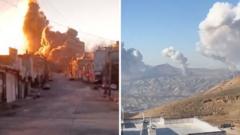
The footage currently hemorrhaging across social media—grainy cell phone clips of orange glows over Tehran and dashcam videos of missiles streaking through the Isfahan night—tells only the surface story of a shattered status quo. On February 28, 2026, the joint US-Israeli offensive known as Operation Epic Fury did more than just strike military coordinates. It effectively liquidated the top tier of the Iranian leadership, including Supreme Leader Ayatollah Ali Khamenei and his inner circle, while simultaneously dismantling the country's integrated air defense network.
While superficial reports focus on the "scale" of the strikes, the true narrative lies in the clinical precision of a campaign designed to induce immediate systemic collapse. This was not a warning shot; it was a decapitation. Within the first ninety-six hours, US and Israeli forces conducted over 2,000 sorties, establishing what General Dan Caine, Chairman of the Joint Chiefs of Staff, described as "local air superiority" over the most heavily defended sectors of the Islamic Republic.
The Strategy of Systemic Paralysis
The bombardment followed a three-pronged doctrine: suppress, degrade, and disrupt. The initial wave relied on long-range standoff munitions, including Israeli air-launched ballistic missiles and US Tomahawks, to blind Iranian radar arrays. Once the "eyes" of the regime were darkened, non-stealth assets like B-1B Lancers began operating with startling freedom, dropping heavy ordnance on hardened underground facilities.
What many analysts missed in the early hours was the deliberate targeting of the Basij regional bases and the Sarallah Headquarters. By hitting these specific command nodes, the coalition didn't just target soldiers; they targeted the regime’s domestic enforcement mechanism. This left the internal security apparatus leaderless and unable to effectively suppress the localized protests that began bubbling up in the wake of the strikes.
Key Targets and Confirmed Damage
- Tehran: The Assembly of Experts building and the Atomic Energy Organization of Iran (AEOI) headquarters were hit. Reports indicate the "stand-in" munitions used were designed to penetrate specific floors without leveling the surrounding urban blocks.
- Natanz: For the first time in decades of tension, the Natanz nuclear facility suffered direct kinetic hits. Satellite imagery confirms the destruction of at least three major structures within the complex.
- Bandar Abbas: The IRIS Kurdistan and other naval assets were neutralized, preventing the IRGC Navy from effectively sealing the Strait of Hormuz.
The Fog of Synthetic War
The visual record of this conflict is being poisoned at a rate never before seen in modern warfare. While genuine clips of the Imam Ali Missile Base explosions are circulating, they are drowning in a sea of sophisticated fakes. Investigative analysis has identified a massive influx of AI-generated content designed to manufacture panic or false victories.
One viral video, purportedly showing Iranian fighter jets over Dubai, was debunked by forensic digital analysts who noticed the "melting" geometry typical of generative tools. Another widely shared image of Khamenei’s body under rubble was confirmed to be a synthetic fabrication containing hidden digital watermarks. This isn't just "fake news"; it is a parallel theater of war where the goal is to obscure the actual military reality on the ground.
The IRGC has attempted to fill the information vacuum by recycling footage from the 2025 regional skirmishes, claiming they have downed US F-15E Strike Eagles over Iranian soil. In reality, the only confirmed US losses were three airframes lost to friendly fire in Kuwaiti airspace.
The Hormuz Chokepoint and Global Shockwaves
The economic fallout is no longer a theoretical "tail risk." It is an active crisis. With the Strait of Hormuz currently under a de facto blockade, vessel traffic has plummeted by 70%. This has sent the global automotive and energy industries into a tailspin.
Major shipping lines, including Maersk and MSC, have suspended all transits through the Persian Gulf. The impact on the global economy is immediate. In the United States, fuel prices have jumped significantly, while in Europe, the threat of a complete natural gas shortfall is forcing emergency policy shifts. The Trump administration’s insistence that the US Navy will escort tankers "if necessary" has yet to be fully tested, as the risk of Iranian "swarm" drone attacks remains high despite the degradation of their primary naval bases.
The Mirage of Regime Change
The coalition's stated goal of "regime change" ignores the messy reality of what follows a power vacuum in a nation of 88 million people. While Ali Larijani has emerged as a central figure in an interim council, the IRGC remains a potent, if bruised, force.
The Iranian military's response has been fractured but lethal. They have pivoted to "asymmetric retaliation," launching ballistic missiles not just at Israel, but at civilian infrastructure in the UAE, Qatar, and Bahrain. By hitting the Dubai International Airport and oil facilities in Oman, Tehran is trying to force the regional players to sue for peace. They are betting that the world’s appetite for expensive gasoline and closed flight paths is shorter than their own will to survive.
The brutal truth is that while the air campaign has been a technical masterpiece of Western military might, the political endgame is a gamble of historic proportions. Destroying a radar site is easy. Managing the fallout of a collapsed state at the world’s most critical energy chokepoint is another matter entirely.
Watch the skies over Tehran, but keep your eyes on the tankers in the Gulf. That is where the war will be won or lost.
Would you like me to analyze the latest satellite imagery coming out of the Natanz facility to determine the extent of the damage to the enrichment halls?