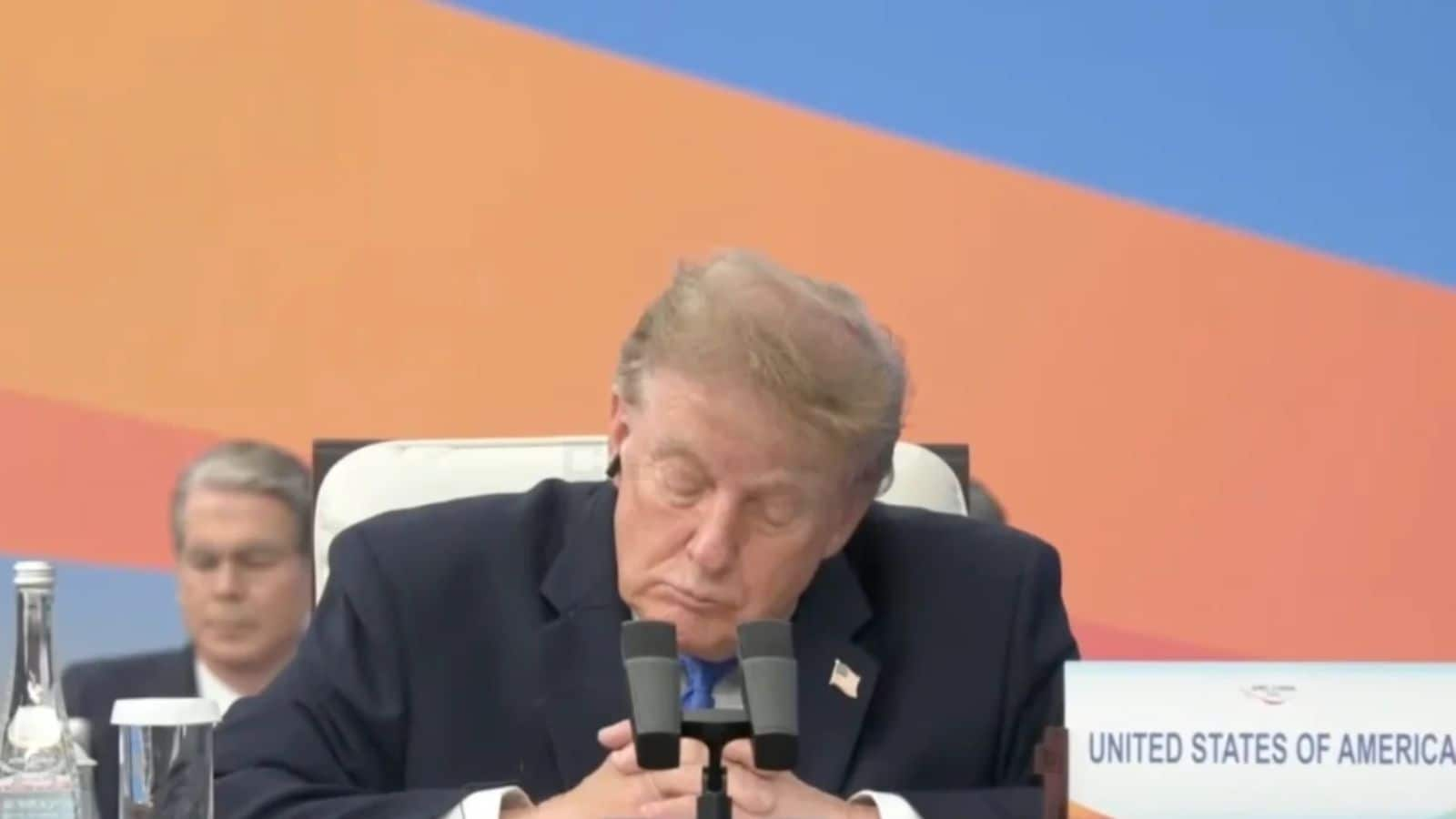
Public perception in international diplomacy frequently hinges on micro-behaviors rather than policy communiqués. When broadcast feeds capture a head of state closing their eyes during a counterpart’s keynote address—such as the circulated footage of Donald Trump appearing to doze off while Xi Jinping addressed Asia-Pacific Economic Cooperation (APEC) leaders in Shenzhen—media coverage typically defaults to partisan framing or superficial commentary. Analysts and political strategists must look past the viral clip to evaluate the underlying operational mechanics, physiological stressors, and diplomatic signaling theories at play.
The core issue is not merely whether an executive experienced a momentary lapse in alertness, but how modern media ecosystems weaponize physiological fatigue into geopolitical narratives. Understanding this phenomenon requires separating verifiable video evidence from speculative intent, mapping the biological realities of trans-Pacific diplomacy, and analyzing the strategic asymmetry of live summit broadcasts. If you found value in this article, you might want to read: this related article.
Deconstructing the Incident and Evidentiary Boundaries
In any rigorous intelligence or media analysis, the primary step is establishing the boundary between empirical observation and inferential leap. The reference material centers on video footage from an APEC leaders' session in Shenzhen, China, during which Chinese President Xi Jinping delivered formal remarks. Camera cuts to the U.S. delegation captured President Donald Trump with his eyes closed for several seconds, exhibiting stillness consistent with micro-sleep or deep concentration.
Three distinct interpretations emerge from this single visual data point, each carrying different analytical weight: For another look on this story, check out the latest coverage from Reuters.
- Physiological Micro-Sleep: A brief, involuntary episode of unconsciousness lasting from a fraction of a second up to thirty seconds, triggered by acute sleep deprivation and circadian misalignment.
- Cognitive Conservation and Auditory Focus: A deliberate behavioral habit where an individual closes their eyes to eliminate visual stimuli and focus entirely on simultaneous interpretation feeds through an earpiece.
- Performative Disengagement: A calculated, non-verbal signal designed to project indifference toward a geopolitical rival's prepared talking points.
Without biometric telemetry or direct confirmation from the principal, asserting one interpretation as absolute fact violates analytical discipline. Media outlets that headline the event with qualifiers such as "appears to doze off" acknowledge this evidentiary limitation while simultaneously capitalizing on the visual ambiguity to drive engagement.
The Physiological Cost Function of Trans-Pacific Diplomacy
To evaluate the probability of genuine fatigue versus deliberate signaling, one must examine the operational cadence of presidential travel across the International Date Line. Traveling from Washington, D.C. (UTC-5) to Shenzhen (UTC+8) imposes an immediate 13-hour circadian phase shift.
Human circadian biology governs alertness through the suprachiasmatic nucleus, which regulates melatonin secretion and core body temperature. Under standard operational conditions, the human body adjusts to time zone shifts at a rate of roughly one to one-and-a-half hours per day. High-level diplomatic summits rarely afford principals a ten-day acclimation buffer. Instead, executives operate on compressed schedules characterized by:
- Sleep Architecture Fragmentation: Long-haul flights, even aboard specialized government aircraft equipped with sleeping quarters, subject passengers to low cabin humidity, engine vibration, and constant operational interruptions from security and policy briefings. This degrades slow-wave and REM sleep cycles.
- High Cognitive Load: Bilateral pull-asides, trade negotiations, and real-time crisis management demand continuous executive function, rapidly depleting metabolic glucose reserves in the prefrontal cortex.
- Environmental Triggers: Plenary halls at multilateral forums like APEC feature uniform ambient lighting, calibrated HVAC systems, and monotonous acoustic profiles—especially when listening to translated speeches delivered in a measured, formal cadence.
When a 13-hour circadian trough intersects with post-prandial metabolic dips and a low-stimulation plenary environment, the biological drive for sleep overrides conscious willpower. In human factors engineering, this is recognized as a predictable system failure rather than a moral or strategic lapse.
Diplomatic Signaling Theory and Visual Asymmetry
In international relations, Thomas Schelling’s theories on strategic signaling establish that actions and demeanor communicate intent alongside formal rhetoric. However, effective signaling requires that the sender control the medium and that the receiver accurately decodes the message. Multilateral summits hosted by rival powers introduce severe visual asymmetry.
Host nations exercise near-total control over the primary broadcast pool feed inside plenary venues. Camera placement, focal length, and switching rhythms are directed by the host's production apparatus. This creates a structural vulnerability for visiting delegations:
- Asymmetric Framing: The host speaker is typically framed in wide, commanding angles surrounded by national insignia, projecting institutional stability and vigor. Conversely, reaction shots of visiting leaders are selective and brief, often capturing unguarded transitions between listening, note-taking, and resting.
- The Translation Lag: Simultaneous interpretation introduces a three-to-five-second delay between the speaker's vocal inflection and the listener's comprehension. A listener waiting for an interpreter to complete a complex syntactical clause often adopts a static, downward-gazing posture that mimics drowsiness on a high-definition telephoto lens.
- Context Stripping: Short-form digital distribution strips away the surrounding two hours of active engagement. A ten-second clip extracted from a multi-hour session creates an availability heuristic, convincing viewers that the isolated moment defines the entire diplomatic engagement.
If a leader intends to signal displeasure or boredom diplomatically, subtle eye closure is an inefficient mechanism because it risks projecting weakness rather than dominance. True diplomatic snubbing relies on overt, unmistakable actions—such as arriving late, visibly conferring with aides during a speech, or departing the chamber early. Appearing asleep invites domestic and international critiques regarding stamina and competence, making it a net negative for the principal's brand.
Media Economics and the Attention Arbitrage
Competitor coverage of such incidents thrives on a straightforward economic model: converting complex geopolitical friction into easily digestible personal drama. Policy disagreements over Pacific trade frameworks, semiconductor supply chains, or maritime security require substantial reader background to parse. A visual clip of a leader with closed eyes requires zero context to trigger an emotional reaction.
This dynamic illustrates how modern newsrooms execute attention arbitrage:
- Visual Hook Extraction: Editors isolate a brief, ambiguous moment from hours of routine pool footage.
- Hedging Language Deployment: Headlines utilize verbs like "appears," "seems," or "caught on camera" to protect against factual inaccuracy while implying a definitive lapse.
- Narrative Reinforcement: The clip is slotted into pre-existing political frames—either questioning the physical vitality of an aging leader or highlighting disrespect toward an international adversary.
The limitation of this coverage model is its complete detachment from substantive outcomes. Whether a leader blinks slowly, rests their eyes during a translated address, or experiences a brief micro-sleep has zero bearing on tariff schedules, bilateral security guarantees, or communiqués negotiated behind closed doors by sherpas and cabinet secretaries.
Operational Countermeasures for Executive Teams
For chiefs of staff, advance teams, and communications directors managing principals in high-stakes international environments, preventing optics failures requires systematic operational engineering rather than simple reminders to stay alert.
Pre-Deployment Circadian Shifting
Advance medical and scheduling teams should initiate a phased circadian adjustment protocol at least 72 hours prior to departure. Utilizing targeted light-therapy exposure and controlled sleep windows helps shift the principal's biological clock closer to the destination time zone before wheels-up, reducing the acute performance trough during the first 48 hours on the ground.
Plenary Schedule Engineering
Schedulers must audit the itinerary to eliminate back-to-back low-stimulation events during the principal's biological nadir (typically corresponding to 2:00 AM to 5:00 AM in their home time zone). High-visibility plenary sessions should be preceded by brief, high-engagement bilateral meetings or physical movement rather than heavy meals or prolonged seated briefings.
Environmental and Tactical Adjustments
Within the plenary hall, staff can implement simple physical interventions to disrupt visual monotony:
- Active Note-Taking: Placing structured briefing cards and a pen directly in front of the principal encourages downward hand movement and visual engagement, reframing a downward gaze as active review rather than fatigue.
- Hydration and Micro-Breaks: Scheduling discreet hydration drops or briefing updates from senior advisors every 20 minutes during lengthy multilateral speeches resets posture and breaks the static camera frame.
- Earpiece Optimization: Ensuring custom-molded acoustic earpieces are used instead of standard venue headsets reduces auditory strain, preventing the principal from closing their eyes to concentrate on muffled translation audio.
Strategic Forecast
As multilateral diplomacy increasingly unfolds under continuous, high-definition surveillance, unguarded physiological moments will remain primary ammunition in information warfare and domestic political messaging. Communications teams cannot rely on legacy media norms to contextualize brief lapses in executive posture. Instead, operations teams must treat circadian management and visual counter-surveillance with the same rigor applied to physical security and policy preparation. Organizations and political campaigns that fail to engineer their principals' biological schedules around peak broadcast windows will continue to cede narrative control to a single, out-of-context camera cut.