The rain in Sussex has a particular way of sticking to the soul. It isn’t a clean, cinematic mist; it’s a heavy, persistent dampness that turns a pristine football pitch into a swamp within forty-five minutes.
For years, this has been the unglamorous reality for women playing the beautiful game. They have been the permanent guests, the polite lodgers in someone else’s house. They play on the "secondary" pitches. They kick off at odd hours—Sunday afternoons at 2:00 PM once the men’s under-21s have finished churning up the turf, or cold Wednesday nights when the stadium lights feel like they’re being used on a budget.
When you are a guest, you learn to be small. You learn to ignore the fact that the locker rooms weren't designed for your body. You ignore the fact that the "home" fans are sitting in stands draped in colors and trophies that don't belong to your team’s history. You play, you shower, and you leave before the real owners show up to sweep the floors.
But Brighton & Hove Albion has decided that the era of the polite guest is over.
The Geography of Belonging
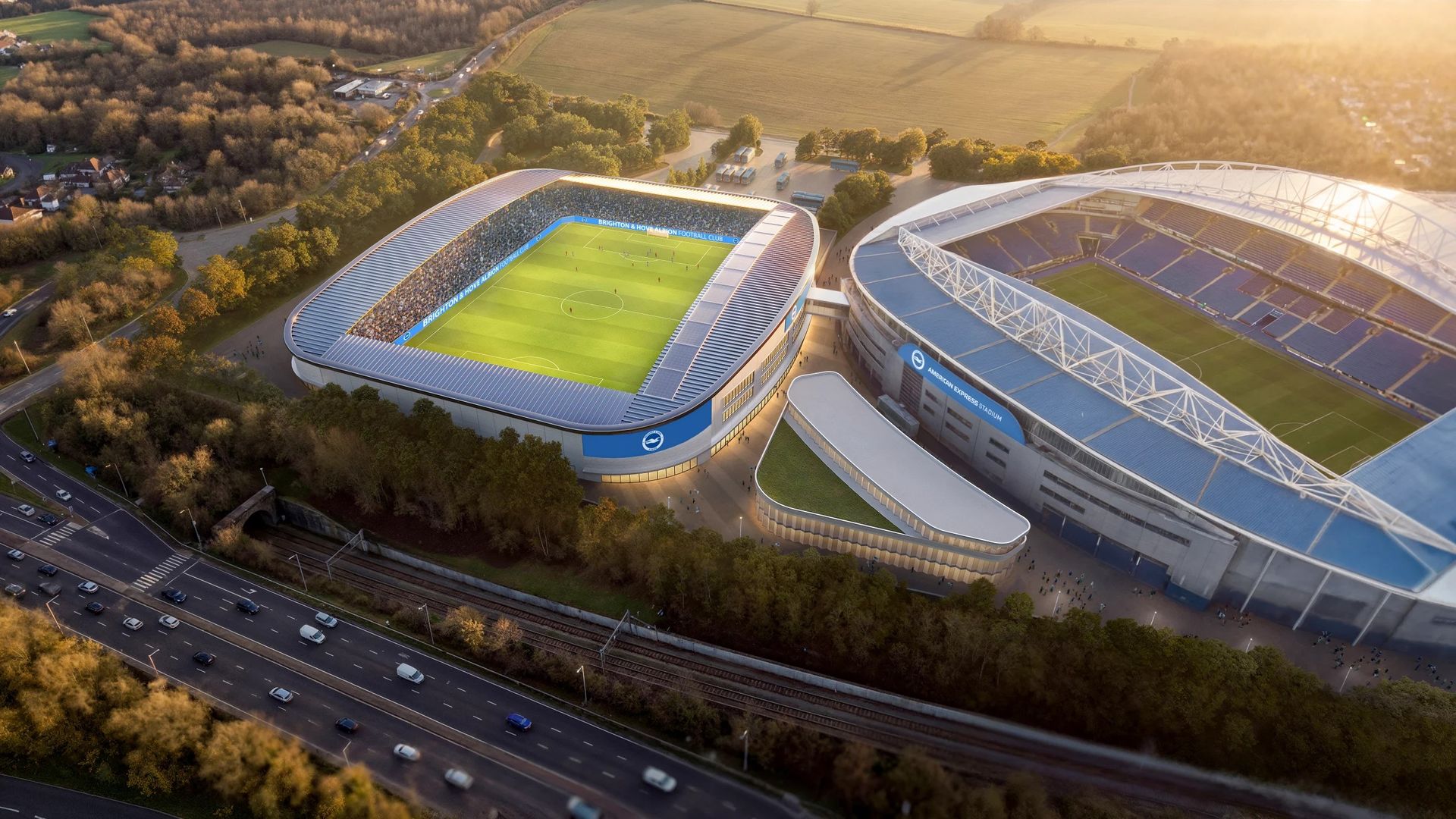
Brighton is set to build Europe’s first purpose-built stadium designed specifically for a women’s football team. This isn’t a renovation. It isn’t a hand-me-down from a local rugby club or a refurbished non-league ground three towns over. It is a ground-up declaration of worth.
To understand why this matters, you have to look at the current map of the Women’s Super League. Most teams are nomads. They play miles away from the city centers they represent, tucked away in suburban pockets that require two trains and a long walk to reach. It’s hard to build a community when the "home" ground feels like an outpost.
Imagine a ten-year-old girl named Maya. In this hypothetical but very real scenario, Maya lives in the heart of Brighton. She wears the blue and white stripes. She wants to see her heroes—players like Pauline Bremer or Maisie Symonds. Currently, that journey involves a trek. It feels like an excursion. When she arrives at the stadium, she sees the ghosts of a hundred years of men's football.
Now, imagine Maya walking into a stadium where every brick was laid with her heroes in mind. The sightlines are optimized for the atmosphere of the women’s game. The acoustics are designed so that five thousand voices sound like fifty thousand. The murals on the walls aren't of legends from the 1970s that she’s only seen in grainy black-and-white clips. They are of the women she saw on television last week.
The club has identified a site at Horsdean. It’s a choice that reflects a broader strategy of integration rather than isolation. By planting a flag here, Brighton is saying that women’s football isn’t a charity project or a line item in the CSR budget. It is a commercial and cultural powerhouse that deserves its own front door.
The Physics of the Pitch
There is a technical argument for this move that often gets drowned out by the emotional one. Football is a game of friction and physics. When a women’s team plays on a pitch that has just been decimated by a heavy-set men’s squad the night before, the quality of play suffers. The ball bobbles. The slick, passing transitions that define the modern WSL become treacherous.
Building a dedicated stadium allows for a specific type of turf management tailored to the frequency and style of the women’s game. It allows for a world where the grass is always exactly 25mm high, watered precisely to allow for the zipping speed of a low cross.
But the "purpose-built" label goes deeper than the grass. It’s about the infrastructure of performance.
Most existing stadiums were built in an era when women’s sports were an afterthought. The medical rooms, the recovery tubs, even the height of the mirrors in the dressing rooms were calibrated for a different demographic. When Brighton builds this stadium, they are building a high-performance lab. They are creating an environment where the "one percent gains" that winning teams obsess over are actually possible because the environment isn't working against them.
A Business Case Written in Blood and Sweat
Critics will point to the ledger. They will ask if the numbers "stack up." They will wonder why a club would spend millions on a bespoke home when they could just keep sharing.
These critics are looking at the past, not the trajectory.
Women’s football is currently experiencing a gold rush of attention, but it is hampered by a lack of inventory. You cannot sell a "premium experience" if your fans are standing on a rain-slicked terrace with a view blocked by a rusty pillar. You cannot build a loyal season-ticket base if the kickoff times are moved every time the men’s team draws a televised cup tie.
A dedicated stadium creates "certainty." Certainty is the bedrock of business. It allows for better sponsorship activations. It allows for a consistent match-day ritual—the same pub, the same walk to the ground, the same seat. It turns a "match" into an "event."
Brighton’s leadership, spearheaded by chairman Tony Bloom and chief executive Paul Barber, has long been praised for its data-driven approach to the men’s game. They don’t gamble; they calculate. The decision to invest in a women-first stadium is perhaps the loudest endorsement of the sport’s financial viability in a decade. They aren't doing this because it’s "nice." They are doing it because they believe that in fifteen years, a dedicated women's stadium will be as essential to a top-tier club as a training ground.
The Invisible Stakes
There is a weight to being a pioneer. Brighton is currently navigating the complexities of planning permissions, environmental impact studies, and local consultations. The site at Horsdean is nestled near the South Downs National Park, meaning the architecture must be sensitive, sustainable, and subtle.
This isn't just about sport; it's about urban planning. It’s about how a city integrates its heroes into its landscape.
If this succeeds—and the momentum suggests it will—it creates a blueprint for the rest of Europe. It puts pressure on the "big six" clubs who still house their world-class women’s stars in aging, borrowed facilities. It makes the "guest" model look obsolete. It makes it look cheap.
Think back to the feeling of having your own room for the first time. The shift in psychology that happens when you stop asking for permission to hang a picture on the wall. That is what is happening in Brighton.
The players will no longer look at the clock, wondering if they’ve overstayed their welcome on the training pitch. The fans will no longer feel like they are watching a fringe event. They will be the center of the universe.
The First Whistle
One day soon, a referee will blow a whistle at Horsdean. The sound will echo off stands that were built specifically to catch that noise and throw it back onto the pitch.
There will be no lingering scent of a men’s match from the day before. There will be no mismatched branding hastily covered up with vinyl banners. There will just be the green, the blue, and the white.
A young girl will walk through a turnstile that was built for her. She will sit in a seat that offers a perfect view of a game she knows she can one day play professionally. She will look down at the grass and know that no one is going to ask her team to move because the "real" game is about to start.
The real game is already happening. And it finally has a home.