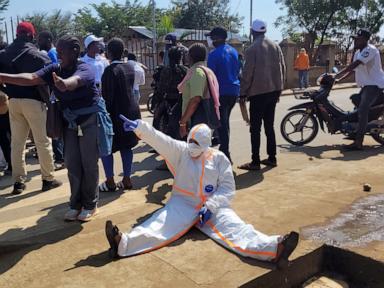
Everyone loves a clean villain. When headlines flash across the screen about healthcare workers protesting at the epicenter of a Congo Ebola outbreak because of unpaid hazard stipends, the moral outrage writes itself. Greedy ministries. Corrupt bureaucrats. Forgotten heroes risking their lives in biohazard gear while their pockets stay empty. It is a neat, emotionally satisfying narrative.
It is also completely wrong.
I have watched international aid money flow into hot zones for decades, and every time disaster strikes, the knee-jerk prescription remains identical: throw cash at the ground-level operators. Fix the paycheck, fix the outbreak. That is the lazy consensus. It assumes that humanitarian crises operate like corporate payroll departments, where discontent is merely a line-item budgeting failure.
Look closer at the mechanics of outbreak containment on the ground in the Kivu or Equateur provinces, and the standard humanitarian playbook falls apart. Pumping sudden, inflated cash bonuses into a fragile local economy during a bio-emergency does not stabilize the response. It short-circuits it.
The Economics of Crisis Cash
Imagine a scenario where a local nurse in a rural Congolese health zone normally earns thirty dollars a month, a standard baseline in a collapsed state economy. Suddenly, international emergency response funds arrive. Daily stipends for Ebola contact tracers and treatment center staff are pegged at fifty dollars a day. Overnight, a local clinic worker is pulling in fifteen times the income of the local schoolteacher, the magistrate, or the agricultural extension officer.
What happens next? The local economy fractures.
Prices for basic staples in the immediate vicinity of the treatment centers spike instantly. Landlords triple rents. The fragile social fabric that keeps a community functioning during a crisis tears open, replaced by hyper-inflationary localized bubbles centered entirely around the foreign aid pipeline.
More dangerously, you create a perverse incentive structure. When public health interventions become the highest-paying enterprise in a destitute region, containment stops being a public service and turns into a scramble for employment.
I have seen local administrators artificially prolong reporting metrics because the moment the caseload drops to zero, the international funds dry up and the hazard pay vanishes. When the financial incentive is tied to the existence of the plague, nobody has a career incentive to eradicate it. You incentivize the management of the crisis, not its termination.
The Data We Refuse to Look At
Public health agencies like the World Health Organization and Médecins Sans Frontières operate under the assumption that worker dissatisfaction directly correlates with operational failure. Yet field data from successive Central African epidemics tells a different story.
The primary driver of transmission inside treatment units is rarely a lack of motivation from underpaid staff. It is administrative bloat, supply chain bottlenecks, and the massive friction of operating complex infection-control protocols in active conflict zones.
When strikes happen, international media focuses entirely on the missing cash. They ignore the structural paralysis caused by parallel financing streams. Foreign NGOs bypass local ministries entirely, setting up rival administrative hierarchies that poach the best doctors and nurses away from routine childhood vaccination, malaria treatment, and maternal health clinics.
By hyper-focusing on hazard pay disputes, we treat the symptom while actively worsening the disease. We drain the local health system of permanent talent, turning lifelong medical professionals into mercenary hazard-pay chasers who vanish the moment the international caravan moves on to the next disaster.
The Alternative Nobody Wants to Fund
If throwing cash at strikes is a trap, what is the fix? It requires a brutal, unglamorous pivot that international donors hate because it lacks a quick photo-op.
Stop funding vertical, emergency-only disease silos. Build permanent state capacity.
Fixing health worker retention in volatile regions means regularizing salaries through predictable, domestic fiscal frameworks, not showering them with sudden cash drops funded by foreign donors who panic every time a filovirus mutates. It means investing in institutional security, proper supply chains, and basic labor protections that exist before the outbreak hits the village.
Admitting this truth comes with a heavy downside. It means accepting that you cannot fast-track a functional healthcare system with a suitcase full of per diems during week two of an epidemic. It means acknowledging that structural neglect takes years to build and years to dismantle, and no amount of emergency protesting will change the underlying math of state failure.
Stop pretending that a delayed wire transfer is the root cause of epidemic persistence. The next time the protests start, look past the picket lines and ask who is profiting from the permanent state of emergency.
Until we stop treating biological crises as temporary cash events, the strikes will continue, the cash will vanish, and the virus will keep winning.