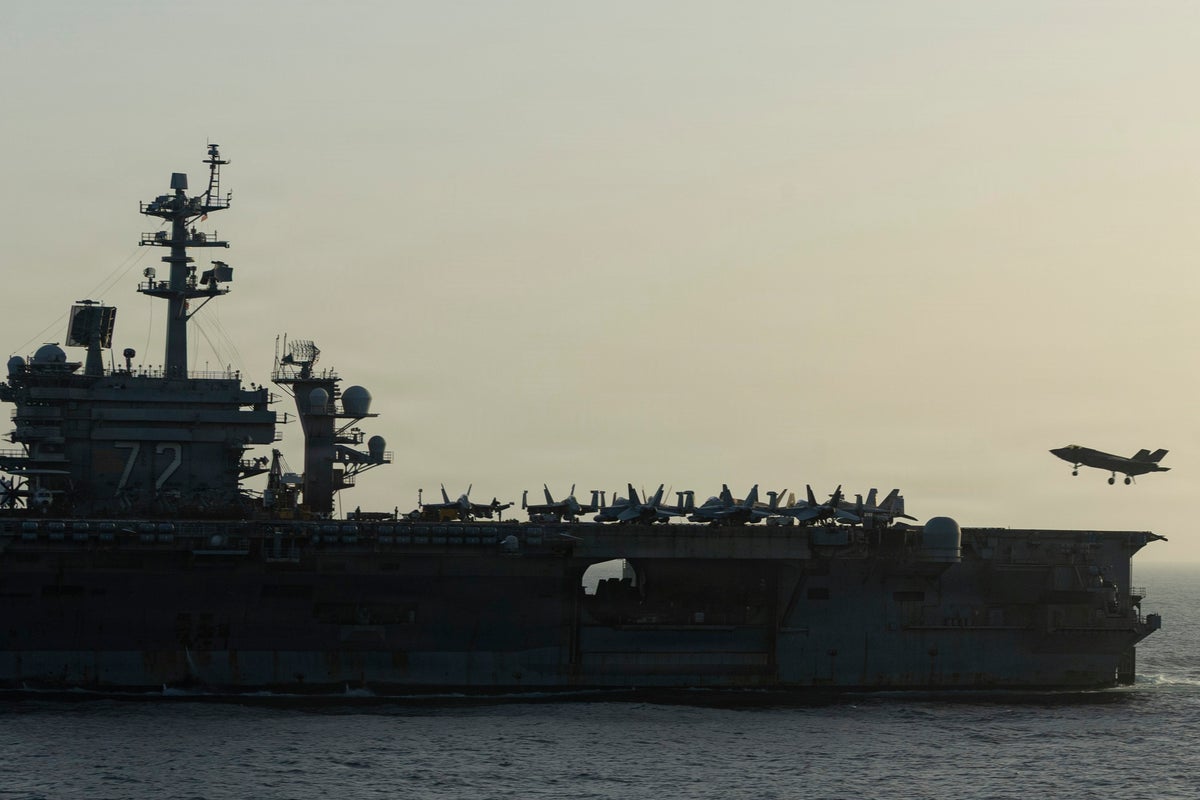
The United States military is currently confronting a math problem it cannot solve with a printing press. For decades, the American defense establishment operated under the assumption that its technological superiority would allow for short, decisive engagements that required limited stockpiles of high-end munitions. The ongoing conflict involving Iranian proxies and direct exchanges with Tehran has shattered that illusion. Washington has spent billions of dollars on interceptors and strike missiles in a matter of months, exhausting supplies that take years to manufacture. We are seeing a historic transfer of wealth from the American taxpayer to the desert floor, with little to show for it in terms of long-term deterrence.
The crisis is not just about the money spent; it is about the rate of consumption versus the rate of replacement. When a $2 million Patriot missile is used to down a $20,000 "suicide" drone, the economic attrition favors the insurgent. This lopsided exchange has pushed the Department of Defense into a corner. Internal reports and logistical data suggest that the U.S. Navy and Air Force have utilized more critical munitions in the last year of Middle Eastern operations than they produced in the previous three. The shelf is becoming bare.
The Industrial Base Bottleneck
The American defense industry is a shadow of its Cold War self. During the 1980s, dozens of "prime" contractors competed for builds, maintaining vast floor space and a surplus of skilled labor. Following the "Last Supper" in 1993—where the Pentagon told defense executives to merge or die—the industry consolidated into a handful of giants. These companies now prioritize "just-in-time" delivery to maximize shareholder value.
This lean manufacturing model is a disaster for a sustained war. If the U.S. uses 500 SM-6 interceptors in a regional flare-up, it cannot simply order more for delivery next week. The lead time for the specialized rocket motors and guidance chips used in these weapons is often 18 to 24 months. The supply chain is brittle. A single factory fire or a shortage of high-grade chemicals can halt the entire production line for a year.
We are currently witnessing a "hollowed-out" surge capacity. While the Pentagon announces massive contracts to replenish stocks, these are merely promises of future hardware. The physical reality is that the machines required to build these weapons are running at maximum capacity already. There is no "extra" gear to shift into.
The Cost of Interception
Defense analysts often focus on the tactical success of an intercept. They see a fireball in the sky and mark it as a win. However, the strategic reality is a slow-motion defeat. Iran and its affiliates have mastered the art of "cheap mass." By launching waves of low-cost drones and ballistic missiles, they force the U.S. to choose between letting a target be hit or firing a multimillion-dollar interceptor.
Consider the math of a typical engagement in the Red Sea.
- An Iranian-designed drone costs approximately $15,000 to $30,000.
- The U.S. Navy often fires two SM-2 or Evolved Sea Sparrow missiles to ensure a "kill" on a single incoming threat.
- Each of those missiles costs between $1 million and $2.1 million.
This is not a sustainable way to fight. The U.S. is essentially trading a Ferrari for a used bicycle every time it engages. Over the course of a six-month deployment, a single carrier strike group can expend a significant portion of its total magazine depth. Once those vertical launch system (VLS) cells are empty, the ship must return to a specialized port to reload. There is no way to reload these missiles at sea in heavy swells, a vulnerability that adversaries are keen to exploit.
Misplaced Priorities in Procurement
For twenty years, the Pentagon focused on counter-insurgency operations in Iraq and Afghanistan. This required "dumb" bombs, small arms, and protected vehicles. The high-end, "near-peer" fight—the kind that requires long-range anti-ship missiles and advanced air defenses—was treated as a secondary concern. The result is an inventory weighted toward the wrong century.
Billions were diverted into prestige projects like the F-35 or littoral combat ships that lacked the teeth for a real fight. Meanwhile, the production lines for the "workhorse" missiles were allowed to stagnate. We find ourselves in a position where we have the most advanced delivery platforms in the world, but not enough of the actual "bullets" to put in them.
The reliance on a few specific vendors has also stifled innovation. Smaller, more agile tech firms that could produce cheaper, attritable drones or interceptors are often locked out of the process by the "Valley of Death." This is the gap between a successful prototype and a full-scale production contract. Most startups go bankrupt before they can navigate the Pentagon's five-year budget cycles.
The Silicon Problem
Modern missiles are essentially flying supercomputers. They require high-end semiconductors, many of which are sourced from overseas. While the "CHIPS Act" aims to bring manufacturing back to the U.S., the transition will take a decade. In the meantime, the defense industry is competing with consumer electronics for the same limited supply of high-grade components.
Furthermore, these weapons require "defense-grade" materials like thermal batteries and specialized explosives that are produced by only one or two facilities in the entire country. If one of those facilities goes offline, the entire national defense strategy effectively pauses. This isn't a hypothetical risk. In recent years, production of certain air-to-air missiles was delayed because a single sub-contractor could not find enough qualified welders for a specific component.
Deterrence by Exhaustion
The most dangerous aspect of the current situation is the message it sends to other global powers. China and Russia are watching the depletion of American stockpiles with intense interest. Every interceptor fired at a Houthi drone is one less interceptor available for the defense of Taiwan or Eastern Europe.
The strategy of our adversaries is clear: engage the U.S. in "peripheral" conflicts to drain its high-end capacity. They want us to burn through our billions. They want our magazines empty.
To fix this, the U.S. must move away from the "exquisite" weapon mindset. We need a "high-low" mix of munitions. We cannot afford to keep using the military equivalent of a surgeon’s scalpel to swat a fly. We need thousands of cheap, mass-produced interceptors that cost $50,000, not $2 million. We need the ability to reload at sea. Most importantly, we need to treat the defense industrial base as a strategic asset rather than a series of private companies solely focused on quarterly earnings.
The era of the "unlimited" American arsenal is over. Unless the Pentagon radically changes how it buys, builds, and employs its weapons, the next major conflict will be lost not because of a lack of bravery or technology, but because we simply ran out of things to fire. The logistics of the future demand a return to the industrial scale of the past. Stop buying gold-plated solutions for paper-thin threats.