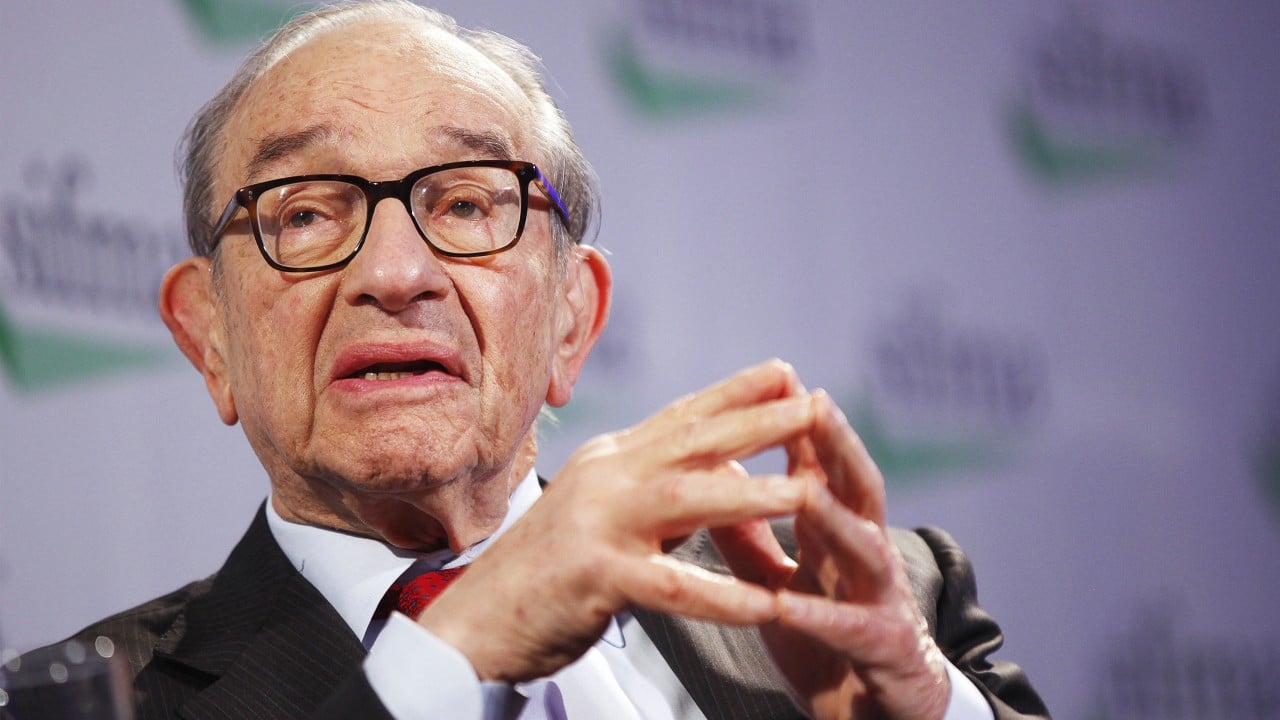
Alan Greenspan is dead at 100. His wife, NBC News correspondent Andrea Mitchell, confirmed he passed away Monday from Parkinson's disease complications.
For nearly two decades, this man controlled the financial steering wheel of the world. Wall Street treated his words like holy scripture. Politicians feared him. Everyday citizens didn't understand what he was saying, but they trusted him anyway because their stock portfolios were up. They called him the Maestro and the Oracle.
Then the housing market crashed.
The legacy Greenspan left behind isn't a simple story of triumph. It's a cautionary tale about what happens when you treat economic models like infallible religion. If you want to understand why your mortgage rate is wild or why the financial system feels permanently fragile, you have to look at the decisions Greenspan made decades ago. He shaped our financial reality.
The Myth of the Financial Wizard
Greenspan took the reins of the Federal Reserve in August 1987. President Ronald Reagan appointed him. Only two months later, the stock market suffered its worst single-day crash in history. Black Monday wiped out over twenty percent of the market value in a few hours.
Most new leaders would panic. Greenspan didn't.
He flooded the banking system with liquidity. He made sure banks had cash to keep operating. The strategy worked. The panic stopped, the economy stabilized, and Greenspan instantly became a financial rock star.
This moment set the pattern for his entire career. Every time a crisis popped up, Greenspan cut interest rates. He did it during the 1997 Asian financial crisis. He did it when the dot-com bubble burst. He did it after the September 11 terrorist attacks.
Wall Street loved this behavior. Investors realized that if things got bad enough, the Fed would bail them out. Traders started calling it the Greenspan put. It was an unofficial insurance policy for risky financial bets.
But free insurance creates reckless behavior. When you eliminate the fear of losing money, people take stupid risks. Greenspan believed that private financial institutions would naturally protect themselves from ruin. He was wrong.
Ayn Rand and the Blind Faith in Deregulation
To understand Greenspan, you have to understand his youth. He wasn't always a central banker. In his early twenties, he played clarinet and saxophone in a New York swing band. He toured the country, managed the band's books, and eventually found his true calling in numbers.
He went to New York University for economics. There, he met Ayn Rand, the author of Atlas Shrugged and the high priestess of radical self-interest. Greenspan joined her inner circle. He spent hours in her Manhattan apartment discussing Objectivism.
Rand believed that government interference was evil. She argued that unregulated markets were morally and economically perfect. Greenspan swallowed this philosophy whole.
Even when he became the head of the most powerful government regulatory body in the world, he kept that worldview. He genuinely believed that modern banks were too smart to destroy themselves. He assumed that self-preservation would force Wall Street executives to manage risks safely.
This philosophical blind spot changed history. In the late 1990s, when credit derivatives and complex mortgage-backed securities started taking over the financial system, Brooksley Born, the head of the Commodity Futures Trading Commission, warned that these new products needed regulation. She saw the danger.
Greenspan fought her. He teamed up with Treasury Secretary Robert Rubin to crush her proposals. They successfully pressured Congress to pass legislation that banned the regulation of these exotic financial instruments.
That decision paved the path directly to 2008. The unregulated derivatives market grew into a multi-trillion-dollar time bomb.
The True Story Behind Irrational Exuberance
Everyone quotes his most famous line, but few know where it came from. On December 5, 1996, Greenspan gave a televised speech. Tucked inside a long, dry paragraph about monetary policy was a rhetorical question. He asked how we know when irrational exuberance has unduly escalated asset values.
The markets went crazy.
Stock indexes dropped around the world within minutes. Traders panicked because they thought the Fed was about to hike interest rates to cool down the tech boom.
Greenspan later admitted he came up with the phrase while sitting in his bathtub writing the speech. He wanted a subtle way to warn investors that the stock market was getting detached from reality.
"How do we know when irrational exuberance has unduly escalated asset values, which then become subject to unexpected and prolonged contractions...?"
- Alan Greenspan, 1996
The irony is astounding. He saw the bubble forming in 1996. Yet, he did nothing to stop it. He kept rates relatively low, allowing the dot-com bubble to expand for three more years before it finally shattered in 2000.
Instead of using his power to pop bubbles early, he preferred to clean up the mess afterward. He thought the economy could handle the hangover.
The Easy Money Mistake That Broken the Housing Market
After the dot-com bubble burst and the 9/11 attacks shook the country, Greenspan panicked about deflation. He dropped the federal funds rate down to one percent. It stayed there for a year.
Money was practically free.
Wall Street took that cheap cash and poured it into the housing market. Banks started offering mortgages to anyone with a pulse. Subprime lending boomed. Wall Street bundled these bad loans into complicated financial packages and sold them as safe investments.
Greenspan actively encouraged this trend. In 2004, he gave a speech telling American homeowners that they were paying too much for traditional fixed-rate mortgages. He suggested they look into adjustable-rate mortgages instead.
Think about that advice. The head of the Federal Reserve told regular families to take on variable-interest debt right when interest rates were at historic lows. When the Fed eventually had to raise rates to fight inflation, those adjustable mortgages ballooned. Millions of families couldn't make their payments.
By the time the system collapsed in 2007 and 2008, Greenspan was already gone. He retired in early 2006, handing the keys to Ben Bernanke. He walked away at the absolute peak of his reputation, leaving his successor to deal with the explosion.
The Historic Admission of Error
In October 2008, Greenspan sat in front of a congressional committee. The economy was melting down. Lehman Brothers had collapsed. The government was forced to bail out giant banks with hundreds of billions of taxpayer dollars.
Waxman, the committee chairman, pressed him hard. He asked Greenspan if his ideology had failed him.
Greenspan didn't dodge the question. He admitted he had found a flaw in his model of how the world works. He looked visibly shaken. He confessed that he had trusted the self-interest of lending institutions to protect shareholder equity, and that trust was misplaced.
It was an incredible moment. The high priest of free markets admitted his core belief system was wrong.
But the damage was done. The middle class bore the brunt of that mistake. Millions lost their homes. Wealth inequality widened. The political anger that defines our current era started right there, in the ashes of the housing crash that Greenspan helped cultivate.
How to Protect Your Own Money Today
You can't change what Greenspan did. You can, however, use his mistakes to protect your personal finances today. Central bankers still use his playbook, even if they claim they don't.
First, never take financial advice from a government official or a central banker at face value. Their job is to manage public psychology, not to maximize your bank account. When Greenspan told people to get adjustable-rate mortgages, he was trying to stimulate economic growth. He wasn't looking out for individual household budgets. Stick to fixed-rate debt whenever interest rates are low or volatile.
Second, expect market bubbles to last longer than makes sense. Greenspan noticed irrational exuberance in 1996, but the crash didn't happen until 2000. Trying to time the market based on valuation models is a fool's errand. Markets can stay irrational far longer than you can stay solvent.
Third, diversify outside the traditional banking system. The 2008 crisis showed that the biggest financial institutions don't know how to manage risk. Keep a portion of your wealth in liquid cash, short-term treasury bills, or hard assets that don't depend on a bank's survival.
Alan Greenspan lived a century. He saw the gold standard disappear, the rise of computer-driven trading, and the creation of the modern global economy. He was a brilliant man who let his philosophical ideals override empirical evidence. Don't make the same mistake with your money. Pay attention to what the markets are actually doing, not what economic theories say they should be doing.