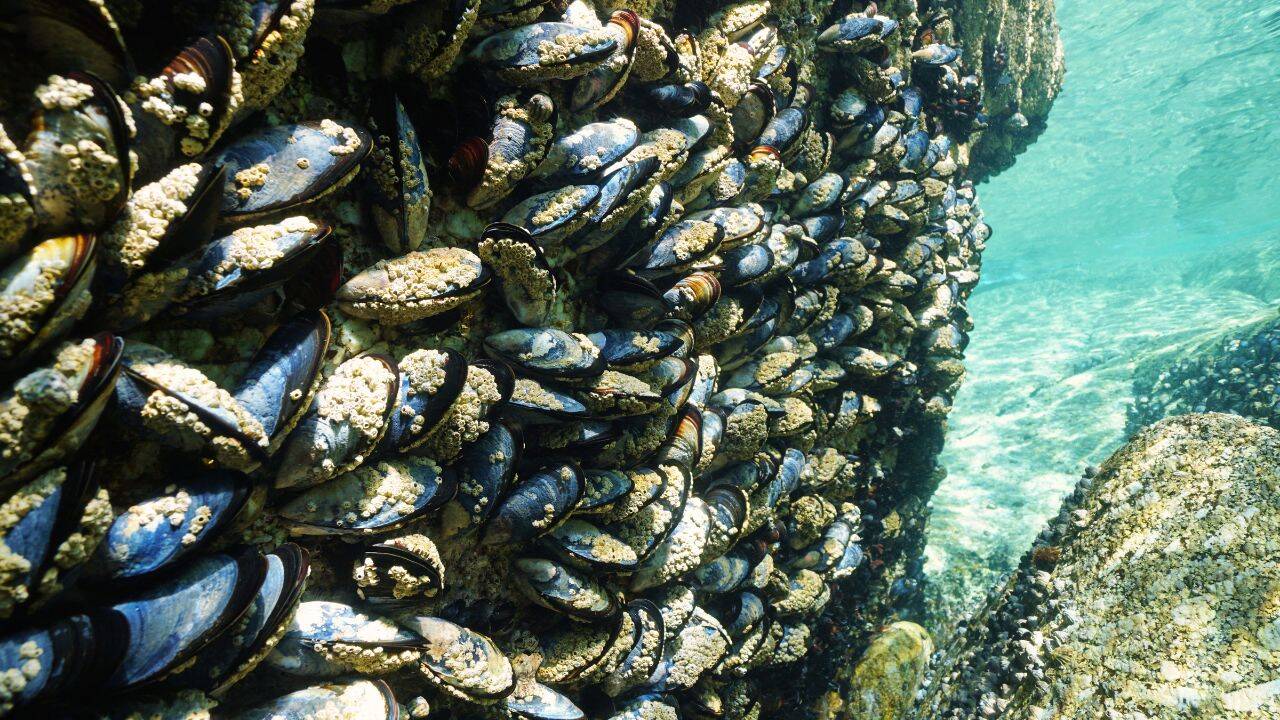
Sunlight dies completely long before you hit 1,700 meters beneath the Atlantic Ocean. Yet down at the Lucky Strike hydrothermal vent field, colonies of Bathymodiolus azoricus mussels are keeping strict time with the moon above them.
It sounds absurd. How do blind animals living in total darkness, nearly two miles underwater, know when the tide is coming in or going out? For decades, marine biologists assumed life in the abyss ran on flat, unchanging schedules because the primary driver of biological clocks on Earth—the rising and setting of the sun—simply doesn't exist down there. For a closer look into similar topics, we suggest: this related article.
They were wrong.
Research on hydrothermal vent communities along the Mid-Atlantic Ridge shows these deep-sea mussels run on a precise 12.4-hour biological clock. That rhythm matches the exact cycle of ocean tides. While surface animals sync their bodies to a 24-hour solar day, Bathymodiolus azoricus syncs its entire physiology to the gravitational pull of the moon shifting trillions of tons of water overhead. For broader background on this development, extensive coverage can also be found on The Guardian.
Why Sunlight Isn't the Only Clockmaker in the Ocean
If you ask ten biology students what sets a circadian rhythm, nine will say light. They're right about land animals, and they're right about creatures living in the sunlit upper layers of the ocean. Light hits the retina, triggers protein cascades, and tells an organism when to sleep, eat, and repair DNA.
Drop below 1,000 meters into the bathypelagic zone, though, and solar photons vanish. Everything is pitch black except for the occasional flash of bioluminescence or the faint, eerie infrared glow of superheated vent water.
Because there's no sunrise or sunset at 1,700 meters, researchers used to think deep-sea organisms abandoned internal clocks altogether. Why waste energy maintaining a rhythmic metabolic cycle if your environment never changes?
That assumption fell apart when scientists started looking closely at hydrothermal vents like Lucky Strike, located southwest of the Azores on the Mid-Atlantic Ridge. The deep ocean isn't static at all. Twice a day, the moon's gravity pulls the ocean water into bulges, creating tidal currents that sweep across the seafloor.
Down at 1,700 meters, you can't see the tide change, so how do you feel it? You feel it through pressure, temperature shifts, and the chemical soup washing over your shell.
The Mechanics of a 12.4-Hour Rhythm
A lunar tidal cycle lasts roughly 12.4 hours—half the time it takes for the moon to complete one apparent orbit around the Earth. When researchers collected Bathymodiolus azoricus mussels from the Lucky Strike vent field and studied their gene expression, they didn't find a 24-hour circadian pattern. They found a dominant 12.4-hour circatidal oscillation.
Think about what that means. The mussels aren't just passively reacting to a sudden rush of cold water. Their cells are anticipating it.
Before the tidal current shifts, the mussels proactively ramp up specific biological processes. They adjust their metabolic rates, alter their stress-response proteins, and prepare their cellular machinery for a completely different chemical environment. Even when scientists brought these mussels up to the surface and kept them in dark, constant-pressure tanks in a lab, the animals kept ticking on that 12.4-hour schedule for days. That's the textbook definition of an endogenous biological clock—an internal timepiece wired directly into their genetics.
Life on the Razor's Edge at Lucky Strike
To understand why a tidal clock is a matter of life and death for these mussels, you have to picture where they live. Lucky Strike isn't a peaceful seabed. It's an active volcanic area where seawater seeps through cracks in the Earth's crust, gets superheated by magma, and shoots back out through mineral chimneys at temperatures exceeding 300°C.
Bathymodiolus azoricus doesn't live inside that boiling water—nothing does—but it crowds right onto the mixing zones where scorching, toxic vent fluid collides with near-freezing deep Atlantic water (around 4°C).
This is where the tide changes everything.
When the tidal current shifts in one direction, warm, mineral-rich vent water washes directly over the mussel beds. That fluid is loaded with hydrogen sulfide and methane. For most animals, hydrogen sulfide is a lethal poison that shuts down cellular respiration faster than cyanide. For Bathymodiolus azoricus, it's dinner.
Then, six hours later, the tide reverses. Cold, oxygen-rich seawater sweeps across the rocks, pushing the toxic vent plume away. The temperature drops, the sulfide disappears, and suddenly the mussels are bathed in clean, oxygenated ocean water.
Symbiosis on a Strict Schedule
These mussels don't eat plankton like the blue mussels you'd find steamed in a garlic broth at a coastal restaurant. Their digestive tracts are shrunken and mostly useless. Instead, they rely on chemosynthetic bacteria living inside their gill cells.
It's a strict biological trade:
- Sulfur-oxidizing bacteria use hydrogen sulfide from the vents to produce organic carbon.
- Methanotrophic bacteria consume methane from the vents for energy.
- The mussel provides a safe home and pumps water containing both vent chemicals and seawater oxygen across its gills so the bacteria can work.
Here's the catch. Hydrogen sulfide and oxygen don't mix well naturally—sulfide reacts rapidly with oxygen, stripping it out of the water, and high levels of sulfide damage the mussel's own tissues.
By syncing their metabolism to the 12.4-hour tidal rhythm, the mussels coordinate their internal chemistry with the external water flow. When the tide brings in the sulfide-heavy vent fluid, the mussels prime their systems to absorb the fuel and pass it to their bacterial partners while activating antioxidant defenses to protect their own cells from free-radical damage. When the tide swings back and floods the reef with cold, oxygenated seawater, the mussels shift gears to aerobic respiration, cellular repair, and waste clearance.
Without that internal 12.4-hour clock, they'd constantly be caught off guard—either suffocating when oxygen drops or getting poisoned when toxic vent plumes surge over their shells.
What Studies From EMSO-Azores Actually Revealed
We don't know this from guesswork. Much of our understanding comes from long-term monitoring at the EMSO-Azores (European Multidisciplinary Seafloor and water column Observatory) site at Lucky Strike, alongside laboratory experiments led by marine chronobiologists like Audrey Mat and researchers at institutions including Ifremer and the University of Vienna.
In landmark studies published in journals like Proceedings of the Royal Society B and Current Biology, scientists analyzed the transcriptomes—the complete set of RNA transcripts produced by the genome—of Bathymodiolus azoricus sampled directly on the seafloor over a full 24-hour period, as well as mussels maintained in pressurized aquaria on land.
The results flipped coastal biology on its head.
Coastal mussels, like Mytilus edulis, deal with both sunlight and tides, so their genes oscillate on both 24-hour and 12.4-hour cycles. When you take coastal mussels away from tidal cues, their circatidal rhythms often fade quickly or get overridden by light cues.
Bathymodiolus azoricus at 1,700 meters showed the exact opposite pattern. In their natural habitat, 12.4-hour gene expression cycles completely dominated their biology. Genes controlling metabolism, oxidative stress, DNA repair, and immune responses pulsed twice every lunar day. Even more striking, key circadian clock genes—the same core molecular gears found in fruit flies, mice, and humans, like Clock, Bmal1, and Period—were still present in their genome, yet their expression was driven by tidal cycles rather than a 24-hour day.
Scientists also looked at behavior, specifically valve gape—how wide the mussels open their shells. In the deep sea, tracked via high-definition observatory cameras on the seafloor, the mussels open and close their shells in rhythm with the tidal currents. They aren't just sitting there like rocks; they're actively breathing and feeding in time with the moon.
Three Common Misconceptions About Deep-Sea Biological Clocks
Whenever deep-sea discoveries make headlines, a few persistent myths pop up right behind them. If you want to actually understand how deep-ocean ecology works, clear these out first.
Myth 1: Deep-sea animals are "seeing" the moon
They aren't. Bathymodiolus azoricus doesn't have functional eyes that detect moonlight at 1,700 meters because zero moonlight reaches 1,700 meters. The physical cues that entrain (set) their internal clock are mechanical and thermal: subtle shifts in hydrostatic pressure as the water column above rises and falls, changes in current velocity, and the rhythmic temperature swings of the vent plumes.
Myth 2: Circatidal clocks are just broken circadian clocks
Some biologists initially wondered if a 12.4-hour rhythm was simply a 24.8-hour lunar-day clock split in half, or a degraded version of a standard circadian clock. Genetic sequencing proved otherwise. While circatidal and circadian systems share some evolutionary toolkit components, the circatidal clock in deep-sea invertebrates operates as a distinct, dedicated timing mechanism built specifically to track marine physics rather than solar radiation.
Myth 3: Hydrothermal vents are isolated from surface events
It's easy to treat the deep seafloor like an alien planet completely disconnected from what happens at the ocean's surface. That's dead wrong. Every storm, tidal surge, and seasonal shift in surface water density sends physical signals downward. Tides act as a planetary metronome connecting the gravitational dance of the Earth, Moon, and Sun directly to bacteria and mussels living nearly two kilometers down in volcanic darkness.
Why Deep-Sea Mining Makes This Discovery Urgent
This isn't just trivia for marine biology nerds. Understanding how Bathymodiolus azoricus keeps time has massive real-world consequences right now, especially as international debates over deep-sea mining heat up.
Hydrothermal vent fields along the Mid-Atlantic Ridge—including inactive and active sulfide deposits—are prime targets for companies looking to extract copper, zinc, gold, and cobalt from seafloor massive sulfides.
Here's the problem. Vent ecosystems are engineered around finely tuned environmental rhythms. Mining operations don't just physically scrape away habitat; they kick up massive sediment plumes, alter local seafloor topography, and disrupt the delicate mixing currents between cold seawater and hydrothermal fluids.
If you disrupt the tidal current patterns around a vent field, you break the physical cues that Bathymodiolus azoricus relies on to synchronize its internal clock. A mussel colony whose metabolism is out of sync with the arrival of toxic hydrogen sulfide won't survive long, even if the mining machine never directly touches its rocks.
And because deep-sea organisms generally grow slower and recover differently than shallow-water species, knocking out a vent's foundational species collapses the entire local food web—shrimp, crabs, polychaete worms, and deep-sea fish all depend on those mussel beds for shelter and biomass.
How to Follow Real Deep-Sea Observatory Data Yourself
You don't need a marine biology degree or a submersible to track what's happening at 1,700 meters beneath the Atlantic. Because observatories like EMSO-Azores stream long-term environmental data, anyone interested in oceanography or chronobiology can explore the raw science directly:
- Explore the EMSO-Azores data portal: Visit the EMSO ERIC website to see how cabled and acoustic seafloor observatories measure real-time temperature, pressure, and seismic activity at the Lucky Strike vent field.
- Search primary literature on Google Scholar: Look up papers by Audrey Mat and Franck Lallier using search terms like "Bathymodiolus azoricus circatidal rhythm" to read the open-access data on gene expression and valve behavior.
- Check MBARI and Schmidt Ocean Institute live streams: Both organizations regularly stream high-definition ROV (Remotely Operated Vehicle) dives at hydrothermal vents, letting you watch live mussel beds, tube worms, and vent chimneys in real time with commentary from onboard scientists.
Life at 1,700 meters proves that biology doesn't need sunlight to tell time—it just listens to the gravity of the moon moving the ocean overhead.