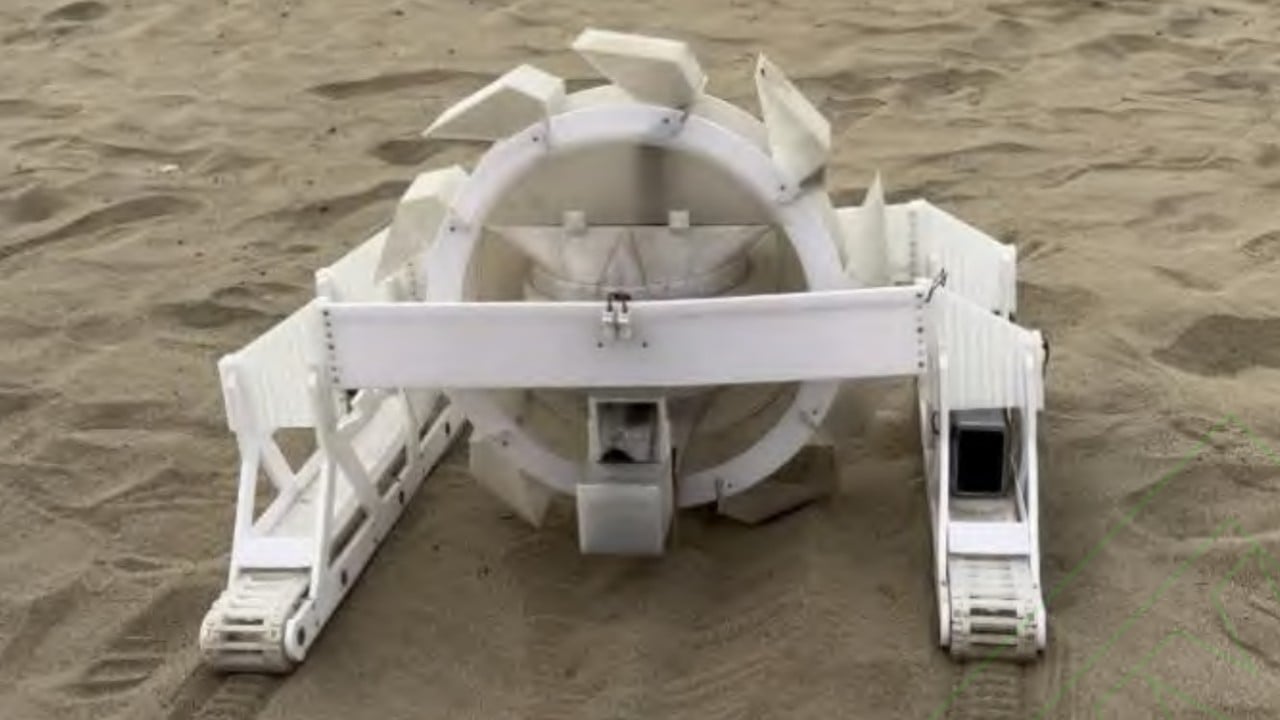
Researchers at Tarim University rolled a tiny crawler robot across the shifting sands of the Taklamakan Desert to pull out iron-bearing grains with magnets, and honestly, the Dune comparisons miss the point. Nobody built a planetary spice harvester. They built a lightweight prototype—weighing around 4.3 kg, running for 12.5 hours on a 20,000 mAh battery, and creeping along at roughly 1.5 centimeters per second—to test whether dry magnetic separation works on loose, sloped desert sand.
When you read headlines about a Taklamakan iron crawler robot, it's easy to picture giant industrial treads chewing through towering dunes like Arrakis. Reality is much slower and weirder. At 1.5 centimeters per second, this little machine moves at a snail's pace, climbing slopes up to 20 degrees while using neodymium-iron-boron permanent magnets to snag ferromagnetic particles directly from the sand.
Why bother? Because China imports massive amounts of iron ore to feed its steel industry—about 1.26 billion tons in 2025 alone—while domestic production has faced pressure and shifts. Prior analyses of the Taklamakan have pointed to iron content around 6% in its sands, and the prototype's dry magnetic setup reached roughly 28% iron in the collected fraction during testing. That doesn't replace open-pit mines in Australia or Brazil tomorrow, not even close. Yet it tests a clever idea in one of the harshest sandy environments on Earth.
How a Slow Desert Crawler Actually Works
If you've ever tried driving or walking up a loose sand dune, you know how quickly traction disappears. Wheels spin out, fine dust gets into every moving joint, and battery life drops fast when motors fight shifting terrain.
That's why crawler tracks matter on loose sand. A tracked chassis spreads weight across a wider footprint than narrow wheels, helping the robot keep its footing on inclines up to 20 degrees without digging itself into a hole. Pair that with a 20,000 mAh battery—and solar assistance noted in coverage of the test—and you get a system designed for long, slow endurance rather than speed.
Underneath or alongside that movement is the real star of the experiment: dry magnetic separation using neodymium-iron-boron (NdFeB) magnets. Traditional mineral processing often relies on wet separation or heavy crushing and sorting plants. In a place like the Taklamakan, where water is scarce and remoteness is extreme, pulling magnetic grains straight out of dry sand avoids hauling huge volumes of water around.
Anyone who has worked with fine dust and strong magnets in the field knows the catch, though. Sand isn't neat little iron filings sitting politely on top of quartz. Grains clump, static builds up, wind blows fine particles everywhere, and non-magnetic grains get trapped mechanically inside magnetic clusters. Getting from a ~6% baseline iron presence in the sand to a ~28% iron fraction in the collected material shows the magnetic geometry can concentrate iron-bearing grains, even at a tiny prototype scale.
Why the Dune Comparison Is Both Fun and Misleading
Comparing a desert resource-harvesting robot to Dune is irresistible clickbait. Deserts, sandworms, giant harvesters—it writes itself.
Still, treating a 4.3 kg Tarim University test rig like a sci-fi megamachine distorts what engineers actually proved. A 4.3 kg crawler moving at 1.5 centimeters per second covers less than a meter a minute. Even over a full 12.5-hour battery run, distance traveled is measured in tens of meters, not kilometers.
In robotics and field engineering, that isn't a failure. It's disciplined early-stage validation. When you're testing how magnet geometry, travel speed, and slope angle interact with real desert sand, going slow keeps variables clean. Move too fast across loose sand and you kick up dust clouds, miss grains, or bog down your drive system.
There's also a broader context in Xinjiang that makes desert robotics feel right at home. As documented by Xinhua, engineers and local teams around the Taklamakan have already been experimenting with desert-adapted machines—such as autonomous robots planting drought-tolerant vegetation—alongside solar and sand-control efforts along the desert's edges. Putting a magnetic mineral collector into that same harsh sandbox fits a wider push toward automation where human labor and conventional heavy machinery struggle.
The Economics and Physics Reality Check
Let's be candid about the math. Turning desert sand into steelmaking feedstock at industrial scale faces steep hurdles.
First, grade matters. Conventional iron ore mining targets deposits with far higher iron concentrations than loose desert sand, and moving massive tonnage requires enormous energy, transport, and beneficiation capacity. A ~28% iron fraction in a prototype test is a neat technical milestone, not blast-furnace-ready ore on its own. Further upgrading, smelting, or blending would still be required, and impurities like silica or titanium-bearing minerals can complicate downstream metallurgy.
Second, scaling up changes the physics. You can't just scale a 4.3 kg robot up by 1,000x and expect the same energy efficiency or dune stability. Heavier machines sink deeper into soft sand unless track surface area grows dramatically, and larger magnetic arrays add weight and complexity. Meanwhile, traditional seaborne supply chains—led by major exporters in Australia and Brazil, alongside new developments like Guinea's Simandou project—operate at scales measured in tens and hundreds of millions of tons per year.
Third, there's a strategic angle worth watching without getting carried away. Analysts tracking commodities and critical minerals note that any viable method for recovering dispersed magnetic materials in remote regions could support domestic resource resilience and put subtle long-term pressure on legacy suppliers if—and that's a big if—costs ever come down. Right now, this is proof-of-concept science, not a market shock.
Where Ideas Like This Could Actually Go
Even if a Taklamakan iron crawler robot never rivals a Pilbara iron mine, the underlying engineering has legs in a few adjacent places.
- Dry mineral recovery in water-stressed regions: Any low-water, mobile sorting concept is worth studying in arid zones where conventional wet processing is expensive or environmentally tough.
- Swarm or modular small-scale harvesting: Instead of one giant Dune behemoth sinking into soft dunes, smaller autonomous units could theoretically operate in harsher spots—though battery limits, maintenance, and recovery logistics remain real bottlenecks.
- Off-world regolith operations: Commentators have already pointed to lunar and Martian dust. Regolith is dusty, abrasive, and energy-constrained, so dry magnetic separation and low-speed terrain navigation are genuinely relevant concepts for future space resource work, even if real spacecraft missions require strict design safeguards.
If you want to dig deeper into this space without falling for sci-fi hype, start with three practical checks. Look up the primary engineering details around dry magnetic separation and NdFeB field geometry to see how recovery purity trades off against throughput. Track China's iron ore import and domestic output numbers alongside major mining projects to keep any "desert iron" claims grounded in real tonnage. And whenever a new desert robot story pops up, check the speed, mass, and battery endurance numbers first—those three figures tell you immediately whether you're looking at a lab prototype or a commercial machine.
CHINA CREATED A DUNE ROBOT EXTRACTING IRON STRAIGHT FROM DESERT SAND
This video offers a visual look at how the Tarim University crawler prototype and its iron-sand extraction concept are presented in recent coverage.