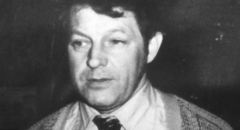
A man walks into his own backyard after a long shift, carrying the day's earnings. Out of the shadows, someone ambushes him with a shovel. This wasn't a movie. It was the brutal reality for Philip Saunders, a 52-year-old Cardiff newsagent attacked outside his home in 1987. He died in the hospital five days later.
For decades, this case has been a stain on British justice. South Wales Police thought they wrapped it up quickly when they locked away three local men, who became known as the Cardiff Newsagent Three. Except they had the wrong guys.
The state stole 11 years from Michael O'Brien, Darren Hall, and Ellis Sherwood before the Court of Appeal threw out their convictions in 1999. Since then, the trail went cold. The real killer walked free. But everything just changed. South Wales Police announced a major forensic review of the original crime scene exhibits.
If you think a 40-year-old murder can't be solved with modern tech, you don't know how fast forensic science is moving.
What Went Wrong with the Original Investigation
The 1987 investigation didn't fail because the killer was a criminal mastermind. It failed because the police manufactured their own answers.
When Saunders was murdered for his shop takings, the pressure was on to find the culprit. Instead of following physical evidence, detectives relied on old-school, aggressive interrogation tactics. They picked up three young men and broke them down.
The prosecution's entire case hinged on a "confession" from Darren Hall, who claimed he acted as a lookout. Years later, experts proved Hall had a previously undiagnosed personality disorder. Combined with extreme police pressure, he simply told them what they wanted to hear to make the nightmare stop.
An appeals review later showed that officers breached the Police and Criminal Evidence Act (PACE) roughly 115 times during questioning. The suspects were handcuffed to hot radiators. They were denied food, water, and access to lawyers.
When you torture the data, it confesses. The same goes for terrified young men. The systematic failure meant the actual killer got a 40-year head start.
How Modern DNA Can Rewrite Cold Cases
The South Wales Police Major Crime Review Unit is banking heavily on the fact that 2026 forensic capabilities look nothing like the tech from 1987. Back then, you needed a pool of blood the size of a coin to get a usable profile. Today, scientists can extract a full DNA profile from microscopic skin cells left behind on a surface.
This is called touch DNA. When the killer grabbed that shovel to attack Saunders, they inevitably left behind epithelial cells. Even if the weapon was wiped down or handled by others later, advanced extraction techniques can isolate distinct DNA profiles from different layers of contact.
We saw this exact strategy work in the Lynette White case, another infamous South Wales police screw-up from the same era. A completely different group of innocent men was wrongfully convicted for her murder. When forensic teams finally re-examined the cellophane from a cigarette packet found at that crime scene using modern DNA profiling, they found the real killer, Jeffrey Gafoor.
Michael O'Brien, who spent over a decade in prison for Saunders' murder, explicitly pointed to the Lynette White breakthrough when discussing this new review. He spent two decades campaigning for this moment.
The Hurdles of a Four-Decade-Old Crime Scene
Let's be realistic. Reopening a case from 1987 isn't an automatic win.
The biggest enemy isn't the killer, it's time. Over 40 years, evidence degrades. If the original cardboard boxes housing the exhibits weren't kept in climate-controlled environments, humidity might have destroyed the fragile biological materials.
There's also the nightmare of contamination. In the late 1980s, police didn't wear full-body Tyvek suits, hairnets, or double gloves at crime scenes. Officers handled weapons with bare hands or standard issue gloves. The risk that an innocent officer's DNA is baked into the evidence alongside the killer's is incredibly high. Modern labs have to painstakingly eliminate the genetic profiles of every first responder, clerk, and archivist who touched the evidence over the last four decades.
The Reality of Hunting a Ghost
Finding a genetic profile is only half the battle. Once you have the DNA, you need a match.
If the killer never offended again and isn't in the UK National DNA Database, a standard search will yield nothing. That's where investigative genetic genealogy comes into play. By uploading the unknown profile to public genealogy databases, specialists can build family trees backward, tracking down distant cousins until they pinpoint the suspect.
The clock is ticking on a biological level too. If the killer was 25 in 1987, they are 64 today. There's a very real chance the person who murdered Philip Saunders is already dead.
Even if the killer has passed away, getting an definitive answer matters. It matters for the family of Saunders, who never got genuine closure. It matters for the men who were framed by a desperate police force. And it serves as a reminder that the justice system cannot bury its worst mistakes forever.
To keep track of this developing story, monitor official updates from the South Wales Police Major Crime Review Unit and UK judicial review announcements. If you are following historical miscarriage of justice cases, review the ongoing case backlogs managed by the Criminal Cases Review Commission (CCRC) to understand how many vintage cases are currently awaiting similar technological interventions.