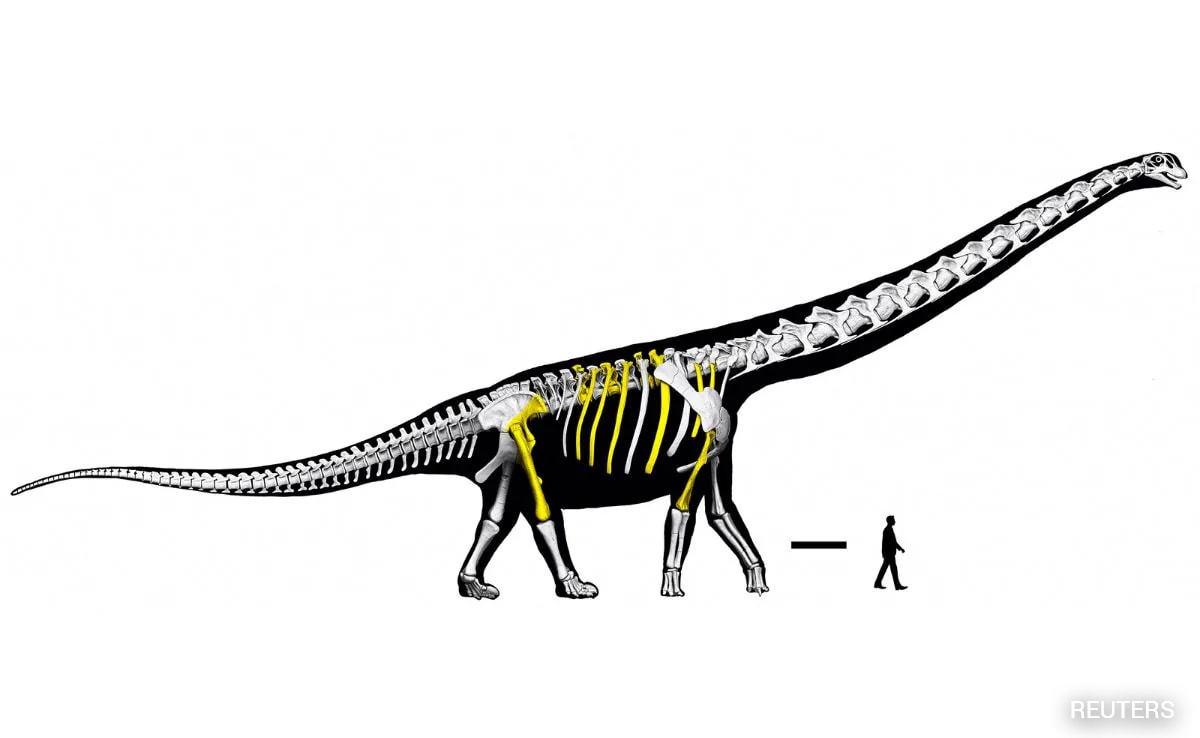
The discovery of a massive titanosaurian sauropod in Thailand’s Phu Wiang District represents a fundamental shift in paleobiogeographical modeling for the Early Cretaceous. While public discourse focuses on the sheer scale of the specimen—estimated at roughly 90 feet in length—the true value lies in the morphological data that challenges the "island isolation" theory of Southeast Asian dinosaur evolution. This specimen serves as a biological data point confirming that the Khorat Plateau acted as a high-productivity corridor capable of supporting mega-herbivores with caloric requirements previously thought unsustainable in this region.
The Biomechanical Constraints of the Phu Wiang Specimen
To understand a 90-foot organism, one must analyze it as a structural engineering problem. The specimen belongs to the Titanosauria clade, a group defined by wide-gauge trackways and advanced vertebral pneumatization. The anatomical efficiency of these creatures is governed by the relationship between mass and structural integrity.
The Pneumatic Architecture
Titanosaurs evolved a system of internal air sacs within their cervical and dorsal vertebrae. This served two critical functions:
- Mass Reduction: By replacing dense bone with honeycombed (camerate or camellate) structures, the animal reduced its skeletal weight without compromising the stiffness required to support a 30-foot neck.
- Thermoregulation: Large-bodied endotherms face a significant surface-area-to-volume ratio deficit. Internal air sacs functioned as a heat exchange system, preventing organ failure during high-exertion foraging.
Weight Distribution and Locomotion
The Phu Wiang discovery confirms a wide-gauge limb stance. Unlike earlier sauropods, titanosaurs positioned their limbs further from the midline of the body. This increased stability on the uneven, fluvial floodplains of the Early Cretaceous Khorat Basin. The pelvic girdle fragments recovered indicate an expanded ilium, providing the necessary surface area for massive muscle attachments required to move a frame weighing an estimated 60 to 80 tons.
The Paleo-Economic Function of Mega-Herbivory
A 90-foot dinosaur does not exist in a vacuum; it is the output of a specific ecological energy budget. The presence of such a large organism in Southeast Asia suggests that the regional flora—dominated by conifers, cycads, and ferns—maintained a high nutritional density or was available in extreme abundance.
The Foraging Radius Model
The caloric intake required to maintain a titanosaur's mass necessitates a "high-volume, low-selectivity" feeding strategy. The long neck functioned as a biological crane, allowing the animal to sweep a wide radius of vegetation without moving its massive torso. This minimized the energy expenditure of locomotion ($E_{loc}$) relative to the energy gain of ingestion ($E_{gain}$).
- Net Energy Gain = $E_{gain} - (E_{basal} + E_{loc})$
In the Phu Wiang ecosystem, the energetic cost of moving an 80-ton body was so high that any anatomical feature reducing movement (like a longer neck) provided a distinct evolutionary advantage.
Nutrient Cycling and Taphonomy
The preservation of these fossils in the Sao Khua Formation indicates a high-energy river system. The depositional environment—characterized by siltstones and sandstones—suggests the animal died near a seasonal water source. For a population of 90-foot herbivores to survive, the Khorat Plateau required a complex hydrological cycle to prevent the rapid desertification that usually follows overgrazing by mega-herbivores.
Taxonomic Disruption and the Asian Land Bridge
The Phu Wiang discovery creates a bottleneck for existing theories regarding dinosaur migration. Historically, large titanosaurs were most associated with Gondwana (modern-day South America and Africa). The presence of a specialized, giant lineage in Thailand suggests one of two high-probability scenarios:
- Early Divergence: Titanosaurs achieved global distribution much earlier than the Aptian-Albian ages, moving into Southeast Asia before the breakup of Pangea was complete.
- Regional Gigantism: Southeast Asian sauropods underwent a separate evolutionary trajectory, achieving massive scale independently due to the lack of large predators or extreme competition in the Khorat Basin.
The specimen shares morphological affinities with Phuwiangosaurus sirindhornae, yet the scale suggests a distinct ontogenetic stage or a new, more robust taxon. The transition from the "smaller" early titanosauriforms to these 90-foot giants marks a shift in the biotic composition of the region, likely coinciding with a change in the dominant forest types.
Limitations of the Current Data Set
While the 90-foot estimate is grounded in limb-to-axial-length ratios, paleontology is constrained by the "Incomplete Skeleton Problem." We must distinguish between confirmed measurements and extrapolated models.
- Knowns: The femur and humerus dimensions provide a reliable baseline for weight estimation via scaling laws.
- Hypotheses: The total length is an extrapolation based on the assumption that the tail-to-neck ratio matches other basal titanosaurs like Patagotitan. If the Thai specimen had a shorter tail or a more compact dorsal column, the length estimate would require downward revision.
The fossilization process often distorts bone shape through lithostatic pressure (permineralization). Analysts must apply "crushing corrections" to the digital scans of the vertebrae to ensure that the volumetric calculations used for weight estimates are not based on flattened geometry.
Quantitative Analysis of the Khorat Basin’s Carrying Capacity
To sustain a population of these organisms, the primary productivity of the Sao Khua Formation must have exceeded 2,000 grams of carbon per square meter per year. This is comparable to modern tropical rainforests but with a higher concentration of fibrous gymnosperms.
The logistical reality for a 90-foot herbivore involves:
- Daily Intake: Estimated 300,000 to 600,000 calories.
- Hydration: Access to perennial water systems, as an animal of this mass cannot survive on ephemeral desert seeps.
- Social Structure: Likely small herds. Large herds of 90-foot animals would clear a forest canopy faster than the regeneration rate of Cretaceous flora, leading to a localized ecological collapse.
Strategic Shift in Southeast Asian Fieldwork
The discovery mandates a transition from "exploratory" paleontology to "systematic" subsurface imaging. The density of mega-fauna in the Phu Wiang region suggests that the current finds are not outliers but representative of a high-density fossil horizon.
The next phase of analysis should prioritize:
- Stable Isotope Analysis: Examining the oxygen and carbon isotopes in the tooth enamel to determine the animal's migratory patterns and water sources. This will confirm if the giant was a permanent resident or a seasonal migrant.
- High-Resolution Photogrammetry: Creating 3D structural maps of the quarry to analyze the orientation of the bones (bonebeds), which reveals the flow direction and energy of the water that buried the animal.
- Comparative Histology: Slicing bone cross-sections to count "growth lines" (Lines of Arrested Growth or LAGs). This will determine if the 90-foot specimen was a rapidly growing juvenile or a slow-growing geriatric, which fundamentally changes our understanding of titanosaur metabolism in the tropics.
The data points toward the Khorat Plateau being a primary center of dinosaur evolution, not a peripheral dead-end. The existence of the Phu Wiang giant proves that the environmental and biological variables required for maximum vertebrate size were fully operational in Southeast Asia during the Early Cretaceous. Researchers must now recalibrate their global mass-distribution models to account for this eastern giant.