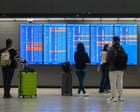
Lifting a nationwide ground stop does not restore air travel; it triggers a secondary, multi-day operational collapse governed by queue theory, federal labor mandates, and spatial resource misallocation. Standard live-blog coverage treats post-ground-stop airport congestion as an inexplicable failure of airline customer service. In reality, the lingering paralysis is a deterministic outcome of how hub-and-spoke aviation networks absorb shock. When the Federal Aviation Administration (FAA) halts departures to clear a systemic failure—whether a Notice to Air Missions (NOTAM) database outage, an air traffic control radar failure, or severe convective weather—the airspace freezes, while the underlying physical and regulatory clocks governing aircraft and crews continue to run.
To understand why terminals remain gridlocked 48 to 72 hours after the FAA issues an "all clear," one must strip away anecdotal passenger complaints and analyze the network as a tightly coupled, zero-slack industrial system. Commercial aviation operates at near-100 percent asset utilization to remain profitable. When an exogenous shock injects hours of zero-throughput into that system, recovery is not a matter of flipping a switch. It is a complex integer-programming problem where every delayed departure invalidates the downstream schedule for three subsequent flights, two flight crews, and dozens of connecting passengers.
The Three Pillars of Post-Stop Paralysis
When a ground stop is lifted, airlines do not face a single backlog. They face three distinct, compounding resource deficits that interact non-linearly. Solving one deficit frequently exacerbates the others.
1. Spatial Dislocation of Hulls
An airline schedule is a closed loop of physical aircraft movements. A narrow-body jet scheduled to fly from Chicago to Atlanta, then to Miami, and finally to Boston cannot execute the Miami-to-Boston leg if it remains parked on a tarmac in Illinois. During a multi-hour ground stop, aircraft accumulate at origin airports and intermediate diversion fields rather than moving toward their scheduled maintenance bases and high-demand hubs.
Once the airspace reopens, airlines suffer from acute spatial dislocation. Aircraft are physically located in the wrong cities relative to passenger demand. Repositioning these hulls requires flying empty "ferry flights," which consume fuel and crew hours without generating revenue, or canceling entire multi-leg rotations to reset the physical distribution of the fleet. Until the aircraft are back in their designated starting positions, schedule integrity remains mathematically impossible.
2. The Crew Legality Cliff
Flight attendants and pilots are governed by strict federal fatigue regulations, specifically FAA Part 117 for flight crew members. These rules dictate maximum flight duty periods (FDP) based on the time of day a crew reports for work and the number of flight segments they operate. Crucially, the duty clock starts when the crew checks in at the airport—not when the aircraft wheels leave the runway.
During a ground stop, crews sit in cockpits or terminal gates burning through their legal duty windows while covering zero miles. When the ground stop finally lifts, thousands of pilots and flight attendants hit their statutory duty limits simultaneously. This creates a crew legality cliff. Even if the runway is clear, the weather is pristine, and the aircraft is fueled, the flight cannot depart if the cockpit crew will exceed their maximum duty time before reaching the destination. Worse, because reserve crews are stationed at specific crew bases (such as Dallas, Newark, or Atlanta), an airline cannot easily dispatch a fresh pilot to a stranded aircraft in a non-hub city like Omaha or Savannah. The crew must be deadheaded in on another flight, which itself is subject to the same congestion.
3. Gate Saturation and Turnaround Bottlenecks
Airports are designed for continuous flow, not simultaneous storage. Hub airports lack enough terminal gates to hold an airline's entire regional fleet at once. During a ground stop, departing aircraft occupy gates indefinitely, preventing arriving aircraft from deplaning passengers.
When the stop lifts, airports experience gate saturation. Outbound flights cannot push back until taxiway queues clear, and inbound flights sit on penalty boxes—remote tarmac areas—waiting for gates to open. This destroys the minimum turnaround time (MTT), the precise window required to deplane passengers, clean the cabin, load baggage, refuel, and board the next group. If an inbound flight is delayed by two hours, the outbound flight using that aircraft is automatically delayed, compressing the airport's ground-handling capacity and creating gridlock on the ramp.
The Queue Theory of Tarmac Gridlock
Live reporting frequently captures the frustration of passengers sitting on planes for hours after the ground stop is officially over. This phenomenon is explained by Little’s Law and basic queuing theory.
In any queuing system, when the arrival rate of tasks exceeds the service rate, the queue grows exponentially. During a ground stop, the service rate (departures per hour) drops to zero, while the arrival rate (scheduled flights ready for departure) remains constant. By the time the FAA lifts the restriction, hundreds of aircraft are already boarded and waiting for pushback clearance.
Airports have finite runway acceptance rates and departure departure intervals dictated by wake turbulence separation standards. A single runway can typically handle only 30 to 45 departures per hour under optimal visual flight rules. If 150 aircraft are sitting on the tarmac at a major hub like Hartsfield-Jackson Atlanta or O'Hare when the stop lifts, the physical infrastructure requires nearly four hours just to clear the existing queue—assuming zero new flights enter the system.
During those four hours, newly scheduled flights reach their departure times and join the back of the line. Air traffic control must also meter traffic entering specific en-route sectors (blocks of airspace) to prevent mid-air congestion. A plane in New York might be ready to fly, and New York's runways might be clear, but if the destination airspace over Florida is saturated with the backlog from three hours earlier, air traffic control imposes a Ground Delay Program (GDP) or Miles-in-Trail (MIT) restrictions. The nationwide stop ends, only to be replaced by hundreds of localized micro-delays.
The Cost Function of Recovery: Delay vs. Cancellation
Airline Network Operations Centers (NOCs) face a brutal optimization problem during recovery: whether to absorb massive rolling delays or proactively cancel flights. Every choice carries a distinct financial and operational penalty.
- The Rolling Delay Trap: Attempting to fly every scheduled flight late preserves passenger itineraries on paper, avoiding immediate rebooking cascades. However, rolling delays push operations past midnight, encroaching on airport noise curfews and overnight maintenance windows. If an aircraft misses its scheduled overnight safety check, it is grounded the next morning, propagating yesterday's crisis into a second day.
- The Proactive Cancellation Reset: Canceling 15 to 20 percent of the schedule immediately frees up gates, preserves crew duty hours for high-priority trunk routes, and allows the airline to reposition aircraft without passenger loads. The downside is an immediate spike in passenger displacement. Because modern US airlines operate at load factors exceeding 85 percent, there are very few empty seats on subsequent days to absorb displaced travelers. A single canceled wide-body flight carrying 300 people can take three to four days to reaccommodate across existing capacity.
NOCs generally prioritize high-density trunk routes and international long-haul departures during recovery. International flights operate on rigid slots at foreign airports and carry massive financial penalties for delays under regimes like EU261. Domestic regional flights—often operated by third-party regional carriers on smaller aircraft—are the first to be sacrificed to preserve slot capacity at congested hubs.
Why Information Asymmetry Worsens Terminal Chaos
A recurring theme in post-stop reporting is the apparent incompetence of gate agents and airline apps, which often push departure times back in 15-minute increments for hours before abruptly canceling a flight. This is not intentional deception; it is a symptom of cascading dependency uncertainty within airline IT architecture.
Airline operational software tracks dozens of real-time variables for every flight: aircraft readiness, fuel load, catering, baggage reconciliation, captain legality, first officer legality, flight attendant legality, origin weather, en-route airspace flow, and destination gate availability.
When a system-wide disruption occurs, these variables decouple. The system might know the aircraft is at the gate, so it projects a 15-minute delay while waiting for air traffic control clearance. Ten minutes later, the automated crew-tracking software registers that the first officer has just timed out under Part 117 due to that 10-minute wait. The system then searches for a reserve pilot, projecting another 30-minute delay. When no reserve pilot is found within the hub, the software finally triggers a cancellation.
Furthermore, airlines maintain legacy mainframe systems (such as Sabre or Amadeus) layered beneath modern consumer mobile applications. During high-volume disruption events, database synchronization lags. The passenger's app displays an optimistic automated estimate based on unverified upstream data, while the NOC is manually executing recovery swaps that have not yet propagated to the front-end interface.
Limitations of Modern Aviation Resilience
No software upgrade or staffing increase can entirely eliminate post-ground-stop chaos due to the structural economics of commercial aviation.
- The Slack-Profitability Tradeoff: Maintaining spare aircraft and idle reserve crews at every spoke airport would allow instantaneous recovery from shocks. However, idle hulls and paid, non-flying pilots destroy operating margins in an industry where net profit margins historically hover in the low single digits. Travelers consistently choose lower ticket prices over systemic resilience, forcing carriers to run lean, fragile networks.
- Airspace Infrastructure Constraints: The US National Airspace System (NAS) relies on aging ground-based radar and legacy telecommunications infrastructure alongside modern satellite systems. While NextGen modernization programs have improved routing efficiency, physical concrete—runways and gates—cannot be rapidly expanded in landlocked metropolitan areas like New York, Chicago, or San Francisco.
- Crew Tracking Computational Limits: Solving the crew-recovery problem in real time across 1,000+ daily flights and 15,000+ crew members is an NP-hard optimization problem. Even with advanced heuristic algorithms, human crew schedulers must manually intervene to verify complex union contract rules, creating an irreducible bottleneck in the NOC during mass disruptions.
Strategic Execution for Navigating Systemic Disruptions
For corporate travel managers, logistics coordinators, and high-frequency flyers, relying on standard airline recovery mechanisms during a post-ground-stop meltdown guarantees prolonged stranding. Tactical survival requires exploiting the operational mechanics of the network before the crowd reacts.
- Bypass Hub-and-Spoke Bottlenecks: Immediately abandon connecting itineraries through major fortress hubs (e.g., ATL, ORD, DFW, EWR, DEN). Hubs suffer the most severe gate saturation and crew legality cascades. Rebook onto point-to-point routes via secondary airports or utilize rival carriers that operate non-hub itineraries, even if it requires purchasing a new walk-up fare while awaiting a refund on the original ticket.
- Track the Inbound Hull, Not the Departure Board: Ignore the airline’s estimated departure time. Use public flight-tracking telemetry to locate the specific tail number assigned to your flight. If that aircraft is still sitting on the ground two legs upstream, your flight will not depart on time regardless of what the gate display indicates. Execute rebooking protocols the moment the upstream leg falls behind schedule.
- Target Morning Departures for Recovery: Because crew duty clocks reset after mandatory rest periods and overnight maintenance windows allow NOCs to reposition empty hulls, the first wave of flights between 06:00 and 08:00 local time has the highest completion probability. Never accept a rebooking onto an evening flight during a recovery day; evening schedules absorb the cumulative delays of the entire operational cycle and face the highest risk of crew time-outs.
- Exploit Interline Agreements Immediately: When a ground stop stems from an airline-specific technical failure rather than an FAA-wide mandate or weather event, legacy carriers are generally bound by Rule 240 equivalents in their Contract of Carriage to endorse tickets over to competing airlines. Demand an interline transfer onto a competitor with available seat inventory before the competing airline's load factors hit 100 percent from other displaced passengers.