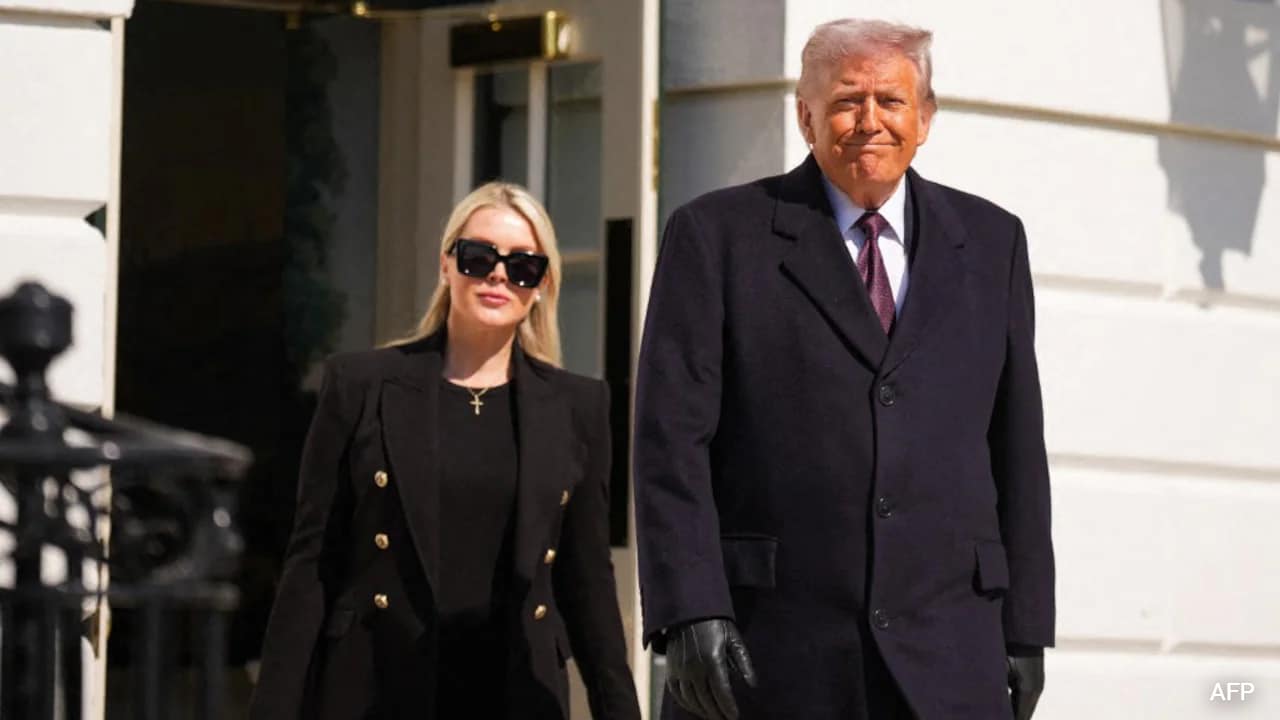
When President Donald Trump jokingly remarked that White House Press Secretary Karoline Leavitt was a "big problem" because "she loves the baby more than me," the comment was instantly clipped for viral social media distribution. At the surface, the line reads like classic rally banter—an off-the-cuff quip aimed at humanizing a demanding boss and his top spokesperson. Yet, for anyone who has spent decades covering the West Wing, throwaway lines from the Oval Office rarely exist in a vacuum. They are almost always pressure valves releasing tension over loyalty, workload, and the grueling mechanics of modern political communications.
To understand why that specific remark resonated across Washington, you have to look beyond the punchline. The modern White House press operation is a 24-hour meat grinder that leaves zero room for divided focus. When Karoline Leavitt stepped into the James S. Brady Press Briefing Room as the youngest press secretary in American history, she inherited an institutional role that demands total personal subordination to the principal's message. Balancing newborn motherhood with the erratic, relentless schedule of a Trump administration is not merely a human-interest story. It is a structural test of how the modern executive branch manages power, visibility, and stamina.
The Anatomy of a Viral Quip
Political theater relies heavily on calculated informality. Throughout his career, Trump has used humor to publicly test boundaries with his closest aides, often masking genuine operational friction behind a grin. By framing Leavitt's devotion to her child as a "problem" for his own political operation, he tapped into a recurring theme of his leadership style: the expectation of absolute, undivided allegiance.
In previous administrations, the press secretary served primarily as a buffer between the president and the press corps. Under Trump, the role operates differently. The president is his own chief communicator, frequently bypassing traditional channels to break news directly to millions of followers. Consequently, the press secretary's primary job is not to set the agenda, but to aggressively defend, rationalize, and amplify the president's existing output in real time.
When an aide has a competing priority—even one as universally sympathetic as caring for an infant—it introduces an unpredictable variable into a tightly controlled orbit. In Washington, public jokes from the commander-in-chief often serve as gentle warnings. They signal to the room that while personal milestones are celebrated, the machinery of the presidency does not pause for maternity leave, sleepless nights, or family emergencies.
The Brutal Reality of the Brady Briefing Room
The podium is an unforgiving piece of furniture. A press secretary does not simply show up at 1:00 PM, read from a binder, and go home. The daily cycle begins before dawn with intelligence summaries, cable news monitoring, and rapid-response coordination across dozens of federal agencies. By the time the cameras turn on, the spokesperson has already fought a dozen internal battles over messaging discipline.
Leavitt's trajectory made her uniquely suited for this environment, yet also uniquely exposed to its pressures. Having served as national press secretary during the 2024 campaign—returning to the trail mere days after giving birth—she established a reputation for relentless durability. That early precedent created an unspoken expectation within the West Wing. Once you demonstrate that you can absorb extreme pressure without stepping back, the institution assumes you can maintain that pace indefinitely.
History offers plenty of cautionary tales. Look back at the tenures of Sean Spicer, Sarah Huckabee Sanders, Stephanie Grisham, and Kayleigh McEnany during Trump's first term. None lasted the full four years. The burnout rate in that specific chair is staggering because the demands come from two opposing directions simultaneously:
- The External Press Corps: Reporters are looking for microscopic inconsistencies between what the president said at 2:00 AM and what the press secretary says at 2:00 PM.
- The Internal Audience: The most important viewer of every briefing is not the American public or the journalists in the front row, but the president watching from the dining room off the Oval Office.
If a briefing falls flat, or if a spokesperson appears even slightly off-balance, the feedback is immediate. Managing that pressure while navigating the early months of parenthood requires an extraordinary support apparatus—and even then, the physical toll is undeniable.
Loyalty as Political Currency
In corporate America, executive burnout is treated as an HR issue. In the West Wing, it is viewed through the prism of loyalty.
When Trump jokes about someone loving their baby more than him, he is playfully articulating a core truth about his political ecosystem. In his orbit, personal devotion and professional output are treated as interchangeable. Staffers who visibly prioritize outside commitments—whether family, personal business, or future political ambitions—often find their influence subtly diminishing.
This dynamic creates a double bind for high-profile women in conservative politics. On one hand, the movement publicly champions traditional family values, motherhood, and the primacy of the home. Seeing a young mother command the nation's most prominent communications podium is a powerful visual asset for the administration. It counters opposition narratives and projects energy and generational renewal.
On the other hand, the operational culture of a high-stakes political operation rewards total availability. There is no part-time press secretary. You cannot delegate a sudden geopolitical crisis or an unexpected policy shift because you are handling a pediatric appointment. The tension between celebrating motherhood publicly and demanding 24/7 availability privately is rarely acknowledged out loud, which is precisely why a stray joke about it catches fire.
The Visibility Trap
One of the least understood aspects of the press secretary's job is the danger of becoming too prominent. Trump has historically maintained a complicated relationship with aides who capture too much independent media oxygen. When a spokesperson becomes a household name, they risk overshadowing the principal—or worse, becoming a target for rivals within the administration who whisper that the aide is building their own brand.
Leavitt's youth and sharp, combative television presence made her an instant star among the conservative base. Every viral clip of her sparring with network correspondents boosts her profile. Yet in Washington, rising visibility brings heightened scrutiny from inside the building.
Consider how quickly narratives shift in the capital. One week, a spokesperson is praised as an unstoppable force; the next, anonymous sources begin planting stories about fatigue, missed signals, or communication bottlenecks. A lighthearted remark from the president about a "big problem" can easily be weaponized by internal competitors looking to subtly undermine a colleague's standing. In a town where perception dictates survival, nobody wants to be seen as distracted, regardless of how noble the distraction might be.
How Modern Press Operations Have Changed
To appreciate the sheer difficulty of Leavitt's position, it helps to contrast the current media environment with that of twenty or thirty years ago. During the administrations of Bill Clinton or George W. Bush, the news cycle moved at a comparatively glacial pace. Press secretaries like Mike McCurry or Ari Fleischer had hours to formulate responses to breaking events, consult with department heads, and craft nuanced language before the evening network broadcasts.
Today, that buffer is gone. The fragmentation of media means a press secretary is simultaneously managing legacy network correspondents, aggressive digital outlets, partisan podcasters, and independent creators—all operating on different deadlines and demanding distinct rhetorical styles.
The modern briefing room itself has evolved. With the inclusion of non-traditional media seats and the constant livestreaming of every micro-expression, there is no off-the-record breathing room. A single hesitant pause or poorly phrased rebuttal is instantly clipped, slowed down, and turned into an attack ad before the press secretary even walks back to their office.
| Era | Primary Media Cycle | Briefing Preparation Window | Main Audience |
|---|---|---|---|
| 1990s–2000s | Evening TV & Morning Print | 4 to 6 hours | Mainstream Press Corps |
| 2010s | Cable News & Early Twitter | 1 to 2 hours | Cable Bookers & Digital Sites |
| Present Day | Continuous Algorithmic Feeds | Real-Time / Zero Buffer | The Principal & Partisan Base |
Operating at this velocity leaves zero margin for human error. When a press secretary is running on four hours of sleep due to a newborn, the cognitive load required to navigate rapid-fire questioning on complex economic data, foreign policy shifts, and legal challenges becomes exponentially heavier.
The Counter-Argument Why the Dynamic Actually Works
Despite the intense speculation that follows any comment about friction in the West Wing, there is a compelling argument that this exact dynamic actually strengthens Leavitt's position rather than weakening it.
First, public teasing from Donald Trump is historically a sign of inclusion, not exile. Throughout his political career, aides who are truly in trouble do not get joked about at podiums or in front of cameras; they simply disappear from the travel manifest and lose access to the Oval Office. When Trump brings up a staffer's family life in a lighthearted way, it signals comfort and familiarity. It shows he views the individual as part of the inner circle rather than a disposable bureaucrat.
Second, Leavitt's background gives her an institutional advantage that many of her predecessors lacked. Having worked in the first Trump White House as an assistant press secretary, she did not have to spend her first six months learning the idiosyncratic rhythms of the building. She already understood the unwritten rules:
- Never contradict the principal to appease the press corps.
- Keep answers punchy and tailored for short-form video consumption.
- Treat every briefing as a direct extension of campaign messaging rather than a dry policy seminar.
Because she already mastered these mechanics before taking the top job, she requires far less ramp-up time than an outsider would. That institutional muscle memory allows her to handle the daily onslaught with a level of efficiency that compensates for the demands of new motherhood.
The Unspoken Toll on Political Families
What gets lost in the partisan point-scoring over viral clips is the broader reality of what public service at the highest level does to young families. Washington loves to talk about work-life balance, yet its incentive structures actively punish anyone who tries to practice it.
For decades, the West Wing was largely staffed by older operatives whose children were grown, or younger staffers who had not yet started families. The rare exceptions often relied on spouses who stepped entirely out of the workforce to manage the household, or an army of private childcare providers. Even then, the casualty rate among marriages and family relationships in senior White House roles remains notoriously high.
When a young mother holds one of the most visible jobs in government, every routine parenting milestone becomes a public spectacle. If she travels with the president, critics question her absence from home. If she stays back in Washington to care for her child, rivals whisper that she is losing access and influence. It is an impossible tightrope walk where the rules change daily depending on the political weather.
What Really Determines Survival at the Podium
Ultimately, the longevity of any White House press secretary comes down to a simple calculation: does the principal believe the spokesperson is winning the daily messaging war?
As long as clips from the briefing room energize supporters, frustrate critics, and align seamlessly with the president's instincts, personal logistics remain secondary. The moment that alignment falters—whether due to exhaustion, strategic missteps, or shifting political priorities—no amount of goodwill will save the tenure.
Trump's remark about Leavitt being a "big problem" was never really about a baby. It was a reminder of the fundamental bargain every senior aide makes when they accept a West Wing pass. The building takes everything you have to give, and the only metric that matters at the end of the day is whether you still have enough left in the tank when the cameras turn back on tomorrow morning.