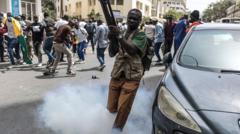
Senegal just proved once again why its politics are the most volatile and gripping in West Africa. On June 29, 2026, the National Assembly turned into a literal battleground. Gendarmes physically dragged an opposition lawmaker, Abdou Mbow, off the podium. Outside, tear gas choked the streets of Dakar as police fought off protesters trying to storm the building.
When the smoke cleared, the legislature had passed a massive constitutional reform designed to strip away the vast powers historically held by the president.
This isn't a dry, legalistic update to a constitution. It's a high-stakes, deeply personal power struggle between President Bassirou Diomaye Faye and the man who put him in office, Parliament Speaker Ousmane Sonko. If you think Senegal's political crisis ended when Faye won the presidency in 2024, you're looking at the wrong playbook. The rules of the game are being completely rewritten.
The Sonko and Faye Split Explained
To understand why lawmakers are suddenly rushing to hollow out the presidency, you have to look at the spectacular collapse of Senegal's ruling alliance.
When Faye won the presidency, he did so as the proxy for Ousmane Sonko, the charismatic firebrand who was barred from running himself. Faye immediately appointed Sonko as his prime minister. It was supposed to be a dual-engine government, but two massive egos can't occupy the same political space for long. By May 2026, Faye grew tired of being in Sonko's shadow and fired him.
Sonko didn't retreat. Instead, he took control of the National Assembly, where the ruling Pastef party holds a massive 130 out of 165 seats. Elected as speaker of the parliament, Sonko immediately turned the legislature into a weapon aimed directly at the executive branch.
How the New Rules Clip the President's Wings
The newly passed constitutional amendment takes a sledgehammer to executive overreach. For decades, Senegal has operated under a hyper-presidential system where the head of state holds almost unchecked sway. Sonko's legislative majority just dismantled that piece by piece.
Here is exactly what changes under the new text.
- No Party Leadership: The president can no longer lead a political party or a coalition of parties while in office. This strips Faye of his ability to legally command his own party machinery from the palace.
- Divided Executive Authority: Drafting the government's official agenda is no longer the sole prerogative of the president. Faye must now draft it "in consultation with the prime minister." The prime minister also gains the independent power to make civil service appointments.
- The Lame-Duck Freeze: The president is heavily restricted from signing official executive acts during the critical transition period between a presidential election and the inauguration of a successor.
- Resource Accountability: The government is now legally mandated to inform the National Assembly of any and all agreements regarding the exploitation of natural resources.
- Judicial Overhaul: The current seven-member Constitutional Council will be replaced by a larger, nine-member Constitutional Court, reshaping the body that mediates election disputes.
Supporters say this is a long-overdue rebalancing of powers. Critics, including presidential coalition leader Aminata Toure, see it for what it is: a blunt instrument used to paralyze a sitting president because he had the audacity to fire his political patron.
The Referendum Gambit
The opposition boycotted the final vote in protest after Mbow was ejected by security forces, allowing Pastef to cruise to an easy victory. But Faye isn't going down without a fight.
Just before the vote took place, Justice Minister Moussa Sarr announced that President Faye plans to bypass the legislature's finality by putting the constitutional changes directly to the Senegalese public in a national referendum.
This sets up an incredibly risky showdown. Sonko has already expressed public skepticism that Faye even has the legal authority to force a referendum, arguing that the assembly's three-fifths majority makes the text final. If the Constitutional Council sides with Faye, the entire country will be forced to choose between the vision of their elected president and the parliament trying to rein him in.
What This Means for Senegal Moving Forward
If you are tracking West African stability, this is the hotspot to watch. Senegal has long been praised as a beacon of democracy in a region plagued by military coups and dictatorships. But its institutions are being pushed to their absolute limits by internal factionalism.
The immediate next step is the legal battle over the referendum. Keep an eye on whether Faye pushes forward with a decree to organize the national vote or if the electoral commission hesitates amid the legal gray area. If the referendum happens, expect Dakar's streets to heat up significantly.
For international investors and regional partners, the political risk in Senegal has fundamentally changed. The era of the all-powerful Senegalese president is ending, replaced by a messy, fractious parliamentary system that could slow down decision-making on major energy and infrastructure projects. Watch the courts and watch the streets; the fight for Senegal's political soul is just getting started.


