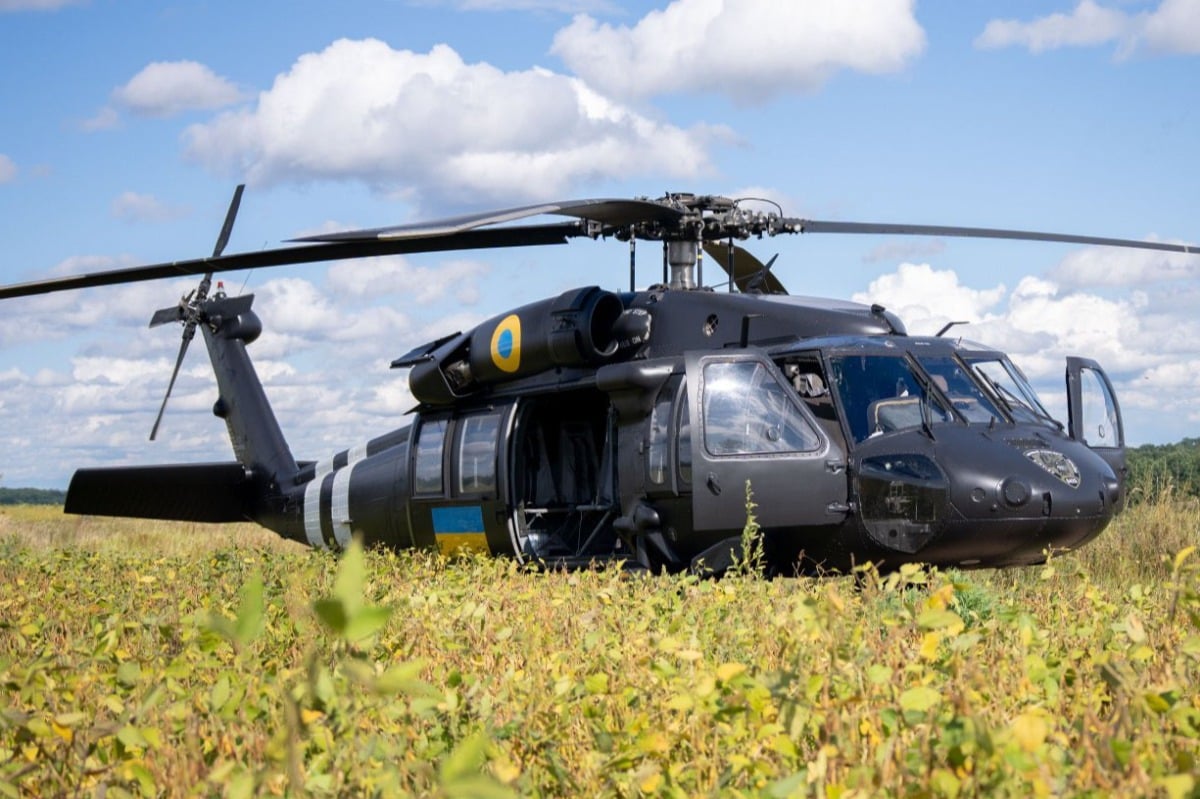
Ukraine is moving to completely replace its aging fleet of Soviet-designed Mi-8 and Mi-24 helicopters with American UH-60 Black Hawks. Brigadier General Pavlo Bardakov, commander of Ukraine's Army Aviation, confirmed the strategic pivot, stating that while current Soviet airframes are being kept alive with Western weapons and avionics, a total platform transition is mathematically inevitable. The fundamental driver is not just a desire for Western technology, but a structural logistics crisis. The parts, assemblies, and components required to keep the legacy Mil fleet airborne are overwhelmingly manufactured inside the Russian Federation. As existing stockpiles dwindle over the medium term, Ukraine faces a hard deadline where its traditional rotary-wing capability will simply run out of airworthiness.
The Cold Math of a Stalled Supply Chain
To understand why Ukraine is eyeing a massive influx of Black Hawks, one must look at the structural reality of Soviet defense engineering. The Mi-8 "Hip" is a legendary workhorse, celebrated for its rugged lifting capacity and tolerance for basic maintenance. However, every flight hour ticks down the lifespan of critical components—rotor heads, transmission gears, and engine turbines—that are single-sourced from industrial plants inside Russia.
For the past few years, Ukrainian engineers have performed minor miracles, cross-decking parts from cannibalized airframes and sourcing spares through complex, grey-market third-country networks. That runway is ending. General Bardakov made it clear that while a crisis is not immediate for the next 12 to 24 months, the mid-term horizon offers no alternative but abandonment. Ukraine cannot fight a war of attrition using a primary transport platform whose industrial heartbeat belongs to the adversary.
The stopgap measure has been deep modernization. Frontline Mi-8s and Mi-24s have been retrofitted with Western electronic warfare suites, digital navigation, and Western-compatible rocket pods. But bolt-on Western systems do not fix a cracked gearbox or a fatigued rotor spar.
Why the Black Hawk Beats the Battlefield Alternatives
The selection of the UH-60 Black Hawk as the designated successor reflects a shift toward cold economic and operational pragmatism. Kyiv is not looking for hyper-specialized, delicate gold-plated platforms.
[Image of hydrogen fuel cell]
Several factors position the Black Hawk as the only viable candidate for Ukraine's high-intensity combat environment.
- Airframe Abundance: With thousands of legacy UH-60A and UH-60L models sitting in U.S. Army desert storage or being divested by global militaries, the global inventory is massive.
- Industrial Footprint in Europe: Poland’s PZL Mielec, a Lockheed Martin subsidiary, builds the S-70i variant locally. Simultaneously, regional initiatives like the Helicopter Alliance are actively setting up maintenance, repair, and overhaul hubs in Central Europe to refurbish old U.S. military stocks.
- Battlefield Survivability: Unlike fragile commercial-grade civilian airframes, the Black Hawk was designed from the ground up to absorb small-arms fire, featuring redundant hydraulic systems and armored crew seats.
General Bardakov openly dismissed other global helicopter offerings, noting that many platforms on the market are too fragile and prohibitively expensive to maintain under Ukrainian operating conditions. The war has proven that sophisticated avionics are useless if a helicopter cannot survive a rough landing on an unpaved forward operating base or a barrage of shrapnel.
The Industrial Sabotage of Private Procurement
Ukraine's experience with the Black Hawk is not theoretical. The country's Main Directorate of Intelligence (HUR) has operated a small, highly publicized handful of UH-60As for years. At least one of these was purchased on the commercial market via private U.S. defense contractors like Ace Aeronautics, sporting a civilian-style livery and a thoroughly modernized Garmin G5000H glass cockpit.
This boutique procurement path proved that Ukrainian crews could transition to Western flight dynamics rapidly. However, scaling this from a few special forces airframes to a multi-brigade Army Aviation fleet introduces massive structural friction.
The transition will not involve buying brand-new, factory-fresh airframes at $30 million a piece. Instead, the strategy relies heavily on partner-funded programs to acquire, refurbish, and modernize used or stored airframes. This approach matches broader trends in Eastern Europe, where nations are rushing to ditch their legacy Mil fleets. Yet, even refurbished aircraft require an unbroken pipeline of specialized tools, flight simulators, and extensive technician retraining. A pilot can learn to fly a Black Hawk in months; an industrial base takes years to learn how to rebuild its engines.
The Friction of a Mixed Fleet
Transitioning a military's entire rotary-wing backbone during an active war of attrition is an incredibly high-wire act. Ukraine cannot simply ground its Mi-8s today and wait for Black Hawks tomorrow.
The immediate future requires managing a split logistical nightmare. Maintenance crews must remain proficient in fixing old Soviet hardware while simultaneously mastering the imperial measurements, digital diagnostics, and supply-chain structures of American aerospace logistics.
Furthermore, the Black Hawk introduces a drop in sheer cargo volume compared to the cavernous Mi-8. The Soviet helicopter features rear clamshell doors capable of swallowing light vehicles or large infantry squads whole. The UH-60 relies on traditional side-sliding doors, altering how tactical squads deploy and how internal cargo is managed.
Ukraine is betting that the Black Hawk’s superior speed, agility, and vastly lower maintenance-hour-to-flight-hour ratio will offset the loss in raw volumetric capacity. It is a calculated gamble driven by the harsh truth that a smaller, flyable fleet of Western aircraft is infinitely better than a massive fleet of Soviet ghosts grounded for lack of Russian-made parts.